UDC 631.312.542. ( 043.3)
ANTIEROSION MOISTURE SAVING TECHNOLOGIES
AND TECHNICAL MEANS FOR SOIL TREATMENT IN THE CONDITIONS OF UZBEKISTAN
Mirzaev B.S., candidate of technical sciences, associate professor ,
vice-rector of the Tashkent Institute of Irrigation and Reclamation, Tashkent,
Uzbekistan,
Mamatov F.M., doctor of technical
sciences, professor of Karshi Engineering- Economic Institute , Karshi ,
Uzbekistan,
Uzakov Z., associate professor of
Karshi Engineering-Economic Institute , Karshi , Uzbekistan
The necessity of the development of antierosion
moisture saving technical means of soil treatment in the conditions of
Uzbekistan is shown. New technologies and technical means of soil treatment
which are helping to prevent water erosion, to the conservation and the
accumulation of moisture in the plow layer are presented.
Keywords: water erosion, moisture
conservation, technology, plow-cultivator, paraglide, slope.
The
soil and climatic conditions of Uzbekistan allow receiving high-quality crop
products. However, the shortage of soil moisture and unstable
nature of hydration inhibit the growth of agricultural production, especially
in rainfed agriculture.
Feature
of the climate is the small amount of rainfall, frequent repetition of long
periods without rain (drought) and strong hot winds that regularly occur at low
relative humidity and high temperatures of air. The shortage of available
moisture is caused not only by the lack of atmospheric
precipitation, but also by irrational their usage. Analysis of the loss of moisture and
assessing the potential of agricultural practices on the accumulation and preservation of
soil moisture are showed the significant moisture improvement reserves of
agriculture through the development and application
of improved soil moisture saving technologies of soil treatment.
It should be accepted that the current system of machinery for plant growing was created basically for optimum soil and climatic
conditions, does not meet the requirements of the most complete accumulation
and conservation of soil moisture. As a
result, over 70% of planting area of Uzbekistan in a varying degree is incurred to water erosion. Water erosion is pronounced
in sloping areas with shallow soil treated,
especially during heavy rains.
In the system
of agricultural practices main moisture saving role is assigned to methods of tillage, which should provide
the most comprehensive accumulation of atmospheric
precipitation moisture in the root zone and prevent its evaporation through the
treated layer of soil. Therefore, to prevent water flow and soil loss it is
necessary to use special anti-erosion tillage technologies.
It
is known that one of the effective moisture saving methods is the loosening of
the topsoil with saving on its surface of
stubble and other crop residues. Suchlike
mulch by
plant
remains and well loosened soil layer prevents capillary evaporation of moisture
from the underlying layers and allows more to save the remaining reserves of
soil moisture. Waterproof coat in
perfect form can be created by tillage cutter that performs fine lumpy soil loosening, complete trimming
of weeds, closing their seeds, and a good
grinding of plant residues.
The most
realistic and reasonably efficient way is the loosening of the top layer of
soil with grinding of crop
residues and while loosening the topsoil and surface loosening it up and packing of
soil. The combination of these operations can be carried out by a combined tool (Fig.1a), consisting of active working
bodies in the form of cutter, flat cutting working bodies and by the set
them support- aligning roller. The latter provides additional crumbling, crushing to the
soil surface the stubble, leveling and sealing
the loosened layer of soil. The combination of the operations of the roller and flat cutting bodies
improves
their stability when the burial is small. After the passage of such combined
plow- ripper on the surface of the soil are saved 85-95 % of plant residues, which significantly reduce
the evaporation of soil moisture.
The authors have developed a plow-ripper [1],
equipped with 1 and 2 working bodies of different size of the type "paraglide"
(Fig. 1b). When ripper is operating, the bottom of the treated field is
obtained as stair-step that allows the
detention and the accumulation of soil moisture and facilitates
the elimination of subsurface erosion on
sloping lands. Depending on the steepness of the slope, the distance between
the cutting deepening can be changed by the arrangement
of the lower working bodies 2 after
few upper working bodies 1.
If it is necessary, the working bodies 2 of a greater height may be equipped
with dumps 3 [2]. In
the result of the operation of such tool, on the slopes is shaped a stepped bottom of the furrow
with periodic deepening (subsurface ridges), which intersects the
compacted base
and surface ridges (Fig. 1c).
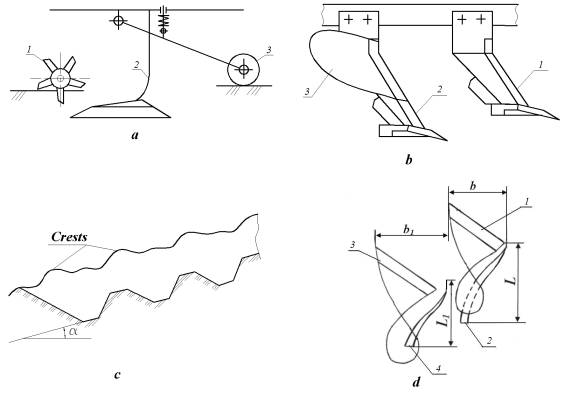
Figure 1. The schemes of tools for the
implementation of moisture saving technologies: a) a
ripper with active and passive working bodies; b) a two-tier plow-ripper with depleted
and moldboard working
bodies of
the "paraglide" type; c) the
cross-section of the field treated by a two-tier plow-ripper with depleted
and moldboard working
bodies; d) plow for smoothly-speed plowing.
Combining of intrasoil ridges with surface ridges
promotes for the full retention and
accumulation of soil water (especially after heavy rainfall), that prevents the
water erosion.
In plow, designed for smoothly-speed plowing [3],
the bodies 1 and
3 are arranged offset relative to each other, and directing
plates 2 and 4 with the working surfaces, faced to the reversible screw-dumping
surfaces of the body, installed on them (Fig. 1, d).
The even bodies 2 made with greater height H1
and width
of capture b1, and odd body 1 - with a less height H and width of capture b.
Width of capture of even body 2 is equal to b1
= b + K (H1-H), where H - the height of odd bodies; H1 -
the height of even bodies; K – coefficient, reflecting the ratio of body width
to depth of
treatment.
The length of
the directing plate 4 of even bodies 3 is
smaller than the length of the directing plate 2 of the odd bodies 1 by the amount 0,25 L,
i.e. L1 = 0,75 L, where L - length of the directing
plate of odd body.
At the operation
of plow transversely of
the slope body 1 with the lower height H and width
of capture b, when intrudes
into the soil, separates layer with a thickness
a1 from the bottom of the furrow and in the interaction with the directing plate 2 turns it up to 1800
into its own furrow. Then the body 3 with a greater height H1 and
width of capture b1 separates the layer a
thickness a2 from the bottom of the furrow, and in the interaction
with short- directing plate 4, turns it up to
1350 . After passing of the plow a stepped bottom of the furrow and estuarine
surface
of the arable are formed.
The combination of a stepped bottom with the estuarine surface of
the arable promotes water retention and excludes washout of soil after heavy rainfall.
Literature
1. Mamatov
F.M., Mirzaev B.S. and etc. The plow-ripper
//Utility model patent, Uzbekistan, FAP 00701. - Tashkent, Official Bulletin. -
Tashkent, 2012. - № 3.
2. Mamatov
F.M., Mirzaev B.S. and etc. The plow-ripper //Utility
model patent, Uzbekistan, FAP 00956. -
Tashkent, Official Bulletin. - Tashkent, 2013.- № 1.
3. Mamatov F.M.,
Mirzaev B.S. and etc.
Plough /Utility model patent, Uzbekistan, FAP
0085. - Tashkent, Official Bulletin. - Tashkent,
2013. - № 3.