Economics/ 8. Mathematical methods in economics
Post-graduate student,
Servetnyk N.
Taras Shevchenko
National University of Kyiv, Ukraine
The Cyclicity of GDP in Developed and Developing Countries
Cyclicity is the one of the key tendencies of dynamic
development, which must be considered analyzing economic development of world
and national economy under globalization.
The research identifies length of economic cycles in
Ukrainian and world economy. There were taken some time series, such as gross domestic
product of development countries: USA, Germany, and Russia. USA was chosen as
the third most developed country in the world [2]. It has the largest economy
in the world, which although is currently in the slumps, is still progressing
at an average rate. Germany is the most important as economic country in
Europe. Russia has very close relationships with our country.
There is great number of methods to identify cycles in
GDP. The most interesting are those, which let to explore periods of rise and fall
of GDP.
The statistical analysis was done using the method of
LOG filters. It shows the instability and difficulties in forecasting of the
development of Ukrainian and Russian economies.
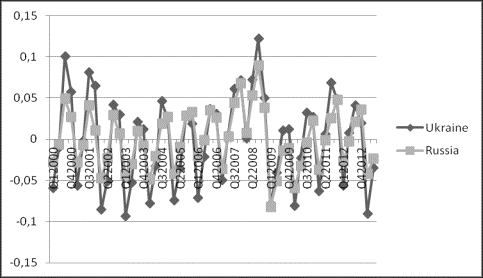
Fig. 1. GDP cycle in
Ukraine and Russia
Source:
https://www.bank.gov.ua, http://www.gks.ru
Large spread in GDP fluctuations of Ukraine and Russia
under crisis indicates higher risks than in Germany or USA. It caused by
undeveloped market relations in Ukraine and Russia, which are depend on external
influence of world market, but haven’t any influence on it.
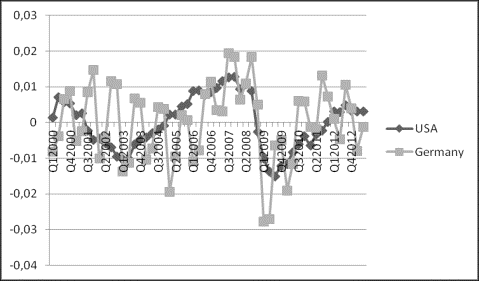
Fig. 2. GDP cycle in USA
and Germany
Source: https://www.destatis.de, http://www.bea.gov/
To identify the cycles the method of Hurst exponent is
used. It helps to analyze the character of mentioned fluctuations and assign
them a numerical characteristic – Hurst exponent. There are three growth cycles
for Ukraine, Russia, and Germany and four – for USA. Coefficients of the trends
are shown in the Table 1. Minimum value of GDP for all countries is in 2nd
quarter of 2009.
Table 1
|
|
Ukraine |
Russia |
USA |
Germany |
||||||||
|
Period |
H |
b |
R2 |
H |
b |
R2 |
H |
b |
R2 |
H |
b |
R2 |
|
2000 - 3dQ2001 |
1,064 |
-0,463 |
0,921 |
0,996 |
-0,436 |
0,796 |
0,849 |
-0,449 |
0,647 |
1,007 |
-0,429 |
0,901 |
|
3dQ2001
– 2005 |
0,258 |
0,122 |
0,325 |
0,258 |
0,133 |
0,172 |
0,103 |
0,644 |
0,142 |
0,076 |
0,301 |
0,054 |
|
2005 - 2008 |
0,512 |
-0,234 |
0,480 |
0,247 |
0,137 |
0,006 |
0,784 |
-0,414 |
0,873 |
0,687 |
-0,466 |
0,606 |
Source: authorial
calculation
GDP in
researched countries has different behavior under the crisis in 2007 – 2009.
For instance, GDP in Germany, Ukraine and USA have stable oscillations on the
first statistical cycle (Hurst exponent is more than 0,5) and sharply reduce
their stability on the second statistical cycle (Hurst exponent is less than 0,5).
Fluctuations of GDP in Russia save their characteristics on the second and
third statistical cycles.
Now let to examine the coincidence of cycles in
different countries. In Germany growth phase was observed during 1987 – 1993,
after which there was a phase of recession lasting to 2003. The peak of growth
took place in 2005 and from 2006 economy in this country develops with
acceleration. The year 2012 saw the first period of weak growth for the German
economy since crisis year 2009. After that a consistent recovery process took
hold, accompanied by rising capacity utilization in industry and a strong
domestic demand. The common expectation among all the estimates for 2013 and
2014 is that a renewed flare-up of the Eurozone crisis is unlikely and the German
economy is going to take a swing upwards from the current growth low [4, p.1].
The growth phase in USA began from 1997. The
US economy is currently embroiled in the economic downturn which followed the financial crisis of 2007–2008.
At last let to analyze cyclicity of Ukrainian economy
in comparison with economic cycles in country with close economic relationships
– Russia. The growth phase in Ukraine and Russia began in 2004. It worth to
emphasize, that world tendency is leveling the onset of phase cycles and
increase of their impact. The most prosperous are considered that country of
Western Europe, in which number of growth phases was more than half of periods
of observations.
References
1.
Peters E. The fractal analysis of financial markets: using of theory of
chaos in investment and economics/E. Peters// - M.: I-trading, 2004. – 304p.
2.
Answers [Online] http://wiki.answers.com
3.
Bureau of Economic Analysis [Online] http://www.bea.gov
4.
Economic Forecast Germany 2013 [Online] http://www.gtai.de
5.
National Bank of Ukraine [Online] http://www.bank.gov.ua
6.
Federal State Statistics Service [Online] http://www.gks.ru
7.
Federal Statistical Office of Germany [Online] http://www.destatis.de