PovzunV.D., PovzunA.A., ApokinV.V., Plekhanova N.P.
Surgut State University, Russia
EDUCATIONAL
OPPORTUNITIES OF UNIVERSITY ENVIRONMENT
IN
DEVELOPING CREATIVE POTENTIAL STUDENTS
OF
THE FACULTY OF SPORT
The need to develop a
new creative pedagogy, based on a philosophy of creativity, is an important
goal of modern society, which in full can be applied to Sport and Physical
Education, where a priority in training highly skilled athletes is given to the
activation of creative potential of the coach with active subjective position.
Taking the diversity of theoretical definitions of creative activity, the
concept of "creativity" and "creativity" [1, 2, 3, 4, 5]
into account, we assumed that the intenseness of a man in his creative
development is the aspiration to own importance [6]. But the pursuit of self
importance can be realized in various ways, depending on the external and
internal conditions, therefore, the relevance of the study is defined on the
one hand, as the objectives of the modernization of the modern Russian
education system, which is focused on the formation and development of creative
competitive person, and on the other hand, an entirely new meaning of the
concept art, therefore new approaches and methods to its estimation. As such an
approach, we used one of the most affordable and adequate methods for the
analysis of personality - self-evaluation, and as a criterion for the students'
level of creativity was used a test of an assessment of creative potential of
the identity of Sharov [7]. The study was conducted at the Faculty of Physical
Education of Surgut State University, during the 2011-12 academic years at all
levels (courses) of study. The study involved 257 people, students of the
Faculty of Physical Education, 18-23 years old of both sexes.
Our results of
self-creativity are presented in Table 1.
Table 1
Distribution ofself-esteemcreative potentialof studentsin groups of the Faculty of Physical Education1 -5 courses
(в %)
|
self-esteem |
1 cours |
2 cours |
3 cours |
4 cours |
5 cours |
|
inadequatelylow |
– |
– |
– |
– |
– |
|
low |
– |
– |
– |
– |
– |
|
below the average |
– |
– |
– |
– |
– |
|
average |
15 |
26 |
15 |
6 |
6 |
|
above the average |
31 |
37 |
30 |
32 |
44 |
|
high |
33 |
33 |
25 |
56 |
38 |
|
inappropriatelyhigh |
21 |
4 |
30 |
6 |
12 |
To make it clear, we
suggest the profile creative qualities for every individual group of students.
The result is shown in Figure 1.
Such graphical interpretation of the results, unfortunately, does not allow us
to identify those personal traits that each student individually identifies as
a priority in its structure, but it allows us to see a complete picture of the
structure of creativity and change it within time-being. It is the time-picture
that shows that the total profile of the creative potential of students for
five years of study remains unchanged. In our case, it is, above all, to
suggest that the university as an educational institution and university
education, as it is, doesn’t play the main role in the development of creative
skills of young people. For the Faculty of Physical Education, it is not a
tragedy, because the athletes are aimed primarily at achieving sporting result,
there are other way for creative abilities besides a "desire for
self-importance." But if the university seems it necessary to have an
impact on the development of the creative potential of its athletes, its
primary objective is to find some adequate ways to provide such an effect.
Another thing is the
structure of the profile. In implementing the importance of self-importance in
a very specific (in this case, sports) activity in the structure of the chart,
even for a large number of people there must be a specific, directed peak of
specified quality of the individual, (as in the shaded sample diagram), which
reflects the main direction of the implementation of creative significance.
However, it’s hardly seen in the students’ structure of creativity, it might
imply some other processes in the highly-observed levels of self-esteem.
Moreover, such a smoothed graphic picture is typical for a non-optimal way of
self-esteem when a person has a claim on his own importance, but there is no
psychological or any other basis for its implementation.
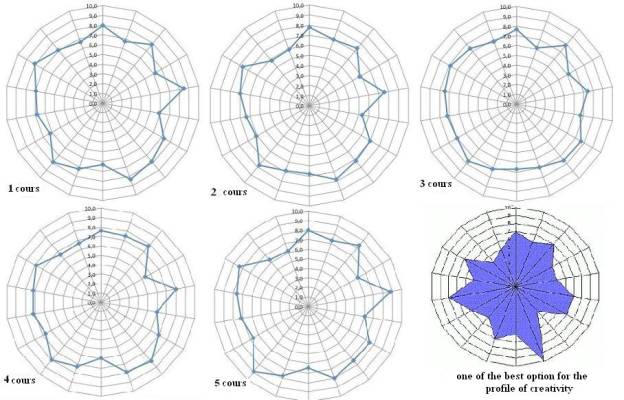 Fig.1.Profile ofstudents' creative potential1-5courses of Surgut State University,Faculty of Physical
Education(bottom right- one ofthe bestoptions forthe profile ofcreativity).
Fig.1.Profile ofstudents' creative potential1-5courses of Surgut State University,Faculty of Physical
Education(bottom right- one ofthe bestoptions forthe profile ofcreativity).
Technically, we have not
identified people with non-optimal level of a self-assessment. It gives us an
idea that the creativity development must be completely different, aiming not
only at development, but at the use of the creative potential of students.
However, anyone who has tried to organize the activities of students, beyond
the standard rules or regulations, ran not so much a desire to participate, but
rather to avoid it, which is hardly possible due to high level of creativity.
It is a reflection of the condition, in our opinion, that is already mentioned
as our "smoothed" profile structure, which allows us to speak not
only about inadequate but unreasonably high self-esteem, the high level of
claims. In this case, confidence is built not onthe
presenceof success,but inthe absence offailure, andthis confidenceis
graduallybecomingunreasonablyhigh.First failuresare ignored,explainedby
chance,external causes, repeated failure is accompanied by strongemotional reactions, sometimes affectivenature, which may lead to a
reductionof themotiveforce, and even abandon it.There
isa heavyemotional state -the affectof inadequacy,which is themain cause
ofresistancestereotypeoverestimatinghis personality.Judging by the
pictureprofile, characterized by the complete absence
ofanyactivity, the third-year students are overwhelmed
with it. Total absence of people with low
self-esteem only confirms these findings. It means there is not only an
opportunity but the need for the university to direct its work in the right
channel of restructuring the creativity, adapting it to the challenges of
modern society and thus relieve the tension between the university and the
person.
We understand that the
results we obtained are preliminary, the issue requires further study and
research, to fully understand the problem, we need to identify the priority of
personal traits for creative potential. But it is clear that to improve the
quality of education as an indicator of the effectiveness of the implementation
of the educational process in high school, it’s not enough to study the
psychological characteristics of students, give them psychological support at
the university, especially during their first years of studies, but seriously
change their approaches to learning, to create new space for personal
development in university education. Only a person who is able to make the most
of the various spaces of his creative potential is able to estimate it and be effective
in his self-realization in the future.
The objective of the
university is to provide this opportunity for a person.
1.AnanievB.G.Man as anobject of knowledge/B.G.Ananiev.- St.: Peter, 2001. - 288.
2.Vygotsky L.S.On thepsychology of creativityactor.Part
2/L.Vygotsky//Coll.Op.- M., 1984. -S.321.
3.Altshuller G.S.Psychologyinventive/G.S.Altshuller, R.B.Shapiro/ /Questions of psychology.- 1956, № 6. - S.37-49.
4.DruzhininV.N. Psychologygeneral abilities/ V.N.Druzhinin.- St.: Peter, 2002. - S.166.
5.BallingV.A.Talent, talent and
abilityin the structureof sports activity/ V.A.Glands/ / Theory andPractice
nat.Culture, 2002. - N4.- S.16-20.
6.Sharov A.S.Reflection
onpersonal development/ /Materials of conference."Reflection,
Education and intellectualinnovation."-Novosobirsk,
1995. -P.224- 225.
7.Sharov A.S.System of
valueorientatsiĭas a psychologicalmechanism of regulationof
life:diss...Dr.psychol.Sciences:19.00.01.- Novosibirsk, 2000. - 383p.