Kyyak
N.Ya., Baik O.L.
Institute of
Ecology of the Carpathians, NAS of Ukraine
11, Stefanyk
St., Lviv 79000, Ukraine
e-mail: kyyak_n@i.ua
Participating of
bryophytes in restoration of the devastated territories of sulphur deposits
INTRODUCTION
The problem of termination of
technogenic degradations of grounds and its phytomelioration has got global importance and requires the urgent decision. It concerns also the
Western region of Ukraine, where during several decades the extraction of
sulfur, sand and clay occurs by the open way. Process of formation and
development of the plants cover and ecosystems in technogenic landscapes occurs as primary succession. In our primary investigation
was shown, that overgrowing of tertiary marly clays, quaternary loams and sandy deposit occurs by the consecutive stages of development
of bryophyte communities, which differ by specific structure, structural
and functional organization.
Bryophytes possess wide ecological diapason
allowing them to populate substrates of technogenic origins which are scarcely
or not suitable for the population with vascular plants. The died off parts of gametophytes gradually form humus enriched substrate, what is
the important link of primary soil forming process, where mosses play the
essential role [1].
Till now the role of bryophytes in restoration
of technogenic landscapes of sulphur deposits in the Subcarpathian region of
Ukraine was not studied. Our primary investigations have shown that depending
on the age of dump, bryophytes formed various, as to their power, communities
consisted of 50 bryophytes species. So, the aim of this
work was to investigate the influence of mosses cover on accumulation of organic
carbon in the dump No1 substrate of Yazivsky sulphur deposit of the State
mining-chemical enterprise “Sirka.
MATERIALS
AND METHODS
The object of investigation was bryophytes from the dump No
1 of Yazivsky sulphur deposit (L’viv region, Yavoriv district), subordinated to
Novoyavorivsk sulphur deposit of State mining-chemical enterprise „Sirka”. 3
moss species were collected for investigation: Barbula unguiculata Hedw., Bryum argenteum L. and Bryum
caespiticium Hedw.
The substrate samples under moss cover have been chosen for
the experiments and the surface substrate layer of 2-3 cm wide, where the
bryophyte cover has the greatest influence, has been analysed [10]. The samples
of the base substrate (without plant cover) have been used as control. The
investigations have been carried out on 7 investigated dump transects (the dump
crest and six transects in the base, on the slope and the top of the north and
south slopes) in summer and autumn 2011-2013. The substrate has been chosen in
3 places within experimental plot, the average sample has been mixed and
formed.
Determination of organic carbon content in the substrate was
fulfilled by I.V. Turyn method in the modification of B.A. Nikityn [6], that is
based on oxidation of organic substance by chromium mixture in strongly acidic
medium. The optical density of solutions was measured spectrophotometrically on
the spectrophotometer Specord 210 Plus having the wave length 590 nm and was
expressed in percentage.
All experiments were carried out three times. The obtained
results were processed by the methods of statistical analysis [7].
RESULTS
Contemporary subsoil cover of Precarpathian sulphur deposits
is heterogeneous as to its mechanical composition and physical and chemical properties.
The main rock of the dump No1, which was formed by dump maker of rotor complex
during 1970-1989, is tertiary marl clays with admixtures of quaternary rocks.
The plant development on such substrates is limited by unstable water regime,
the lack of the main nutrition elements (especially nitrogen), high clay
density, weak aeration, active erosive processes and other factors [5].
Although on the basis of the latest literary data it is possible to confirm,
that general property of embryonic soils on the investigated territory is the
formation of lacking power surface organogenic horizon, that shows essential
natural potential of the surface ecosystems selfrestoration and
renaturalization of the posttechnogenic landscapes of sulphur extraction
enterprises [2; 4].
The ability of dump rocks to form fertile soil by 25-30 %
depends on the presence of organic carbon in them. Taking into account this
fact, the substrate which contains 0.5-1.0 % of organic carbon is considered to
be the substrate of fertile ground layer [9]. The process of technogenic lands
overgrowing takes place in such a substrate that provides the corresponding
level of stable ground ecological functions creates natural preconditions for
the development of ground cover on devastated territories. The content of
organic carbon in the upper layer of the bare substrate (without plant cover)
was 0,9–1,8 %
in the territory of the dump No 1 (Table 1). Besides, the
tendency to the content decrease of organic carbon from the dump base to the
top by 1.5-2.0 times has been found out. First of all, this is caused by the
conditions peculiarities on the dump top, which are the least favourable for
the plants growth as the result of wind and water substrate erosions, as well
as moisture deficit that leads to the slowing down renaturalization processes
of rock substrates. Such difference in quantity of organic carbon on the dump
top can be caused by washing out the surface substrate layer from the top to
the dump base. Thus, the stripping dump No 1 rocks of Yazivsky deposit are
potentially fertile and fit for plants overgrowing.
The pioneers of bryophyte species which were used in
investigations settling on the dump slopes cause both mechanical and chemical
influence on the substrate. First of all, they fix the movable slopes substrate
mechanically and prevent it from scattering light fractions. The species that
form the life form of dense and loose turf – Bryum caespiticium and Bryum
argenteum play a special part in these processes. Besides, the
species Bryum
caespiticium forms dense rhizoid tomentum, which penetrates into
substrate densely, providing plants with additional fixation on the slopes. It
has been found out during investigations that rhizoid tomentum reached 2 cm in
some turfs Bryum
caespiticium. Penetrating into the substrate moss rhizoids form dense
net, increasing porosity and promoting enrichment of substrate with oxygen and
moisture.
Table 1
Content of organic carbon in the substrate under moss cover on the
territory of the dump No 1 (August 2011)
|
Locality of substrate samples collection under moss turfs |
Content of organic carbon, % |
|
|
North slope |
South slope |
|
|
Uncovered substrate (control) |
||
|
crest of the dump |
1,72±0,12 |
|
|
base |
1,64±0,13 |
1,82±0,23 |
|
slope |
1,66±0,21 |
1,62±0,14 |
|
top |
1,23±0,10 |
0,92±0,15 |
|
Bryum caespiticium |
||
|
crest of the dump |
4,53±0,21* |
|
|
base |
2,56±0,12* |
2,32±0,22* |
|
slope |
2,84±0,23* |
2,65±0,25* |
|
top |
2,36±0,22* |
2,04±0,21* |
|
Bryum argenteum |
||
|
crest of the dump |
3,92±0,22* |
|
|
base |
2,56±0,20* |
1,94±0,11* |
|
slope |
2,73±0,27* |
2,43±0,27* |
|
top |
2,21±0,24* |
2,11±0,23* |
|
Barbula unguiculata |
||
|
crest of the dump |
3,26±0,21* |
|
|
base |
2,15±0,13* |
2,04±0,21 |
|
slope |
2,23±0,21 |
2,02±0,11* |
|
top |
1,95±0,23* |
1,56±0,22* |
Footnote: – * the difference compared to control (base substrate) is
statistically reliable at p<0.05.
According to literature data mosses
localize the largest number of carbon in aging brown shoot parts [8],
localization of Corg. specificity in moss turfs Bryum
caespiticium, Bryum argenteum and Barbula
unguiculata has been estimated (Fig. 1). It has been found out that the
largest quantity of carbon in accumulated in dead part of moss turfs. Corg. content amounted to 16.3±1.5 % in the
dead shoot parts in Bryum caespiticium, in Bryum
argenteum it was 14.5±1.3% and 12.5±1.2 % in Barbula unguiculata. The quantity of organic carbon was 3-4 times smaller in green shoot
parts of these moss species.
We established direct dependence between
bedding thickness and the content of organic carbon in the substrate under
vegetable cover in natural moss samples. The maximum content of organic carbon
in the substrate under moss cover was determined on the dump crest (3.9-4.5 %).
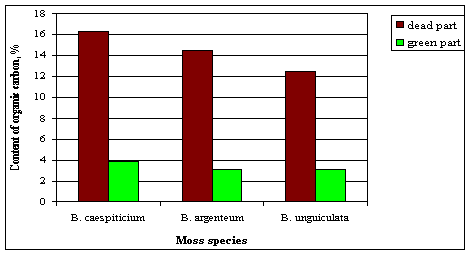
Fig. 1. The content of organic carbon in green and dead shoot parts of
mosses.
The highest content of organic carbon was in the substrate
under mosses Bryum
caespiticium and Bryum argenteum
(2.8±0.2 % and 2.7±0.2 %) on the north slope, that is almost 1,7 times higher
compared to the carbon quantity in bare substrate from this dump plot (Table
1).
The carbon quantity was 1.4 times higher under turfs Barbula
unguiculata compared to its content in the substrate without turfs.
Similar tendency of organic carbon content change in the substrate under
investigated moss species has been observed in the slope base as well. The
smallest quantity of organic carbon under moss turfs has been found on the top,
although comparing to its quantity in bare substrate on this dump plot, its
content increased almost 2.4 times, that shows essential bryophyte contribution
in accumulation of organic substances even under unfavourable ecological
conditions.
The results of determining content of organic carbon in the
substrate under moss cover on the south dump No 1 slope show the similar
conformity: the highest content is in the substrate under mosses on the slope
and in the dump base, and the lowest content is on the top.
The highest quantity of organic carbon is in the substrate
under Bryum
caespiticium and Bryum argenteum. In
general, the quantity of organic carbon has increased 1.5-2.6 times in bedding
substrate layer under moss turfs on all dump levels compared to its content in
the bare dump substrate.
On the basis of the obtained results it is
possible to confirm, that the process of primary ground formation which is on
the stage organic substance accumulation in the surface ground layer, occurs
with bryophyte participation on the dump territory. Organogenic horizon having
thickness of 0-3 cm, characterized by wide range of organic carbon content
(1.5-1.7 %) is formed under moss cover.
It is known, that the growth of organic
carbon content in technogenic grounds taken place until its losses, as the
result of mineralization and washing out processes do not become equal with the
entrance of organic substance to the ground block of ecosystems as dead organic
remnants. This process can last from 20 to 50 years according to the data of
many investigators. Then it continues mainly at the expense of qualitative
transformations of organic substance. That is, the total regularity of the
processes of organic substance accumulation is the following: relatively rapid
accumulation of organic carbon, at the initial period of younds ontogenesis and
the following slowing down of humus accumulation rates with the change of
components correlation of organic substance [3].
The results of two year analysis of
organic carbon content in not populated substrate and the substrate under turfs
of investigated mosses show positive dynamics of its increase in all
investigated transects, but the rate of accumulation of organic carbon in upper
horizons of posttechnogenic ground is different, it depends on the dump
territory relief, microclimatic conditions and plants projective covering
(Table 2).
The rate of humus formation in upper horizons of posttechnogenic ground
on the dump territory is different, it depends on the microrelief, microclimatic
conditions, projective bryophytes covering and their species composition. On
the basis of organic carbon content analysis in 2013 year is esteblished that
carbon content within the investigated plots is increased on 0.04–0.20% Corg.
on the average, in comparison with the data of 2011 year (Table 2).
Table 2
Content of organic carbon in the substrate under moss cover on the
territory of the dump No 1 (August 2013)
|
Locality of substrate samples collection under moss turfs |
Content of organic carbon, % |
|
|
North slope |
South slope |
|
|
Uncovered substrate (control) |
||
|
crest of the dump |
1,75±0,12 |
|
|
base |
1,71±0,17 |
1,84±0,25 |
|
slope |
1,59±0,25 |
1,65±0,14 |
|
top |
1,19±0,12 |
0,92±0,24 |
|
Bryum caespiticium |
||
|
crest of the dump |
4,75±0,41* |
|
|
base |
2,70±0,25* |
2,45±0,21* |
|
slope |
2,95±0,13* |
2,48±0,16* |
|
top |
2,41±0,2* |
2,11±0,10* |
|
Bryum argenteum |
||
|
crest of the dump |
4,06±0,32* |
|
|
base |
2,68±0,15* |
2,05±0,18* |
|
slope |
2,91±0,32* |
2,52±0,23* |
|
top |
2,23±0,21* |
2,16±0,14* |
|
Barbula unguiculata |
||
|
crest of the dump |
3,36±0,31* |
|
|
base |
2,22±0,11* |
2,13±0,21* |
|
slope |
2,31±0,22 |
2,10±0,15* |
|
top |
2,01±0,20* |
1,56±0,09* |
Footnote: – * the difference compared to control (base substrate) is
statistically reliable at p<0.05.
The changes of organic carbon content in the uncovered substrate
were not essential during this period. The highest indices of organic carbon
content in the bedding layer under moss cover have been determined on the crest
and in the dump base, especially under the species B. caespiticium with dense turfs, which accumulate organic substances. The tendency of
decreasing organic carbon content has been observed in the substrate under moss
turfs from the base to the dump top of the north and south exposition as
before.
Conclusion
Bryophyte cover provides the formation of humus horizons on the surface
of technogenic substrates that is connected with the character of the dump
substrate population by moss turfs which form the whole dense cover on the dump
substrate surface. Colonizing technogenic exfoliation bryophytes perform
complex action on the dump substrate:
–
They initiate the processes of upper
horizons structuring (under moss cover technogenic soil is loosened, acquires
coarse lumplike structure, its porosity increases, that promotes substrate
enrichment with oxygen and moisture.
–
On the slopes mosses fix movable substrate
mechanically and prevent scattering of its light particles.
–
Mosses accumulate organic substance.
Taking into account the fact, that moss turfs overgrow and
are concentrated in the upper layer 0-3 cm of the ground substrate, it is
natural that almost all organic substances which are the potential source of
humus at the initial stage of ground formation are concentrated on the surface
or in the ground having the thickness of 0-3 cm, where the process of their
mineralization and humus formation take place.
The high variability of organic substance content is
determined by both specific moss peculiarities and the microconditions on the
dump territory. The highest content of organic carbon in the upper dump
horizons has been established under moss species which have the life form of
short dense (or friable) turf B. caespiticium and B. argenteum. The lowest indices of organic carbon content have been determined on
the dump top that may be caused by both tension of ecological factors on this
plot (high insolation level, moisture deficit), and the periodic transference
of upper horizons of ground formation substrate down the slope as the result of
morphodynamic processes characteristic of technogenic landscapes.
The rate of humus formation in upper horizons of
posttechnogenic ground on the dump territory is different, it depends on the
microrelief, microclimatic conditions, projective bryophytes covering and their
species composition. On the basis of organic carbon content monitoring during
2011–2013, the accumulation rates of carbon within the investigated plots
amounted to 0.02–0.10% Corg. per year on the average. The changes of
organic carbon content in the uncovered substrate were not essential during
this period. The highest indices of organic carbon content in the bedding layer
under moss cover have been determined on the crest and in the dump base,
especially under the species B. caespiticium with
dense turfs, which accumulate organic substances. The tendency of decreasing
organic carbon content has been observed in the substrate under moss turfs from
the base to the dump top of the north and south exposition as before.
It is obvious, that essential changeability of organic
carbon accumulation rate can be caused by the fact that essential part of
organic substance on the dump territory is represented by humus compounds and
not decomposed organic remnants (mainly by the dying off products of moss turfs
and by the introduced falling of vascular plants). This can point to the slow
mineralization of plant remnants as the result of specific hydrological
conditions and unripeness of microorganism groups, which are the main
destructors of organic remnants.
Thus, the common property of young soil on the dump No 1 of
Yazivske deposit sulphur extraction is the appearance and development of not
intense surface organogenic horizon. At the early stages of ground formation bryophytes
as pioneer plants play the key role in this process promoting accumulation of
organic substance and in this way creating the conditions for the development
of other higher plants and soil biota.
LITERATURE CITED
1. Bardunov L.V. Most ancient on the land. – Novosibirsk: Nauka, 1984. – 156 p. (in Russ.)
2. Dyguh O.I., Malyovanyj M.S.,
Shpakivska I.M. Physical properties of the soil of posttechnogenic landscape of sulphur
mines Yavoriv enterprises “Sirka” // Proceeding of National University “Lviv Polytechnic”.
– 2008. – Vol. 609. – P. 216-224. (In Ukr.)
3. Humus
formation in technogenic ecosystems //Ed. R.V. Kovalev. – Novosibirsk: Nauka,
1986. – 164 p. (In Russ.)
4. Kozlovskyy V.I. Heavy metals in soils of
anthropogenic landscapes of sulfur mining of L’viv region (Ukraine) //
Gruntoznavstvo. – 2008. – Vol. 9, No 3–4. – P. 94-107. (In Ukr.)
5. Manuyilova H.M. Plant community formation on the
devastated territory // Proceeding of State
University of Forestry. – 2004. – Vol. 14, No 4. – P. 34-37. (In Ukr.).
6. Myneyev V.G. Practical work on agricultural chemistry. – Мoskow: Nauka, 1989. – 304 с. (In Rus.).
7. Plochinsky N. А. Biometry. М.: Moscow
Univ. Publ., 1970. – 367
p. (In
Russ.).
8. Ringen D. The role
of moss in facilitating natural revegetation of metal-contaminating sites
during primary succession. www.bioed.org/ibscore/.
9.
Shilova I. I. Restoration of technogenic landscapes of Siberian. – Novosibirsk, 1977. –
230 p. (In Russ.).
10. Trofimets V.I., Ipatov V.S. The role of lichens and moss cover in the dry pine forest // Bot. Journ. – 1990. – Vol. 75, №8. – P. 1102-1109. (In Russ.).