Teaching Science/5. Modern methods
prepodavanyya
Aspyrant Pawluk L.V.
National University of Life and Environmental Sciences
of Ukraine,
Ukraine.
Research
skills of the future bachelor ENERGY BASED methodical system
System
(from dav.-hr. σύστημα -
"Shuttle") - a set of interrelated elements, separated from the
environment and interacting with it as a whole [4, p.320].
The
value of a systematic approach to learning emphasized K. Ushinsky: "Only a
system is certainly clever, coming from the very essence of objects gives us
complete control above our knowledge. The head is full of fragmented, unrelated
knowledge is similar to a barn, where all things without order and where the
owner did not find; head, where only the system without knowledge, like a store
where all the boxes are the inscriptions, and they empty "[5].
It
should be emphasized that the training of highly qualified specialists is
necessary to build a system way of the educational process. As a consequence of
sharply raised the question of the development of methodological research
skills in forming future bachelors power engineers.
Using
a systematic approach is important because it is necessary to consider the
formation of research skills of students as an integral process of professional
formation of future energetics. This process is aimed at creating a positive
motivation at students to search activity, where the formation of research skills
is in the unity of theoretical training of students and their abilities to use
the acquired knowledge in practice, in particular, solving all sorts of
educational and professional tasks of the research nature.
Articles
system consists of the same components as the educational system (aim,
contents, methods, forms and means); difference is that each of them gets
methodological function [2].
Given
previous experience, and in particular the specific construction of the
educational process, and a student and teacher and based on previous
experience, we have adopted a methodical system that has the following
functional relationships.
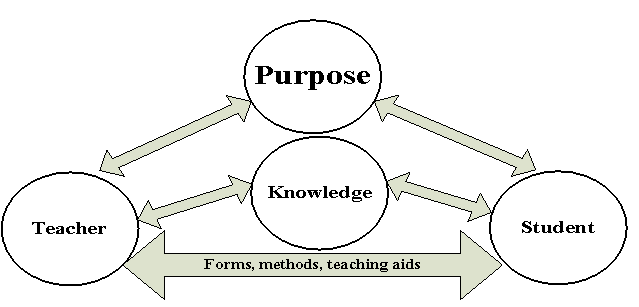
Pic.
2.2. Articles System
Continuity
formation of research skills at students while studying electrical engineering
disciplines, based on standard forms and teaching methods (lectures,
laboratories, workshops, self-study, individual work). Consider the using of
basic learning in higher education in the context of research skills of students.
Indirectly
link that students learn in lectures is the knowledge that the teacher gives
different forms, methods and means of teaching. This all creates aim and the
relationship between students, teachers and knowledge, which in turn is
integrated methodological system formation research skills of students in
bachelor study electrical disciplines. For the success of the educational
process and to form research skills at students, teachers appear to the
following questions:
-
You need to use the methods and techniques of teaching and learning of
students, how to guide those activities, in order to teach new material is most
effective for all groups of students;
-
Which methods of mental activity required in the study of this section;
-
What should be the structure of the lecture, that students have learned the
material.
An
analysis of educational and methodical literature [3] is reason to confirm that
the most appropriate to ensure regularity and continuity of preparing students
for research turns the following structure of the lecture:
-
Post topics, goals and objectives;
-
Motivation of learning activities of students (students notice about the
relevance and importance of the topic and the impact on the formation of future
professionals);
-
Notification of new material in the form of front heuristic conversation or
production problems;
-
Algorithmic presentation of the same material;
-
Formation of the conceptual apparatus;
-
Use of various forms of educational activity at consolidation and systematization
of the material subject;
-
Conclusion of the lecture;
-
Report reference for an independent and individual performance.
Problem
of lecture is a lecture class, which involves the teacher audience to solve
major scientific problems by providing a framework of the research skills of
future professionals. [1] Each training and installation material lecturer
concerns the merits of a scientific problem, reveals the possible ways its
solution shows the theoretical and practical significance of achievements that
each lecture is problematic that forms the context of professional and directs
it to the research. Stile, the purposeful inclusion of lectures of at least
desirable one problem lecture. It is just necessary in cases where the
scientific staff of the department for many years engaged in the study of a
scientific problem. Naturally, it has a unique, and possibly unique scientific
data. Reading the problem lecture is essential didactic meaning value and
attract potential researchers to address the pressing problems of science.
Problem lecture helps to overcome the associated mainly with the information
role of passive lectures students will activate their cognitive activity during
lectures, and involve them in research.
Management
tools for teaching students thinking problematic lecture system is pre-trained
teacher problem and information questions that guide the teaching and learning
activities of students and affect the formation of research skills.
Articles
construction problem lecture clearly contains both methodological and
informational material creates intellectual difficulties, cognitive activity of
students. Opportunities for a variety of problem situations are different.
Often used educational problem, when the teacher poses the problem that
students solve with it. Offered to students to create their own challenges and
identify ways to solve it.
In
terms of the formation of research skills of students to create a problem
situation to use the techniques offered by S. Vitvytska:
-
A direct statement of the problem;
-
Problematic task as a problem (question);
-
Notification of information pertaining to conflict;
-
Post opposing views on any issue;
-
Drawing attention to a particular phenomenon of life that needs to be
explained;
-
Notice of facts that cause confusion;
-
Comparison of representations of life science;
-
The question to which the student should answer after listening to some
lectures, and dive conclusions.
In
any case, the problem is connected with the traditional method, explanatory,
illustrative method, so that the learning process is impossible without
generalization ready information where necessary to identify strong points,
show the connection between theory and practice and draw conclusions after
working out new material.
Conclusions
So,
it was first developed methodical system formation research skills for future
bachelors of electrical engineering in the study subjects.
Literature
1.
Qasim RJ Preparation of bad lectures at the university: (recommendations
Metod.) / RJ Qasim. – M., 1981. – 21p.
2.
Kuzmina NV Methods for systematic pedagogical Studies / Kuzmina N V. –L.: Izd
LSU, 1980. – 172p.
3.
Kuz'minskii AI Omelianenko VL Pedagogy: Tutorial. – K.: Knowledge Press, 2003.
– 418 p.
4.
Peregudov FI Introduction to systems analysis / FI Peregudov, FP Tarasenko. –
M., 1989 – 367 p.
5.
Ushinsky KD Teaching essay: In 6 volumes – Vol 1: Oh nationality in socially
education. / Pedagogy. – M., 1988. – 416 p.