Экономические науки/10.Экономика
предприятия.
Usanov A.Yu.
Department of Economic Analysis
FGOBU VO "Financial
University under the Government of the Russian Federation».
Financial analysis of the
enterprise, its value, the nature and objectives
The
financial condition of the company is a
complex concept, the financial credit relations arising from enterprises in
difficult conditions of the Russian tax climate with different interests in the
regulation of profits, capital increase and property valuation share price,
dividend policy, increasing the value of the enterprise[1].
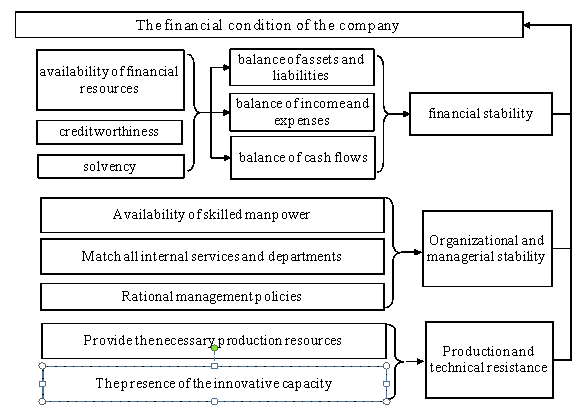
Figure
1 - Components of the financial condition of the company[2]
Financial
companies are based on three main types of sustainability: financial,
managerial and technical production.
Production
and technical sustainability is a set of tools and objects of labor used in the
production process, in an amount necessary for expanded reproduction, taking
into account their degree of wear.
Organizational
and managerial stability is characterized by the relevant internal services and
all parts of the organization, the right choice of the legal form that is
suitable for the organization and rational management of internal and external
policies of the organization.
The
most important among the components of the financial condition of the company
is financial stability.
Financial
stability is an economic category which expresses a system of economic
relations in which the company generates effective demand, which can create a
balanced raising loan obtained by the
own sources of active investment and growth of current assets, to create
financial reserves to take part in the formation of the budget[3].
As
well financial stability should be seen as the ability of a business entity to
operate and develop, maintain balance of their assets and liabilities in the
changing internal and external environment, ensuring its continued solvency and
investment appeal within the boundaries of the acceptable level of risk. This
concept of financial stability should be seen through the relationship between
the company's solvency ratio analysis and capital structure. This will
determine the balance of assets and liabilities and the level of risk of
financial dependence, which is the company.
Thus
the financial condition of the company is its inherent property to resist the negative impact of factors
in the course of its operation and development by achieving and maintaining
financial stability, ensuring the preservation of all the primary features of
the enterprise system including its structural integrity.
Since
the financial analysis of the company is an integral part of the economic analysis,
its essential element, it focuses on its goals and objectives.
In
modern literature financial analysis of a company is classified according to
various criteria.
Classification
of the financial analysis of the enterprise is essential to a proper
understanding of its contents and objectives.
The
most common ways of classifying financial analysis of the company are presented
in Table 1.
Table
1 - Classification of the financial analysis of the company[4]
|
Classification sign Type of analysis |
Type of analysis |
||
|
Members analysis |
External |
Internal |
|
|
The analyzed manufacturing enterprise |
Production |
Finance |
|
|
The temporal aspect |
Preview (perspective) |
The subsequent
(retrospective) |
|
|
Operational (situational) |
Total (final) |
||
|
Facility management |
Facilities Management Feasibility, economic and financial, economic and
social, economic and statistical, marketing, etc. |
||
|
Methods of studying the object |
Comparative, diagnostic, factor, marginal, Economics and Mathematics,
Economics and Statistics, functional and cost, stochastic, deterministic |
||
|
Coverage of the studied units |
Solid |
Selective |
|
|
The content of the program |
Integrated |
Thematic |
|
The content of
activity is largely determined by the purpose, objectives and interests of
users of information which are different.
The
main purpose of the financial analysis of the enterprise is an objective and
reasonable assessment of its current and future financial condition obtained on
the basis of a certain number of key informative indicators (parameters)
allowing to give an objective and accurate picture of its financial condition,
the possible rate of economic development and financial results and parameters
of efficiency of financial and commercial activity.
The
objectives of the financial analysis of the company:
· the identification of changes in indicators of financial condition;
· identification of factors affecting the financial condition of the
organization;
· evaluation of quantitative and qualitative changes in the financial
condition;
· assessment of the financial situation of the company on a certain date;
· definite trends in the financial condition of enterprises.
The
main objectives of the financial analysis of the company realized in the
implementation of successive stages:
· preliminary (common) analysis of financial condition;
· assessment of financial stability;
· assessment of liquidity and solvency;
· evaluation of business and market activity;
· evaluation of financial results and profitability of the organization;
· diagnosis and prediction of potential bankruptcy of the financial
condition of the organization.
As a
result in the course of these stages of the financial analysis of the company the
following results can be obtained:
·
timely and objective assessment of the financial
condition of the company, identification of "bottlenecks" in its
financial and business activities and study of the causes of their formation;
·
assessment of the possibility
of bankruptcy of the enterprise;
·
identification of the
factors and causes of the state of progress;
·
identification and
mobilization of reserves to improve the financial condition of the company and
increase the efficiency of all its business activities;
·
preparation and
justification for the proposed management decisions in order to improve the
financial condition of the company;
·
identification of
trends in the development of the enterprise on the basis of forecasting its
financial condition.
The accuracy
and completeness of the financial analysis of the company allows to assess
progress and the required level of financial stability, solvency and liquidity,
to establish the optimum size of inventories, accounts receivable and accounts
payable, the feasibility of investments in real and financial assets[5].
Effective
organization of financial activity is impossible without the ability to analyze
the economic processes taking place. If the analytical work is built correctly,
the company is able to respond quickly to possible adverse circumstances.
Financial analysis of the company designed to identify the strengths and
weaknesses of the financial and economic activities of the organization.
Thus
the financial analysis of the company is an important stage in the development of its financial strategy
and tactics, it makes possible to set
the parameters of deviation from the industry average and more powerful
competitors[6].
References
1.
Ефимова,
О. В. Анализ финансовой отчетности / О. В. Ефимова, М. В. Мельник. – М.:
Омега–Л, 2009. – с. 83
2.
Ковалева, А.
М. Финансы фирмы / А.М. Ковалева, М. Г. Лапуста, Л. Г. Скамай. – М.: Инфра–М,
2009. – с. 32
3.
Комплексный
экономический анализ хозяйственной деятельности. Ионова Ю.Г., Усанов А.Ю.,
Фефелова Н.П. учебно-методическое пособие для бекалавров направления подготовки
080100.62 Экономика/ Москва, 2013
4.
Кочетков Е.П. Финансовая устойчивость предприятия и ее оценка для
предупреждения банкротства / С.Е. Кован, Е.П. Кочетков // Экономический анализ:
теория и практика – 2009. – № 15 (144). - С. 52-60
5.
Павлова, Л.
Н. Финансовый менеджмент: Учеб. пособие. – 2–е изд., перераб. и доп. / Л. Н.
Павлова. – М.: ЮНИТИ–ДАНА, 2011. – с. 126
6.
Савицкая,
Г. В. Анализ хозяйственной деятельности предприятия: Учебник. – 4–е изд.
перераб. и доп. / Г. В. Савицкая. – М.: ИНФРА–М, 2011. – с. 79