Economic Science / 13.Regional Economy
Kazmir L.P., Kushniretska O.V.
Dolishniy Institute of Regional Research
of NAS of Ukraine
Lviv
Metropolization Dualism
In
the conditions of
civilization transition from
industrial to post-industrial
(information) society organization of economic activity is
going more and more actively
beyond
the boundaries of
specific states and
is done within
the global reference frame with involvement of
the branched network of economic agents and starts depending more and more on
generation, processing and dissemination of information, effective use of human and social capital. In
modern spatial economy
there gets gradually affirmed the
interpretation of
economic space as
a force field,
the determining elements of which
are growth poles,
and of which innovations diffusion is the process. Permanent high-quality
transformation of
the centres (cores)
of economic space
is considered to
be the driving
engine ensuring permanent development and
recreation of economic space due
to generation, introduction and diffusion of innovations [8].
In
this background the
polycentric model of
social and economic development and
economic space structuring is becoming more and
more popular, and
it is based
on the idea
of formation of
a multi-tier
system of powerful centres of
local, regional and
interregional levels. To
our mind, it
is the model
of polycentric development that is
most suitable for
studying the processes of metropolization manifested in
the rapid growth
of the role of metropolitan centers in the conditions of globalization and
regionalization challenges [3; 4].
The complexity and
ambiguity of metropolization processes cause
a wide spectrum of directions of their
study and the topicality of relevant discussions among scientists and experts.
Modern studies of
metropolization phenomena are mainly
based on its
interpretation as
a manifestation of
the new way of
territorial division of
labour, capital, knowledge and
power [9] and "response"
of urbanization processes to globalization challenges [1].
The majority of those who research metropolization processes today agree
to the statement that metropolization is more of a functional rather than morphological process
[5; 9]. That presupposes the
determining role of
functional criteria (here
primarily performance of
certain metropolitan functions and their
further development by
the metropolitan centre
is meant).
Preliminary analysis of
literary sources in
the outlined topics has
shown that in
contemporary scientific literature there are
certain discrepancies in
the interpretation of
the content of
notions and terms
directly referring to
identification and study of metropolization phenomenon
used by the representatives of different research schools and directions [3].
For
instance, an outstanding Polish social
scientist B. Jałowiecki determines metropolization as the
"process
of acquisition of
certain managerial functions by some
large cities in
managing post-industrial economy on the
supranational scale, along
with a political and/or
creative function in
culture" [7], while in
the opinion of
the Russian researcher of metropolization processes A. Druzhinin, metropolization stands for
achievement of
systemically significant mission, functions, structure, status by the city (and the corresponding region, country on the whole) in the background of
(and in competition with) other key elements of
the urbanistic network [2].
In our opinion, in the given situation it is worth distinguishing
between metropolises in the narrow and broad sense of the notion. It is quite
logical to consider global and continental cities (they can relatively be
called Ist type metropolises) metropolises in the narrow sense, while centres
of national and subnational (regional) levels as well (they can relatively be
called IInd type metropolises) can be considered metropolises in the broad
sense.
Such division of metropolises enables to differentiate between the approaches to the analysis of the very metropolization as a kind of manifestation of the
processes of globalization and regionalization, synthesis of quality and quantity [2]. Since when we speak about the so called “supranational” (global and continental) centres, that
is Ist type
metropolises, professionals more and more frequently point to their role as the centres of innovations and certain "higher level" units in the global network of contacts (including cultural and
political contacts) [3]. For the development of such metropolises international contacts start playing a greater role, while the adjacent territory does not have a crucial impact on the structure and functions of such cities (figure 1, а). Therefore, many experts come to agree that intensification of contacts between global and continental centres makes those cities more "independent" of physical distances, and, as the result of that, – on their nearest
surroundings.
In case of IInd type metropolises the picture is absolutely
different. National and regional metropolises are the places where the regions "get involved" in global contacts and
processes.
And that means
that "transfer" of
development impetuses obtained due to
international contacts out
to the surrounding territories and
the corresponding regions
in general can
be considered to
be almost the
most substantial function of the
IInd type metropolises (fig. 1, b).
Such
peculiarity in the
development of national and regional centres is,
in particular, pointed
out by B. Domański, who
outlines the effects
of the so
called "positive metropolitan spread" manifested in the
corresponding structural changes
in the economy
of the whole
region, and hence – also in the formation of additional conditions for the improvement of
the living standard of local residents [6].
Therefore, it is absolutely logical to talk not only about the existence of two types of metropolises, but about two metropolization types (let us call them correspondingly Ist and IInd type metropolizations). The same as in case with metropolises, different metropolization types are determined by the prevalence of different types of contacts between metropolises and their surroundings (fig. 1): in case of the Іst type metropolization there prevail "supranational" contacts, while in case of the IInd type metropolization
there dominate intraregional and interregional contacts. To our mind, it is the IInd type metropolization processes that enable the regions to form their polyfunctional centre (areas) of competitiveness – centres of innovations and new economy [3; 4].
It is easy
to notice that
the suggested approach to the differentiated study of
the metropolization phenomenon coordinates well
with the standpoint of those
authors who stress
that metropolization is
a controversial process, ambiguous by its prevailing vectors.
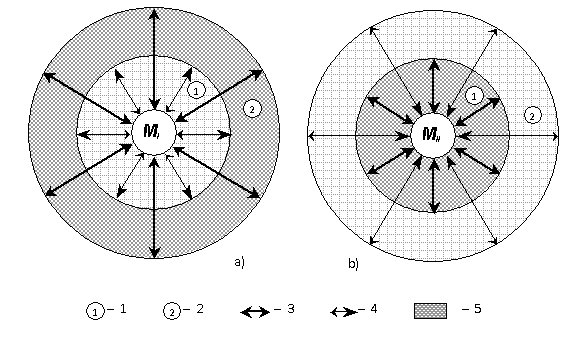

Fig.
1. Contacts of Ist
and IInd type
metropolises with the
surroundings:
MI – Ist type
metropolis; MIІ – IInd
type metropolis;
1 – subnational (regional) and
national levels;
2 – supranational (continental and
global) levels;
3, 4 – lines of metropolis’
“field force”;
3 – dominating mutual contacts;
5 – area of dominating impact of
a metropolis.
Source: compiled by the
authors
For
Ukraine particularly topical
is the study
of the IInd
type metropolization processes,
and that can
be accounted for
not only by
the need for
systematization and
deepening of the
corresponding theoretical knowledge about the
specificity of metropolization, but by
the practical significance of the
outlined problems as
well. That is because the results
of those studies
are aimed to
become the theoretical basis of
scientifically substantiated recommendations both on
the development of
Ukrainian cities with
metropolitan functions and
on the improvement of national regional and
spatial policies with due account of available and potential metropolization challenges.
That is why special attention shall be paid to the issues of profound spatial
analysis of the complex impact of metropolization processes both on the
development of cities-metropolises and their nearest
surroundings, and on the development of specific regions and the country in
general.
References:
1.
Denysenko O.O. Protsesy metropolizatsii:
svitohospodarskyi aspekt / O.O. Denysenko. – K. : IH NAN Ukrainy, 2012. – 192
c. [in Ukrainian].
2.
Druzhinin A.G. Metropolizatsiya kak dominantnaya
tendentsiya territorialnoy organizatsii obschestva v postsovetskiy period:
universalnyie proyavleniya i yuzhno-rossiyskaya spetsifika / A.G. Druzhinin //
Geograficheskiy vestnik [Nauchnyiy zhurnal Permskogo un-ta]. – 2009. –
No 3 (11). – Retrieved from:
http://www.geo-vestnik.psu.ru [in Russian].