P.h.D. Kryuchin
O.V., Kryuchina E.I.
Tambov State University
named after G.R. Derzhavin
The currency exchange rates prediction
and artificial neural networks
The prediction of
financial time series is an actual problem of economics because changing cost of
shares and currency exchange rates influences different economic parameters.
For a long time it is assumed that financial time series are random but in the
1980s the theory of deterministic chaos appeared. This theory predict that
there are many hidden conformities in financial time series.
The deterministic
chaos theory suggests that a financial time series is a dynamic system. There
is a group of parameters for such a system which characterizes the system
condition and allows to calculate system values at every point of time from
initial values by special convention (is defined by the following function of
system evolution  ) [1]. Here
  is group of parameters characterize system
condition, L is lag space size
(number of previous series values used to calculate the value of the
current value),
is group of parameters characterize system
condition, L is lag space size
(number of previous series values used to calculate the value of the
current value),  are manager parameters,
  is the system evolution function. The
currency exchange rates system condition is characterized by time series
is the system evolution function. The
currency exchange rates system condition is characterized by time series  . Here
  is currency exchange rates at time
  . For simulating
the time series it is necessary to discover the function
. For simulating
the time series it is necessary to discover the function  and the parameter
  from function
  . The flavor of
function
. The flavor of
function  is unknown so in simulation this function is
changed to approximate function F which is defined for minimum
difference between empirical currency
is unknown so in simulation this function is
changed to approximate function F which is defined for minimum
difference between empirical currency  and forecast currency
  in equation
  . Here c is discharging
coefficient which defines the length of the forecasting period. So the target
of forecasting currency exchange rates is to detect the parameters F, L
and c by minimizing the value
. Here c is discharging
coefficient which defines the length of the forecasting period. So the target
of forecasting currency exchange rates is to detect the parameters F, L
and c by minimizing the value 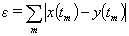 .
.
One of the most
often used strategies is direction detecting. So at the current time  it detects the next direction of change and
calculates value at time
it detects the next direction of change and
calculates value at time  . This calculated
value is
. This calculated
value is  . Then the
difference of the values at points
. Then the
difference of the values at points  and
and  is compared to swap value
  . The swap value is
point
. The swap value is
point  around radius in which all operations are
unprofitable. If constraint
around radius in which all operations are
unprofitable. If constraint  is executed then the operation will be open.
If new value
is executed then the operation will be open.
If new value  is greater than current value
  then a buying operation is recommended
othersize a selling operation. So it is necessary to define one of three
conditions:
then a buying operation is recommended
othersize a selling operation. So it is necessary to define one of three
conditions: 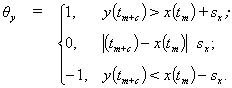
To solve this task
it is possible to use different methods, for example technical or neural
network analysis. This analysis has not limitation of the character of the
input information. This may be a time series or information about behavior
other market factors. For example, artificial neural networks (ANN) are
actively used by institutional investors (such as large pension funds etc.)
which work with a large amount of information and which need to make allowances
one currency to other. The difference to technical analysis (based on general
recommendations) is the possibility to find optimal factors (for currency pair
quotations forecasting) and to use them in forecasting [2-3].
The aim of this
paper is to predict exchange rates between Euro and US dollar using an
artificial neural network. To achieve this aim, several tasks have to be
solved. These tasks are the training of ANN structure witch consider time
series of currency pair €/$ quotations, the
check of ANN-model adequacy based on this structure, the forecasting result of
technical and neural networks analysis comparison and to formulate a corollary
about the possibility to use ANN for predication.
ANNs are
mathematical instruments which are computer models of biological neural
networks, which can be trained using log-normal observations and can be used
with information dearth or its noisiness. This instrument is very flexible and
this property allows to consider different log-normal red observations using
the change of structure and of manager parameters of model [4].
Training ANNs is
reduced to minimizing the inaccuracy function  . Here
  are weight coefficients.
The ANN which
simulates currency pair quotations series are formulated using the algorithm
defined in [5]:
·
The
lag space size L is searched. This value defines the number of input neurons
in the ANN. Usually this value lies in the band (8; 16) [6].
·
The
type of structure of ANN is selected. The numbers of neurons in hidden layers
and the number of hidden layers are defines by the configuration of the
structure.
·
The
value of the number of the discharging.
·
The
optimal number of pattern lines count are calculated. This value is defined by
the structure size and the number of weighs. If there are N quotations
then the number of pattern lines is N-L [7].
·
For
pattern building the quotation values at time points  are calculated.
These values are
are calculated.
These values are  .
.
·
The
input pattern (X) and output pattern (D) are formulated 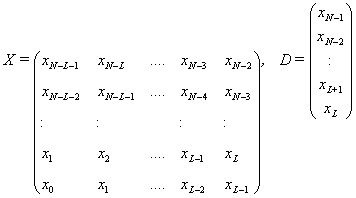
·
Weight
coefficients are changed using a gradient algorithm of the steepest descent
[8].
There are not
monosemantic methods of searching of the lag space and the discharging values
searching because each method has advantages and disadvantages. For the
exchange rates used in this paper €/$ witch series are showed in picture 1 it sets parameter L whose
time series is show in figure 1, and c taken the values 15, 30, 60 and
120 minutes (standard periods witch used in trade strategies).
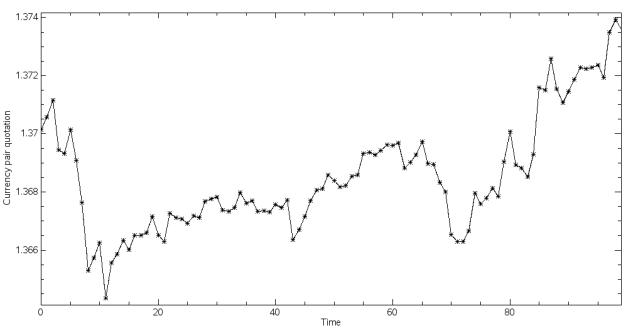
Pic. 1. Quotations
of currency pair.
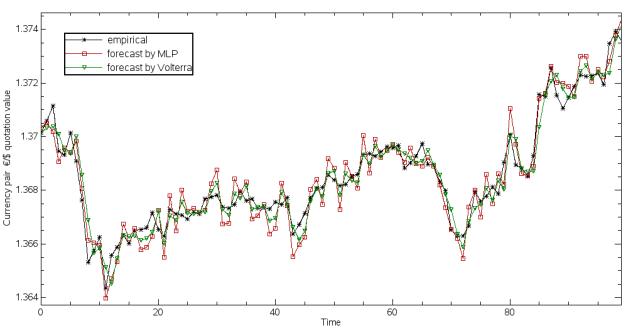
Pic. 2. Quotations
of currency pair (real and predicating).
Literature
1.
Кузнецов С.П. Динамический хаос. // Москва,
1994. – 274 с.
2.
Бэстенс Д.Э. ван ден Берг В.М. Вуд Д.
Нейронные сети и финансовые рынки: принятие решений в торговых операциях. //
Москва: ТВЦ. 1997. – 236 с.
3.
Вострокнутова. А.И. Модели прогнозирования
курсов акций российских нефтяных компаний // Извесия Санкт-Петербургского
университета экономики и финансов. \textnumero3), СПб. 2000. –
C. 126-144.
4.
Зенкова Н.А. Моделирование на основе
аппарата искусственных нейронных сетей как метод исследования в психологической
науке. // Вестн. Тамб. ун-та. Сер. Естеств. и техн. науки. Тамбов: 2009. Т. 14,
Вып. 3. – С. 577-591.
5.
Крючин О.В, Арзамасцев А.А. Прогнозирование
котировок валютных пар при помощи искусственной нейронной сети. // Вестн. Тамб.
ун-та. Сер. Естеств. и техн. науки. Тамбов: 2009. Т. 14, Вып. 5. – С. 591-596.
6.
Козадаев А.A.
Предварительная оценка качества обучающей выборки для искусственных нейронных
сетей в задачах прогнозирования временных рядов. // Вестн. Тамб. ун-та. Сер.
Естеств. и техн. науки. Тамбов: 2008. Т. 13, Вып. 1. – С. 99-100.
7.
Крючин О.В, Козадаев А.С. Арзамасцев А.А.
Паралельные алгоритмы обучения искусственных нейронных сетей и их использование
для прогнозирования массы выловленной креветки в Индийском океане. // Вестн.
Тамб. ун-та. Сер. Естеств. и техн. науки. Тамбов: 2010. Т. 15, Вып. 5. – С.
185-190.
- Osowsky S. Sieci neuronowe w ujeciu algorytmicznym // Warszawa. 1996.