Shatalova Y.O.
Odessa state academy of
building and architecture
Socio-economic
factors of development of astronomical research centers in modern conditions
Astronomy is a discipline that opens our eyes, gives
context to our place in the Universe and that can reshape how we see the world.
When Copernicus claimed that Earth was not the centre of the Universe, it
triggered a revolution. A revolution through which religion, science, and
society had to adapt to this new world view.
Astronomy opens history even further by explaining the origins of our
planet, our sun, our galaxy – even providing insights into our Universe and how
it all started some 13 odd billion years ago. It tells us
about our past. Earth sciences
rediscovered our planet due to crucial data related to the nature of the bowels
of the earth, lithosphere, hydrosphere and atmosphere.
Cosmonautics in recent decades has stepped away from
the first artificial satellites and manned space vehicles to the long-term
functioning of the orbital complex, automatic interplanetary station, orbiting
observatory and the "constellation" of satellites that can
effectively solve many problems without which could not be a modern
meteorology, geology, geography, navigation, communications and many other
scientific fields.
Unfortunately, the exact natural science mass media
pay too little attention. At the beginning of the XXI century astronomy subject
was excluded from the number of subjects taught in secondary school. In such a
paradoxical situation significantly increases the role of the popular science
magazines, which, despite the difficulties associated with their publication
and distribution, make efforts to interest the readers in science and maintain
this interest for decades. Of particular importance astronomy acquired in our
time, in the era of scientific and technological revolution. Without it, it
would be impossible to achieve many of science technology, including advances
in human space exploration.
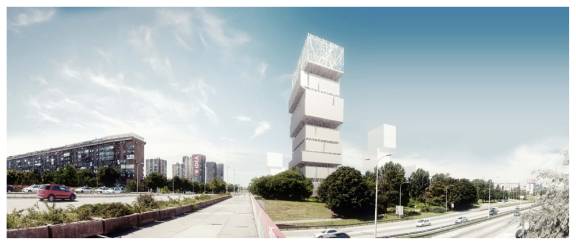
Pic.1 Belgrade
Centre for Promotion of Science
The days
are gone when scientists managed to achieve impressive results with a simple
visual observation and simple devices. Scientists in modern conditions require
far more impressive instruments: multifunctional astronomical observatories,
giant telescopes and radio telescopes, particle accelerators, laser and
thermonuclear installations, space stations, satellites, high-speed electronic
computers. And the researcher must have a deep knowledge of the subject, a
wealth of experience of the observer and experimenter.
a)
b)
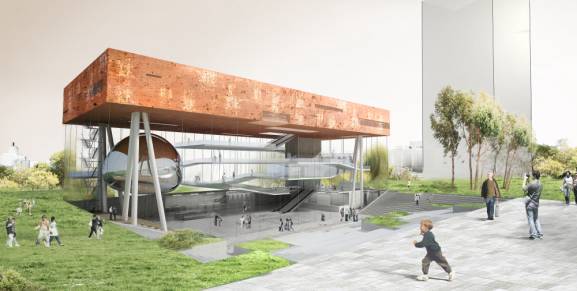
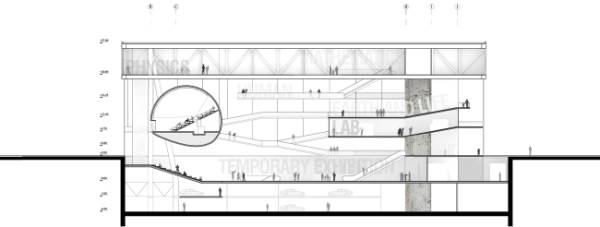
Pic.2 Center
for Promotion of Science. Experimental project (a,b)
Due to
the increasing needs of mankind, it has qualitatively changed the typology of
specialized public buildings dedicated to astronomy.(Pic. 1, 2(a,b)) Modern
astronomical research center dedicated to the universe exploration, requires a
flexible and functional structure, to provide a wide range of services to the
population
(Pic.
3, 4).
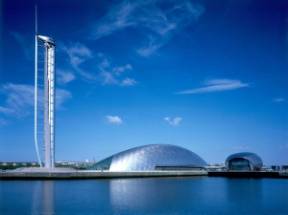
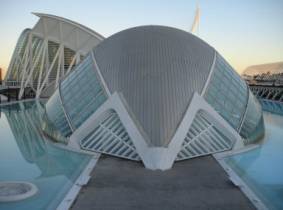
Pic.3 Glasgow. Science
centre Pic.4 Valencia. City of
the Arts and
Sciences
We live in a world
faced with the many immediate problems of hunger, poverty, energy and global
warming, we argue that astronomy has long
term benefits that are equally as important to a civilized society. Several
studies have told us that investing in science education, research and
technology provides a great return — not only economically, but culturally and
indirectly for the population in general — and has helped countries to face and
overcome crises. The scientific and technological development of a country or
region is closely linked to its human development index — a statistic that is a
measure of life expectancy, education and income.
Astronomy and
related fields are at the forefront of science and technology: answering
fundamental questions and driving innovation. It is for this reason that The
International Astronomical Union`s (IAU) strategic plan for 2010–2020 has three
main areas of focus: technology and skills; science and research; and culture
and society.
The fruits of
scientific and technological development in astronomy, especially in areas such
as optics and electronics, have become essential to our day-to-day life, with
applications such as personal computers, communication satellites, mobile
phones, Global Positioning Systems, solar panels and Magnetic
Resonance Imaging (MRI) scanners.
Although the study of astronomy has provided a wealth
of tangible, monetary and technological gains, perhaps the most important aspect
of astronomy is not one of economical measure. Astronomy has and continues to
revolutionize our thinking on a worldwide scale.
Conclusions:
Astronomy
has always had a significant impact on our world view. Early cultures
identified celestial objects with the gods and took their movements across the
sky as prophecies of what was to come. Astronomy
is important to our future, from the short term to the distant long term. Over
the coming decades, private companies will take over much of the heavy lifting
formerly associated with government agencies such as NASA and ESA. This will
create new jobs and new wealth. Bigger telescopes, better equipment and
building of modern astronomical research centers with flexible and
functional structure will provide insights into
reality that will stretch our technological capabilities.
The first calendars
were based on the movement of the Moon and even the way that we define a second
is due to astronomy. The atomic clock, developed in 1955, was calibrated using
astronomical Ephemeris Time — a former standard astronomical timescale adopted
by the IAU in 1952. It is the way that science can bring nations together,
encouraging collaboration and creating a constant flow as researchers travel
around the globe to work in international facilities.
Modern
astronomical research center dedicated to the universe exploration, requires a
flexible and functional structure, to provide a wide range of services to the
population.
Astronomy is
particularly well suited to international collaboration due to the need to have
telescopes and astronomical research centers in different places around the
world, in order to see the whole sky.
References:
1. Bode, Cruz & Molster 2008, The ASTRONET Infrastructure
Roadmap: A Strategic Plan for European Astronomy,http://www.eso.org/public/archives/books/pdfsm/astronet.pdf, August 2013
2. International Astronomical Union 2012, IAU Astronomy for
Development Strategic Plan 2010–2012.http://iau.org/static/education/strategicplan_2010-2020.pdf, June 2013
3. Renée James, C. 2012, What has astronomy done for you
lately?, www.astronomy.com, May 2012
4. Marissa Rosenberg, Pedro Russo (EU-UNAWE, Leiden Observatory/Leiden
University, The Netherlands), Georgia Bladon, Lars Lindberg Christensen (ESO,
Germany) Astronomy in Everyday Life https://www.iau.org/public/themes/astronomy_in_everyday_life/