Конференция «Перспективы мировой науки»
Строительство и архитектура/3. Современные технологии
строительства, реконструкции и реставрации.
Zaiats I.I.
State Higher Educational Establishment «Pridneprovs’ka
State Academy of Civil Engineering and Architecture»
TENDENCIES OF FORMATION AND DEVELOPMENT OF THE CONSTRUCTION OF HIGH-RISE MULTIFUNCTIONAL COMPLEXES AND URBAN PLANNING
PRACTICE
High-rise
construction began in the USA in the early twentieth century. It technical
pre-requisites have become the invention of the elevator and the production of
steel and the subsequent development and widespread introduction of steel
structures frame, which spurred the transition from wall structural system to
frame. Formed techniques of group accommodation and mostly monofunctional
purpose of high-rise buildings with the formation of the downtown. Depending on
natural conditions downtown is solved in the form of a concentrated core of
high-rise buildings or linearly along the waterfronts or highways [1].
In
Europe the construction of high-rise buildings and
structures began in the late 1950 – early 1960. Feature of the European
approach to high-rise development is the complexity and multifunctionality. The
multifunctionality of European high-rise buildings is based on a combination of
mono-functional high-rise buildings with residential houses, high-rise and
low-rise buildings of the infrastructure that enables you to solve every type
of buildings according to their purpose (intransigence of space-planning
decisions dictated by multifunctionality) and to provide a multi-faceted life
areas during the day. Usually, in Europe today land for high-rise buildings are
discharged outside of the historic areas of cities. It is placed on the
outskirts, on the territories of obsolete industrial areas.
High-rise
construction in Asia intensified in the last decades of the twentieth century.
Mainly the formation of mono-functional compact or linear high-rise urban
centers – office-bank, sometimes supplemented by the small number of high-rise hotels.
Since
2000, the pace of high-rise construction is constantly growing. In 2012-2013,
the number of completed high-rise buildings has somewhat decreased, but this
decline can be attributed to the effects of the global financial crisis of
2008-2009.
The
most successful years for the number of constructed buildings taller than 200
meters were in 2011 and 2013, respectively, 81 and 73 of the completed objects.
From
2000 to 2014, the total number of high-rise buildings over 200 m or more
increased from 261 to 830, that is 318%.
2013
was the fourth year in a row are built in 9 ultra-high buildings (height of 300
m and more). 36 built in this period buildings account for almost half of the
total number of existing ultra-high buildings.
With 73
high-rise buildings, built in 2013, 12 (16%) entered the list of 100 tallest
buildings in the world.
For the
sixth consecutive year in China built the largest number of buildings over 200
m and more, with can not compare to any one country. Here were completed on 37
sites in 22 cities.
For the
second year in a row, three of the five tallest buildings are located in the
United Arab Emirates.
In
2013, for the first time since 1953, in Europe built two of the ten tallest
buildings.
Of the
73 buildings over 200 meters completed construction in 2013, only one built in
the USA.
The
share of North America in the total number of high-rise buildings with a height
of 200 m and more, built in 2013, decreased from 6% to 1%. And all the tall
buildings in this period were built in Panama (fig. 1).
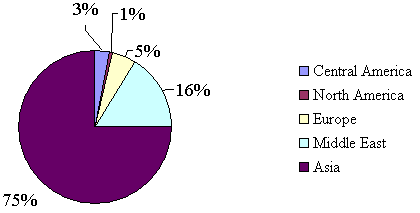
Fig. 1.
The distribution of high-rise buildings in regions of construction
In the last decade, we continued the development of
several trends in functional buildings: the share of high-rise office buildings
was reduced from 39% to 34%; high-rise buildings designed only for housing, up
30%; the share of multifunctional high-rise buildings has increased from 29% to
31%; high-rise hotel is 5% of the total number of high-rise buildings (fig. 2).
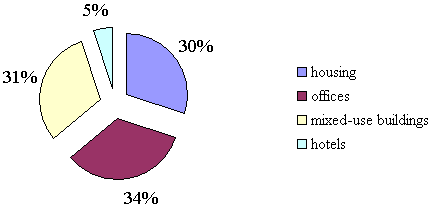
Fig. 2.
The distribution of high-rise buildings by functionality
Among the predominant building materials concrete used
in the construction of 63% of sites. The number of concrete structures has
increased from 26% to 32%, while steel design make up 3% of the total number.
This is very different from the 1970s, when 90% of high-rise buildings in the world
were built of steel (fig. 3).
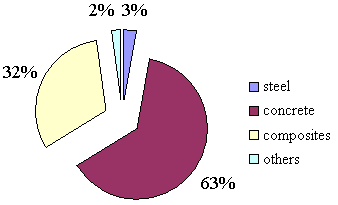
Fig. 3.
The distribution of high-rise buildings by material of structures
It all
depends on where the project is and how radically different floor layout in the
case of multi-purpose use. The most used concrete in the construction of
residential and hotel areas of high-rise buildings with a powerful core, a
smaller number of iterations and a higher hardness. For office space may have a
size with a free plan, which is easier to achieve if you work with steel.
Because there is more and more high-rise multifunctional buildings, a growing
need for the combination of different types of building materials within the
same building [2].
For
Ukrainian urban planning practice the most valuable may be the European
experience of high-rise construction:
-
consistent concentration of power production on a limited number of
sites;
-
subordination of the urban design to principles of integrated urban
development with deployment of transport networks in several levels;
-
ensuring the comprehensiveness of the development due to the combination
of objects of different functional purposes in buildings, space-planning
decision which most harmoniously match their functions, however, this does not
mean the creation of multifunctional high-rise buildings, and the combination
of comprehensive construction of different buildings for different functions,
i.e. the creation of a high-rise multifunctional complexes.
References:
1.
Маклакова Т.Г.
Высотные здания. Градостроительные и архитектурно-конструктивные проблемы
проектирования: Монография / Т.Г. Маклакова. – М.: Издательство АСВ, 2008.
– 160 с.
2.
Сафарик Д.
Тенденции высотного строительства 2013 года / Д. Сафарик, Э. Вуд,
М. Карвер, М. Герометта // Высотные здания. – 2014. – № 2. –
С. 92-97.