Technical
science/2. Mechanics
Dr. Sc. Techn., professor Gots A. N.
Vladimir state University of a name Alexander
Grigorievich and Nikolai Grigorievich Stoletovs, Russia
New schematized diagram of limit cycles under the action of shear stresses
Calculation
of factors of safety to parts of machine parts under the action of shear stresses in the case of uniaxial stress
state and the asymmetric cycle of loading with amplitude τa and medium-stress τm is performed on
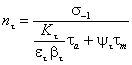
the basis of dependency S. W. Serensen and R. S. Kinasoshvily [1]:
 , (1)
, (1)
where Kτ is the effective stress concentration factor; ετ – scale factor; βτ – coefficient of the surface
layer; ψτ – coefficient of
influence of cycle asymmetry or coefficient, which characterizes the
sensitivity of the material to the asymmetry of the cycle [2] .
The
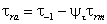
maximum amplitude of the stresses τra
for laboratory sample with asymmetric cycle of loading can be expressed by the
equation, well the corresponding experimental data in the range of variation of
the coefficient of asymmetry 
 , (2)
, (2)
where τrm is the current
value of the limiting medium shear stress of cycle.
In
computational practice, often use a schematized diagram of the limiting
amplitudes Serensen-Kinasoshvily, in which the coefficient ψτ equal
 , (3)
, (3)
where τ0 is
the fatigue limit of laboratory samples in a pulsating cycle.
Because
the value of τ0 in the reference literature is not given, it is
recommended to define her by the approximate formulas [3]. For steels in
torsion 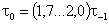 , and non-ferrous metals
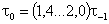 . For steels in bending and tension-compression
 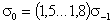 . Upper limits refer to mild steels. It is easy to notice that with this
choice of τ0, after substitution in (3) the coefficients ψτ will be constant, independent
of the mechanical characteristics of the material.
. Upper limits refer to mild steels. It is easy to notice that with this
choice of τ0, after substitution in (3) the coefficients ψτ will be constant, independent
of the mechanical characteristics of the material.
In [1]
for steels it is recommended to take ψτ =0,5 ψσ. The value of ψσ it is proposed that the
formula
 , (4)
, (4)
where σv is the tensile strength,
MPa.
The
author offers new schematized diagram of limit cycles τra = f(τrm) with the use of
the mechanical characteristics of the materials shown in the literature.
When
evaluating the effect of average shear stress on fatigue resistance in [4] it
is noted that for ductile metals in torsion, the majority of experimental
results with the maximum shear stresses not exceeding the yield strength τт be above the
Gerber parabola:
 . (5)
. (5)
If we
approximate the dependence of the limiting amplitude of shear stress τa medium τm according to the
results of experimental data of elliptical dependence [5]
 , (6)
, (6)
|
|
|
Fig. 1. Chart of the limiting
amplitudes for steel 40XH |
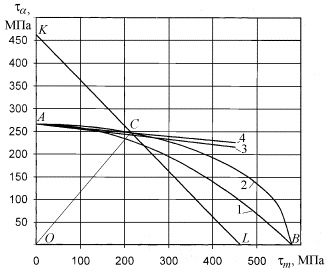
 : 1 – Gerber parabola; 2 – elliptic curve; 3 – marginal
direct sørensen-Kinsolver (
: 1 – Gerber parabola; 2 – elliptic curve; 3 – marginal
direct sørensen-Kinsolver (the curve (6) is
located above the parabola gerbera (5).
Most
experimental results on the determination of fatigue limit with of the ratios
coefficient of asymmetry cycle lie in the area limited by the parabola gerbera
and elliptic curve.
In Fig.1
for steel 40XH (with the characteristics of mechanical strength for shear
stresses in MPa: tensile strength (tensile strength) τv=580; yield stress τ0,2=460; the limit of endurance
for a symmetrical cycle τ-1=270) diagrams of
the limiting amplitudes using dependency: parabolic gerbera (5) and elliptic
(6) (curves 1 and 2 respectively). Point
A on the y-axis determines the value of τ-1, and the point B on the x – axis τv. Eliminate from the chart τra = f(τrm) the area where the limiting maximum stress τrmax=τra + τrm > τ0,2. To do this, take the
straight line KL, which cuts off on
the cuts the coordinate axes OL and OK is equal to the yield strength τ0,2. The equation of a line KL is:
 . (7)
. (7)
Line KL intersects the elliptical at point C. The coordinates of the point C we determine after the joint solution
of equations of the elliptic curve (6) and (7)
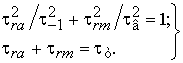 (8)
(8)
After
solving the system (8) will receive:
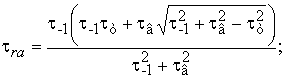 (9)
(9)
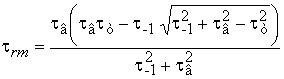 . (10)
Build a
schematized diagram for shear stresses by connecting a line between A and C. The
tangent of the slope of the line AC
(4 in Fig. 2) to offer a schematized diagram for shear stresses, is numerically
equal to the ratio yτ:
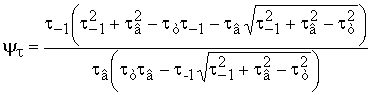 . (11)
In Fig.
1 line KL, built by the formula (7)
with τ0,2=460 MPa,
intersects the elliptic curve 2 at point C. On the graph obtained two areas – OAC and OCL. If working shear stress τa and τm are located in OAC, and τm/τa  τrm/τra, the safety factor
is defined by the formula (1).
τrm/τra, the safety factor
is defined by the formula (1).
If τa and τm are located in OCL, the safety factor is equal to:
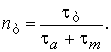 (14)
(14)
In
works [6, 7] present a new schematized diagram the results of calculations of
the coefficients yσ and yτ for
steels and ductile cast irons, which are widely used in power engineering. In
addition, to determine the areas in which the working voltage, the calculation
of ratios for normal and shear stresses χτ = τm/τa и χσ = σm/σa.
LITERATURE
1. Kogaev V. P., Makhutov N. A., Gusenkov A. P.
Calculations of machine parts and structures for strength and durability: Handbook – M.: Mashinostroenie, 1985. – 224
p.
2. Birger I. A., Shorr B. F., Iosilevich G. B.
Calculation of the strength of machine parts. Handbook.– 4-e Izd., revised and
enlarged – M.: Mashinostroenie, 1993. –
640 p.
3. Handbook on strength of materials // M. N.
Rudizin, P. Y. Artemov, M. I. Lyuboshitz.; Under the editorship of M. N.
Radizina. – Minsk: Vysheishaya school, 1970. - 630 p.
4. Forrest P. Fatigue of metals. Translation
from English. Under the editorship of S. V. Sorensen. – M.: Mashinostroenie,
1968. – 352 p.
5. Collins J. Damage of materials in
structures. Analysis, prediction, prevention: Trans. from engl. – M.: Mir,
1984.– 624 p.
6. Gots A. N. The strength calculations at
variable voltages: monograph./ A. N. Gots – Vladimir: Publishing house of the
University, 2012 – p. 138.
7. Gots A. N. The calculations of the strength
of engine parts with voltages, variable in time/A. N. Gots – 3-e Izd. – M.:
FORUM; infra-m, 2013 – 208 p.