Yu.
F. Arefjev,
Doctor of Biol. Sciences, Professor
Voronezh
State University of Forestry and Technologies
named after G.F. Morozov
Autoregulation
of pathogenesis in forest ecosystems
INTRODUCTION
Autoregulation, understood
as a process within biological systems, resulting from an internal adaptive
mechanism and working to adjust or mitigate that system's response to stimuli, is
one of the most important properties of biological systems. The modern forest ecosystems
of the Central Russian forest-steppe not fully correspond to this property. Sporadic
mass premature dying off of wood plants, excessive reproduction of some pathogenic
organisms and insufficiency of natural renewal of the main forest forming breeds,
show it convincingly. The purpose of the conducted researches is strengthening of
the natural ecosystem regulating mechanisms for suppression of populations
pathogenic for the wood organisms. Achievement of this purpose is closely
connected with understanding of a role of forest structure in pathogenesis
regulation.
METHODOLOGY
Viability of forest forming
breeds and development of populations of pathogens were compared in relative to
the heterogeneity of forest ecosystems. The level of heterogeneity was
determined by Shannon's formula [1-5]:
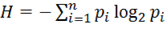 ,
,
где:
H – the level of heterogeneity, i –
element of heterogeneity,  probability of an element, n – number of elements.
Model test object is askomyzetes Erisiphe
alphitoides.
Viability of trees was estimated on the following
scale: 5th point – healthy trees, without signs of considerable damages or
dying off; 4th point – the weakened trees: krone is a little rare or (and) dim,
smal defects of a trunk are possible; 3th point – trees are sick of the 1st
degree: krone is considerably rare, major defects of a trunk are possible, the
probability of recovery of health of a tree remains; 2th point – trees are sick
of the 2nd degree: a krone is rare more
than 50%, recovery of health of a tree is improbable); 1st point – the
dying-off trees: only separate live elements remained. Recovery of a tree is
impossible; 0 – point for the died-off trees.
The difference of results
were compared by statistically reliable at p
< 0,05; k = 10 %. .
RESULTS
It has been found that in
heterogeneous ecosystems viability of the main tree species is higher, than in
the homogeneous ecosystems (table 1).
Table 1
Viability of oak seedlings in various growth conditions
|
Growth
conditions |
Viability of
oak seedlings, point |
|
|
Annual seedlings |
Five-year seedlings |
|
|
Heterogeneous: mixed
group of oak, pine, birch plantings, H = 8,42 bits |
4,31±0,02 |
4,23±0,01 |
|
Homogeneous: pure linear plantings of an oak, H = 2,41
bits |
3,42±0,03 |
1,56±0,03 |
The success of natural
regeneration depends on the abundance and survival of seedlings. The survival
is better in heterogeneous growth conditions.
We have established that in rather small
subpopulations of pathogens the effect of an inbreeding depression develops (table.
2). Inbreeding results in population
homozygozygosity. Thus the chances of offspring being affected by
recessive or deleterious traits can increase. Biological fitness of a
population decreases. Inbreeding depression in our case suppresses population
of E. alphitoides, its ability to
survive and reproduce.
Table 2
Key
parameters of generative bodies of E. alphitoides
in various growth conditions
|
Growth
conditions |
Parameters of generative bodies |
|
||
|
Frequency of kleystotetion, n/cm2 |
Diameter of kleystotetion, µm |
Length of konidiya µm |
Width of konidiya µm |
|
|
Homogeneous: pure linear plantings of an oak, H =
2,41 bits |
64,3 ±
3,2 |
99,5 ± 5,3 |
32,7 ± 2,9 |
18,1 ± 0,9 |
|
Heterogeneous: mixed
group of oak, pine, and birch plantings, H =
8,42 bits
|
8,7 ± 0,6 |
74,4 ± 3,1 |
24,8 ±
1,6 |
13,7 ± 0,8 |
Inbreeding
is especially dangerous in small populations where the genetic variation is
already limited. In our case the area of ecologically isolated plantings of ≈
0,25 hectares is optimum (table 3).
Table 3
Development of E. alphitoides in various oak sites
|
Area of an oak
sites, ha |
Development, % |
Selection
volume, n |
Variation coefficient,sx % |
|
|
Primary inokulyation |
Konidial inokulyation |
|||
|
≈ 0,25 |
6 |
14 |
18 |
21 |
|
> 0,25 |
34 |
96 |
44 |
33 |
An optimal area of forests, at which the effect of
decrease in density of a populyation of a pathogen is shown ≈ 0,25 ha. At
the bigger area (> 0,25 ha) the effect of an inbreeding depression is not
shown. Area of an oak sites less than a quarter of hectare (< 0,25 ha) is undesirable,
as biotiс forest interrelations are broken [].
An internal adaptive mechanism works to adjust
(mitigate) the development of E.
alphitoides in heterogeneous growth conditions (tables 1 – 3). Main reason
for the phenomenon is inbreeding. System's
response to development of the pathogen and holds
pathogenesis at rather low level. That is some degree of autoregulation. High-heterogeneous
systems are more sensitive.
Autoregulation
of genes is the heart of population autoregulation in forest ecosystems. The
understanding of the phenomenon leans on fundamentals of population genetics. Genetic
stability is provided in rather big populations. Small populations generate
inbreeding and population depression.
CONCLUSION
Basic phenomenon of
autoregulation of pathogenesis in forest eсosystems is inbreeding in pathogenic
populations. The inbriding depression is caused by splitting of pathogenic
populations into rather small subpopulations, approximately on the area of 0,25
hectares. High level of planting heterogeneity is adverse for excessive
reproduction of pathogenic organisms. The populations of pathogens are
maintained by autoregulation at almost admissible level. The viable populations
of a forest tree species for the spontaneous development needs a larger areas.
Literature
cites
1.
Acek
S.V. Minimum area of forests left to spontaneous development in
protected areas // Journal of forest science,
49, 2003 (8): 349 – 358.
2.
Arefjev
Y.F., Senf V. A., Mamedov Ecological
and genetic aspects of forest
phytopathology.
Voronezh, 2017. – 115 p.
3.
Brisbee
K.E., Gower S.T., Norman J.M., Nordheim E.V. Environmental control on ground
cover species composition and productivity in a boreal black spruce forest //
Oecologia. 2001. Vol. 129. P. 261 – 270.
4.
Shannon
C.E. A mathematical theory of communication // The Bell System Technical
Journal, 27 – 1948. – P. 379 – 423 and 623 - 656.
5.
Heydenmann
B. Zur Frage der Flächengrössen von Biotopbeständen für den
Artenschutz und Ökosystemschutz // Jb. Naturschutz und Landschaftspflege,
31, 1981: 21 – 51.