AGRICULTURAL ENTERPRISE
INVESTMENT RATING MODEL BASED ON FUZZY CLUSTERING
Gromov V. V., graduate student of chair «Department of Applied Mathematics», Department of Computer Technologies and Applied Mathematics, the Kuban State University, Krasnodar, Russia
It is
necessary to classify Investment Rating of Agricultural companies especially in
Krasnodar region. Agricultural complex is a priority in the development of the
Krasnodar region economy.
We suggest a model
based on Fuzzy Logic which can work with minimal data to give more accurate
Investment ratings. Preliminary analysis of the model outputs confirms the
advantages of the Fuzzy Logic model over the current models.
Many of the current
scoring models use the Altman Model in some form or the other. This model while
being simple to use, has problems relating to the availability of data and
multi-collinearity of variables.
The design of the Fuzzy
Logic Investment Rating System involves the following steps:
1)
We selected the data of 150 Agricultural companies. We used balance sheet
and profit-and-loss report.
2)
The following 4 groups are selected as input parameters:
- liquidity;
- profitability;
- business activity;
- financial soundness.
For each company were
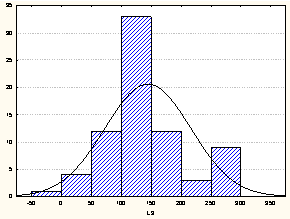
counted 15 ratios. And for each ratio were built clustering histogram.
3)
We have identified five fuzzy classes: very low level of factor (OH) - Low
levels of factor (H) - Medium factor (CP) - High levels of factor (B) - very
high level of factor (ОВ).
4)
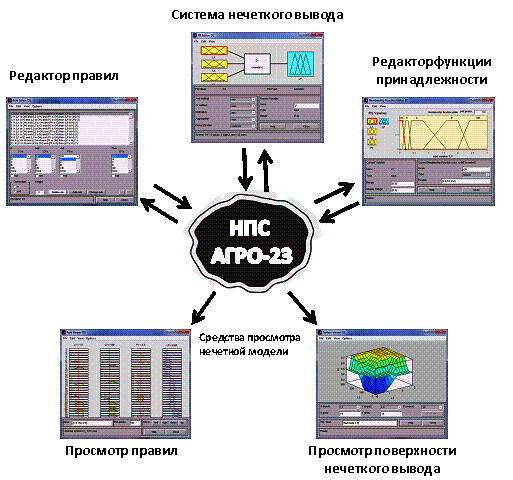
Fuzzy logic
model (mamdani)
Building
fuzzy logic system
View rules Surface of
fuzzy model Editor rules Membership
functions (mamdani)
Conclusion
Fuzzy systems have
found practical application in many cases5. The model developed here, with only
financial parameters as inputs, gave results which were more accurate than
models based on Multi Discriminant analysis, such as the Altman model. This
shows that Fuzzy Logic models have an inherent advantage because of their
ability to take care of the fuzziness or ambiguity in the system. Other
advantages include easy interpretability and scope for integration with other
systems such as neural networks for higher accuracy.
Further,
Fuzzy Logic models can be integrated with neural networks resulting in a better
model with higher prediction accuracy to make the model self-learning. The
scope of the model increases when one incorporates qualitative data the system.
References
1.
Gromov V. V. Rating agricultural enterprises
of Krasnodar Territory / Applied Mathematics XXI century
(Intrahigh collection), materials
X Joint Scientific Conference of students and graduate students of computer technology and applied mathematics faculty. Krasnodar: Kuban State University, 2011.
2. Ognev Y. Y. Аgrarian
question. The main proposals
/ Y. Y. Ognev. M: Press,
2010. 56 p.