Bazhenova B., Bidagaeva S.
East-Siberian State
University of Technology and Management
SELENIUM ENRICHMENT OF
THE MINCED PASTE MEAT
The
modern human food ration testifies of the insufficient consumption of vitamins
and minerals, including selenium. The spectrum of selenium action in a human
body is wide enough. According to the data of the epidemiological research more
than 80 % of the Russian population are provided with selenium below the
optimum level [1]. The paper deals with developing and processing a functional
meat product enriched with selenium.
Meat
products, including paste, are highly nourishing foodstuff. Minced paste meat
is the ground homogeneous substance of the paste-like consistence with aroma of
spices. Paste belongs to emulsified products and its quality is mostly defined
by the functional and technological properties of minced meat.
One
of the ways of the improvement of the minced paste meat technological
properties is the combination of the vegetative and animal origin proteins. The
proteins of the vegetative origin are added into the structure of meat products
in a dry or a hydrated way or as part of the protein-fatty emulsions which
allow to rationally use meat raw materials and to regulate consumer properties
of a ready product.
The
objects of the research were the minced paste meat combined with the
protein-fatty emulsion and wheat flour (control) and minced paste meat combined
with the protein-fatty emulsion enriched with selenium flour and the protein
stabilizer (experience). In developing the recipe of the minced paste meat we
used the pork skin as a protein stabilizer which had been boiled and ground
with water. Then it was necessary to define its water retaining ability [2], as the basic functional and
technological indicator of the minced paste meat.
As
a result, without the protein-fatty emulsion the water-retaining ability of the
minced paste meat sample was 92.8 % (fig. 1). But its water retaining ability
increased by 2.1 % when added 5 %
protein-fatty emulsion with wheat flour into the recipe. The protein-fatty
emulsion increased the product’s binding properties due to the dairy protein
additive – the so called
"Anisomin".
The
increase of the dose of the added protein-fatty emulsion by 10 % resulted in
higher water-retaining ability of the minced paste meat by 1.5 %. But, on the
contrary, more than 10 % of the protein-fatty emulsion added to the substance
did not result in higher water retaining ability.
We
found out that the addition of the selenium flour into the composition of the
protein-fatty emulsion resulted in the increase of the water-retaining ability
of the product, for the proсess of starch gelation started at 620
С and higher which enabled the product to retain water.
The
differences in the indicator studied are also caused by the changes of β-gluсan which is released from the walls of endosperm cells while the process
of wheat germination. High-molecular β-gluсan seems to act as the additional gelation formation factor in case of
the thermal processing. All the
indicators mentioned bring about higher gelation formation ability of the
minced paste meat.
The
introduction of the protein stabilizer with high gelation forming properties
into the structure of the trial samples enhanced the water-retaining process.
As a result the more the dose of protein-fatty emulsion samples is, the higher
the water-retaining ability of the minced paste meat is because of the increase
of the constituents of "Anisomin", a biologically active additive,
phosphates and the protein stabilizer in the dose.
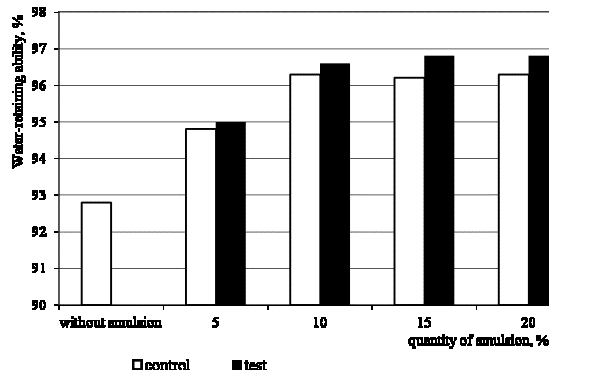
Fig.1. Water-retaining
ability of the minced paste meat
Thus,
the introduction of the protein-fatty emulsion with the selenium flour and the
protein stabilizer into the minced
paste meat raised the functional and technological indicators of the minced paste meat. In such a way the product
is enriched with selenium.
List
of Readings:
1. Tuteljan V. A. Selenium in a Human
Body: Metabolism, Antioxidant
Properties, Cancerogenesis Role / V. A Tuteljan, etc. – М.: Publishing House of
the Russian Academy of Medical Science, 2002. – 224 p.
2. Antipova L.V., Glotova I.A., Rogov I.A.
Research Methods of Meat and Meat Products / L.V.Antipova, etc. – М.:
Kolos, 2001. – 376 p.