RAPID MOWING MACHINE with enhanced ks-2.1Zh DRIVE
G.S.
Zhumatai – c.t.s., D.K.Batyrbekov – c.t.s.
«Kazakh Research
Institute of Mechanization and Electrification of Agriculture» LLC
Present time, Kazakhstan has 5.0 million hectares of
land, occupied by the natural grass with low yield and 2.4 million hectares of
cultivated grass with crop yield. Peasant farmers, who engaged in forage
conservation, mainly use mowers with segment-finger cutter.
Currently, mowers are not produced in Kazakhstan that
brought to big deficit of these machines. There are several new models of
mowers with segment-finger cutter,
developed in CIS countries: KS-F-2.1B, KS-D-2.1B,
KD-F-4 (Russia); KDS-4 modular mower (Belarus)
is differed with less weight and better quality of mowing.
Simple design and low costs of
energy on cutting device drive are the numbers of mowers advantages.
The main disadvantage
of mower is the big alternate inertial loads during reciprocating motion of the knife, which limit
the speed of cutting, consequently efficiency of the
machine. When grass mowing
on the field irregularities,
frequently broken components of cutting device
and frequent clogging of knives
by plant material and soil are occurred.
Increasing of efficiency is provided by the radius increasing
of the eccentric or crank shaft speed
in the existing mowers, what brings to higher dynamic loads. To
increase the cutting speed, consequently increasing of efficiency, the foreign firms increase the cutting stroke up to 84mm.
«Kazakh Research Institute of Mechanization and Electrification of
Agriculture» LLC has developed new and
improved drive of cutting device of mower, which provides double cutting stroke.
Newness of the technical solutions of mower drive is confirmed by preliminary
license RK # 1273, F16H19/06, 21/16 and an innovative license #21946, 2008/1336.1 RK.
Drive of the cutting
device is carried from VOM mower tractor through the drive and belt transmissions and
the knife mechanism drive. The knife mechanism drive has
plate - stand,
two supporting rollers that
connect it with drive shaft with crankshaft, on finger
which roller is mounted to rotate, driven element, and two flexible
elements covered roller on both sides, each of
which interacts with one of the supporting rollers
and attached by one end to the plate – stand and another end to the drive element
- the knife. The flexible element is designed like chains.
Experimental sample
of mower passed preliminary
tests in the
field conditions during mowing the motley grass and alfalfa.
To test the mower
it is tenzometric mobile station equipped with appropriate measuring devices.
The improved drive
of the cutting device meets the essential requirements, necessary
for the drives: crank shaft and cutting device,
mounted on one
stiff frame that supports the
work of cutting device
during mowing the grass at an angle of ± 45 degrees (gullies, ditches, etc.); drive provides
the knife a cutting speed, higher than the minimum allowable – 2.15 m/s; inertial loads acting
on the links of the drive
are minimal.
The results of
preliminary calculations and laboratory-field tests showed
that the frequency of the shaft rotation of the eccentric can be
reduced by almost in two. If the rotation frequency of the crankshaft
of the existing mowers is 780 ... 1010 r/min, then the rotation
frequency of the improved drive is
460 r/min. Reduction
of the angular velocity of
the crank shaft brings
to the reduction of the force of inertia. In this case,
supply for a cutting device with double
running increases in 1.6 times. Under similar cutting
device captures the forces of
inertia of machine knife with
double running decreased in 1.2 times.
|
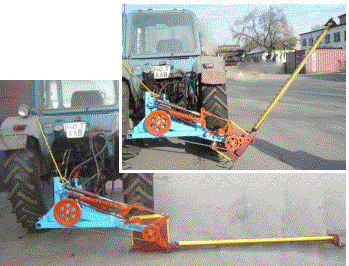
Picture 1 - Mowing machine with an enhanced KS-2.1Zh drive |
The power required for overcoming the friction forces in the cutting machine with double running is increased slightly. The results of the studies used under development of initial
requirements and technical specifications for mowing machine with an enhanced KS-2.1Zh drive.
According to results of tests it is recommended to release prototypes of mower to provide on acceptance testing. |
References
1 B. Yefremov, Yu. Matvienko. Machines for fodder conservation, //Country mechanic #4,
2004, 16-18 pages.
2 G.K. Ossobov, G.K. Vassilyev. Haymakers and complexes. – M.: Engineering, 1983, 304 p.