I. Kovalenko1,
O. Khaytovych1,2
1Public Institution
“Ukrainian Anti-Plague Station” of
Ministry of Health of Ukraine,
2Public institution
“Crimean State Medical University named after S.I. Georgievsky”, Simferopol,
Ukraine
Risk
level of Anthrax in territory of Ukraine
The
potential biological threat of anthrax can be realized as a result of human exposure
to the natural pathogen (from natural foci or from infected animals), and under
the influence of an artificially-grown pathogen (bioterrorism or biological
weapons).
For
determination of the potential biological threats to human infection with
anthrax through contact with a pathogen from a natural environment, the analysis
of registered anthrax permanently- unfavorable points (APUP) in the territory of Ukraine
from 1918 to 2011 was conducted with using ArcGIS. APUP is a town (village),
farm with premises and pastures, watering places, where cases of animal anthrax
disease have been, regardless of the number and the statute of limitations.
Thus, the APUP may include burial ground for animal refuse and place of animal
death; they may become as a source of inadvertent human infection through
contact with contaminated soil, and as a source of raw material for the unauthorized
use (terrorism) or for creation of biological weapons.
On the territory of Ukraine, the APUP located
in 26 administrative regions from 27. Determination of “the proportion of trouble”
with the calculation of the mistakes of arithmetic average (x ± Sx%) for every
region allowed to make the differentiation of Ukraine regions into four groups
by the degree of risk of natural biological threats (99.9% of data verification):
• high level of risk (“the proportion of trouble” -
71,4 ± 2,15%, P <0.001) – 3 administrative regions;
• the average level (43,5 ± 2,13%, P <0.001) – 15 administrative regions;
• low level (17,3 ± 2,21%, P <0.001) – 8 administrative regions;
• the zero level (0%) - 1 administrative region (pic.1).
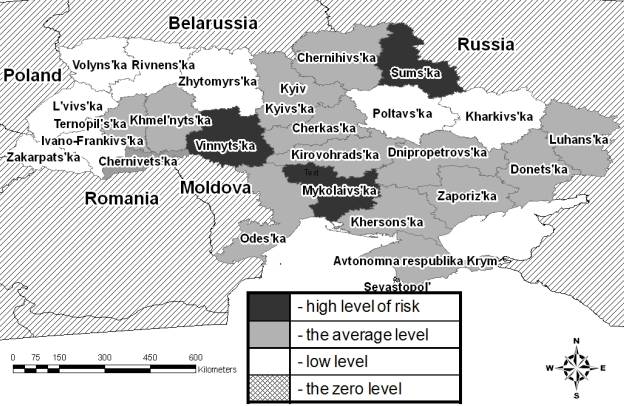
Picture 1. Risk level of
Anthrax in territory of Ukraine
It should be noted that the
administrative regions with the highest risk are the areas that have the
international boundary that can cause a biological threat for foreign
countries.
The monitoring of anthrax
permanently-unfavorable points at the national level is a prerequisite as for
national as for global biosafety and biosecurity.
References:
1.
Применение
статистических методов при анализе инфекционной заболеваемости (методическое
письмо). – Киев, 1969. – 30 с.
2.
Centers for Disease Control and Prevention
(CDC). Fact sheet: anthrax information for health care providers. Atlanta: CDC.
[Accessed 2 Dec 2011]. Available from: http://emergency.cdc.gov/agent/anthrax/anthrax-hcp-factsheet.asp
3.
Dragon D, Rennie PR. The ecology of anthrax
spores: tough but not invincible. Can Vet J. 1995; 36(5):295-301.
4.
Titball RW, Turnbull P, Hutson RA. The
monitoring and detection of Bacillus anthracis in the environment. Soc Appl
Bacteriol Symp Ser. 1991;20:9S-18S.
5.
Schmid G, Kaufmann A. Anthrax in Europe: its
epidemiology, clinical characteristics, and role in bioterrorism. Clin
Microbiol Infect 2002;8(8):479-88.