Tехнические науки/ Авиация и космонавтика
Nickolay Zosimovych, Achhaibar Singh
Sharda University (Greater Noida, India, UP)
CONSTRUCTION
OF AN ALGORITHM DETERMINING THE OPTIMAL TOLERANCE FOR THE DESIGN OF UAV
As a
result of perfection of forms modern and perspective Unmanned Aerial Vehicle
(UAV) of typical geometrical parameters of a surface have been made the
technique of appointment of admissions and criteria for tolerances external surfaces on
external surfaces is offered. That allowed us to build the algorithm and applied computer program for
solving the task to choosing optimal tolerance for the UAV external surfaces.
Key
words: Unmanned Aerial Vehicle
(UAV), surface, aerodynamic quality, sinuosity, technological roughness’s, ledge, constructive and technological
actions, fuselage, fuel consumption, specifications, performance, manufacturing,
maintenance, cost, lifecycle, technical requirements (TR),
design
and technology implementations.
Introduction. Increase
of efficiency of UAV is caused, on the one side, by a problem of fuel
resources, and with another side a tendency of change of structure of expenses
for life cycle aside reduction of a share of initial UAV cost. Aircraft
engineering practice marks following basic ways of increase of UAV efficiency [1]:
1. Application of
essentially new constructive decisions and materials (10-20%).
2.
Perfection of engines (20-30 %).
3.
Aerodynamics perfection (0-40 %).
The importance and urgency of improving the aerodynamic efficiency by improving the forms of modern and advanced UAV, including by improving the quality of exterior surfaces, confirmed by the entire history of aviation. Detailed consideration of
dependence of resistance on quality of performance of external surfaces by
manufacturing shows that additional resistance can reach 2-10% at zero upward force
[2]. The greatest share is brought by the deviations increasing a lateral
section, details for example acting in a stream (approximately 5 %). Nearly
1.2-1.5 % is necessary on rivets and bolts connections; 0.5 % on joints of
sheets; 1.0-1.5 % leaky position of shutters and hatches gives; rough coloring
(over 20 microns) – up to  At speed above М=1.5, the size of all components increases approximately twice and
resistance from a sinuosity - more than 5 times. For the reasons specified
above, the resistance increase through technological roughness is for subsonic UAV
makes approximately 5-6 %, and for supersonic (М=2-3) – 10-16% [2].
At speed above М=1.5, the size of all components increases approximately twice and
resistance from a sinuosity - more than 5 times. For the reasons specified
above, the resistance increase through technological roughness is for subsonic UAV
makes approximately 5-6 %, and for supersonic (М=2-3) – 10-16% [2].
Perfection
of quality of external surfaces, due
to constructive and technological actions,
can lead to additional expenses. Therefore,
an important question at definition of quality of external surfaces, quantitative
estimations of similar actions. As such criterion for a quantitative estimation
of losses from additional resistance it is possible to accept the expense or
fuel cost. The expediency of an estimation of such kind is obvious, as fuel
consumption is unique precisely measured parameter at the given design stage UAV,
directly reflecting infringement of aerodynamics of a surface, both in
manufacture, and in operation [3].
Problem statement. In development of designs UAV
and, accordingly, technologies of their manufacture always crucial importance
had constant increase in speeds of flight [1]. Growth of speeds of flight not
only causes of application of new, more and more heat-resistant materials, but
also is accompanied still nearby important for development of the production
technology of tendencies [4].
Deviation
of elements of a surface from a theoretical contour, a raising of heads of
bolts, rivets, screws in a stream, steps, a roughness etc. on everyone concrete
FV or group of planes are appointed in specifications developers.
Results of researches. By working out of
constructive and technological decisions it is necessary to define the
requirements shown to quality of object of manufacture and technological
processes, in particular to appoint maximum deviations of aerodynamic surfaces.
Admissions on a relative positioning of global surfaces of separate units and
units among themselves in this case are not considered.
1. Technique
of appointment of admissions on external contours of flying vehicles. For the purpose of definition of a generality of the constructive and
technological decisions accepted in specifications, revealing of the reasons
defining size of the admission have been analyzed specifications for more 30 FV
various types and appointment [5].
2. Criteria for choosing tolerances for contours of the UAV. Qualitative performance indicator, as noted in [1], is a ratio impact
on target impact cost to the whole lifecycle  is
is  As for since
the cost of surface quality of a targeted
output are generally, does not change
As for since
the cost of surface quality of a targeted
output are generally, does not change  the improvement in the efficiency is possible by changing the value of the life cycle. Hence the
condition for as a selection criterion of tolerance
is assumed as [6]:
the improvement in the efficiency is possible by changing the value of the life cycle. Hence the
condition for as a selection criterion of tolerance
is assumed as [6]:
 (1)
(1)
where  manufacturing cost;
  maintenance costs
for the entire
lifecycle, equal
to
maintenance costs
for the entire
lifecycle, equal
to 
 staff salaries;
  the cost of ground
handling and support
of UAV flights;
the cost of ground
handling and support
of UAV flights;  the cost of UAV repairing;
  fuel costs.
Surface quality a direct impact on UAV fuel costs, because
deviations from ideal surface in majority cases helps to increase the resistance at zero lift, i.e.  Whereas
  where
where 
 range (field)
error.
range (field)
error.
3. The factors
determining value
for admission to contours of the UAV. The
magnitude of external outline tolerance
influences range of factors which determine the value derived from operating costs which depend on the quality the external surface is defined as the cost
of an additional fuel [3]:
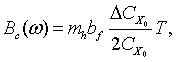 (2)
(2)
where  hours
fuel consumption;
hours
fuel consumption;  increment value of
resistance due to surface
defects.
increment value of
resistance due to surface
defects.
In order to reduce the amount of calculations
for comparing various design and
technological solutions, the
concept of costs per unit of
surface area ($/m2) is introduced [7]:
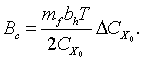
Taking into account the additional resistance for irregularities such as wave,
step, slit, etc., can be described by the following equation:
 (3)
(3)
where  drag coefficient of
isolated irregularities;
drag coefficient of
isolated irregularities; 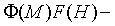 functions reflecting the influence of speed and altitude;
  maximum height of the surface that is equal to scale of error;
  the coordinate characteristic
parameter roughness (in m, for example, maximum amplitude of wave, a step, etc.);
the coordinate characteristic
parameter roughness (in m, for example, maximum amplitude of wave, a step, etc.);  relative area
occupied by roughness of investigated;
relative area
occupied by roughness of investigated;  the exponents.
According to the equations (2) and (3):
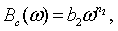 (4)
(4)
where 
Thus the additional cycle costs are defined by basic parameters of UAV and conditions of its exploitation. Expenses
of manufacturing, in general, depend on pre-production method adopted; level of the cost of one hour defined by accepted methods and means. In general, this set of
determines the technological solutions
which used to implement the some
set design solutions.
Establishment of functional relation between cost of production and size of the construction errors are self-task. The present paper
considers only the final results to
principal design solutions. Proceeding
from the results of statistical analysis, manufacturing
costs may be given as:
 (5)
(5)
These equations (1), (4) and (5) allow establishing
a quantitative correlation
between the described forms factors, i.e. to present the process of choice of tolerances as mathematical models.
Presented
equations (1), (4) and (5) enable us to establish the quantitative relationship
between the described form factors and define the process of selecting
tolerances as a mathematical model (Fig. 1) [8].
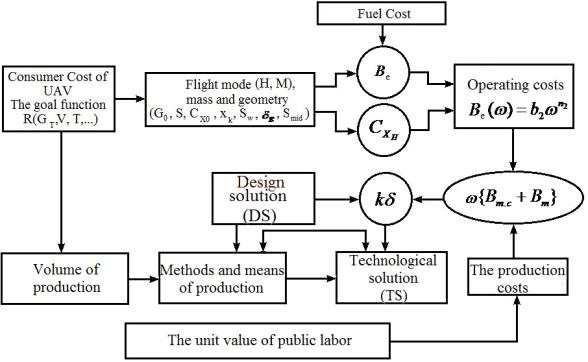
Fig. 1. The
structure of the mathematical models of choice the tolerance on the external
contours
In
general this MM should be supplemented by description of effects of external
factors  on the goal function,
represented in the form of fuel prices, the unit cost of labor, etc. [9]. The
optimal value of tolerance according to accepted criteria given by the equation
[10]:
on the goal function,
represented in the form of fuel prices, the unit cost of labor, etc. [9]. The
optimal value of tolerance according to accepted criteria given by the equation
[10]:
 (6)
(6)
using which one can
find an estimate of each factor relative to the base value, i.e.
 (7)
(7)
The equation
(7) allows recalculating the tolerance when you change the flight modes, design
and technology implementations and external conditions. For example, the
service life changes is determined by the ratio  [7,9]. Then for
  a close tolerance as
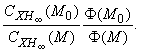
  is needed. Influence of the
speed estimated by the flight ratio [1]:
is needed. Influence of the
speed estimated by the flight ratio [1]:
 (9)
(9)
In the case
of monotonic change incoming parameters  required for the tolerance with
toughening of the rising of
required for the tolerance with
toughening of the rising of  For the solution problems of
choosing the tolerance (especially in the case of iterate options), for
example, more than 30 and the various flight conditions we can use the
algorithm and program of calculation developed by the authors based on the
proposed mathematical model.
For the solution problems of
choosing the tolerance (especially in the case of iterate options), for
example, more than 30 and the various flight conditions we can use the
algorithm and program of calculation developed by the authors based on the
proposed mathematical model.
4. Construction of an algorithm determining the
optimal tolerance for the design of UAV. The procedure of determination
the optimal tolerance by  for a particular design solution must be performed in solving tasks
enumerated in the previous section.
for a particular design solution must be performed in solving tasks
enumerated in the previous section.
In
order to prepare the information and as a basis for the calculation must be
taken of (2) and (3) that characterize the influence of various factors on the
operating costs, and the equations describing the effect of structural and
technological factors (STF) (5). The final result of the calculation should be
formed as an array of data elements of optimal tolerances for different STF as
a result of the solution of (6) [7].
The sequence of calculations
1. Determine the typical
design solutions, the area of their placement on UAV  coordinates
2. Find the possible
technological implementations and parameters  and
and  depending from expenses for
manufacturing tolerances.
depending from expenses for
manufacturing tolerances.
3. Find the specific
geometrical parameters of roughness  or
or  in the case waviness – the allowable
wavelength [1].
in the case waviness – the allowable
wavelength [1].
4. Determine normative
data depending on the type of UAV and flight mode:  and compute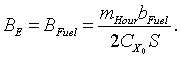
5. For the researched define
species roughness coefficient  which takes into account the
probabilistic nature of value
which takes into account the
probabilistic nature of value 
6. Calculate
parameters  and
and  For obtain the waviness
 For the remaining unevenness


7.
Compute the 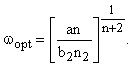
8. Check the
possibility of realization 
9. Compute the
quantities of losses or effect compared with the analogue as the difference
between the above costs, i.e. 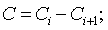

Conclusion. The analysis of appointment of
admissions on external surfaces of units UAV, practice of their appointment and
realization in manufacture allow drawing following conclusions:
1. Practically UAV in
one interval of numbers admissions on performance of geometrical elements of an external
surface are identical to all and decrease with growth
admissions on performance of geometrical elements of an external
surface are identical to all and decrease with growth  The highest requirements to quality of an
external surface are shown to a wing, as to the unit creating carrying force.
The highest requirements to quality of an
external surface are shown to a wing, as to the unit creating carrying force.
2. Experimental
researches of the isolated roughness are put in a basis of calculation of
resistance from roughness’s taking into account its site in the boundary layer.
The roughness height is defined by admissible size of additional resistance . Practical technique to an establishment of dependences and functional
communications between values of admissions and expenses by the generalized
criterion and consequently, and to a choice of economically optimum admissions,
still it is not defined unequivocally. Therefore for the generalized criterion
accept additional fuel consumption because of resistance of roughnesses, as
influence of additional resistance on speed almost slightly.
. Practical technique to an establishment of dependences and functional
communications between values of admissions and expenses by the generalized
criterion and consequently, and to a choice of economically optimum admissions,
still it is not defined unequivocally. Therefore for the generalized criterion
accept additional fuel consumption because of resistance of roughnesses, as
influence of additional resistance on speed almost slightly.
3.
Thus, the additional life-cycle costs
are determined by the basic parameters
of UAV and conditions of its
exploitation. Production costs in
general depend from method
adopted pre-production, the level
of cost per hour,
determined by conventional methods and
means.
4.
These dependences allow presenting
the process of choosing the tolerances
as a mathematical model and build the
algorithm and applied computer program.
References
1.
Негреба В.А., Фирсов В.А., Бобрыкин Ю.А. Технологические основы
проектирования конструкций самолетов. – М.: МАИ, 1986. – 43 с.
2. Краснов Н.Ф., Захарченко
В.Ф., Кошевой В.Н. Основы аэродинамического расчета. Трение и теплопередача.
Управление обтеканием летательных аппаратов / Под ред. Проф. Н.Ф. Краснова:
Учебное пособие для студентов втузов. – М.: Высш. шк., 1984. – 264 с.
3. Мероприятия зарубежных
авиакомпаний по экономии топлива / Техническая информация ЦАГИ, 1981. – № 9. –
С. 30-32.
4.
Вигдорчик С.А. Технологические основы проектирования и конструирования
самолетов. Часть 1. – М.: МАИ, 1974. – 140 с.
5.
Бобрыкин Ю.А., Негреба В.А. Выбор технологических решений сборочного
производства с использованием ЭВМ. – Харьков: Изд. ХАИ,
1980.- 64 с.
6.
Denis A. Coehlo, Filipe A.A. Corde. Technology
as a determinant of object shape. In book: Industrial design – new frontiers;
edited by Denis A. Coehlo. Crotia, 2011, pp. 15-32.
7.
Nickolay Zosimovych, Singla R.K. The analysis of tolerances criteria to UAV external
surfaces // “Современные проблемы и пути их решения в науке, транспорте,
производстве и образовании”. Сборник научных трудов SWorld по материалам международной научно-практической
конференции/ Выпуск 4, Том 6. Одесса:
Черноморье. – 2011. – С. 26-35.
8.
Nickolay Zosimovych. The basic directions of improvement of quality the
UAV external surfaces. Materiały VII Międzynarodowej Naukowi-Practycznej Konferencji, 07-15 października 2011 roku. Przemyśl: Nauka I studia. – Vol. 16 Techniczne nauki. – 2011. Pp. 82-89.
9.
Zosimovych N.V., Singla R.K. Influence of factors determines the value
of tolerance on the outboard side unmanned aerial vehicles. Авиационно-космическая техника и технология, Харьков: ХАИ, № 3/90, 2012. – С. 37-46.
10.
Проблемы строительной механики и прочности ЛА: Тем. сборник науч. тр. /
МАИ. – М.: МАИ, 1990. – 72 с.