EFFECT OF LOCAL COOLING IN HOT CLIMATIC ZONE
Geda S.M, Torshin
V.I. Severin A.E. Mensur H.
Department of
Normal Physiology, PFUR. Moscow, 117198, M-Maklaya st. 8, Medical faculty.
Abstract
The present work focuses on the impact of local cooling on the skin and
core temperature of the body. 32 subjects, from Gondar (Ethiopia), participated.
The wrist and axillary temperature was measured before, during and after immersion of fingers
in ice water. This study revealed that, the presence of gender
and individual variations of thermoregulations.
Keywords: core
temperature, skin temperature, local cooling,
It is known that due to local
cooling, the temperature of the skin decreases, for preservation of the core temperature
of the body at constant level. However, it is not clear, how this reaction is
expressed in inhabitants of a hot climatic zone.
The purpose of the present study was
to investigate the reaction of an organism of inhabitants of a hot climatic
zone (Ethiopia) to the action of local cooling.
This study was conducted among
students and young teachers of Gondar University from August 28 to September
14, 2012 (one of the coldest periods of the year) in Gondar. Gondar is located
on the North Western part of Ethiopia, at 12°36′N
37°28′E
in the globe. It has an
altitude of around 2,133m above sea level and average temperature ranging from
12 to 29oC.
The experiments were performed in
physiology laboratory room of Medical College of Gondar University, where the
room average atmospheric pressure, moisture and
temperature during the experimental session was maintained at 596mmHg, 60.1% and 20.6oC ± 1.5oC., respectively.
Thirty two volunteers, 25 males and 7 females, students and young
teachers with the age of 23.4 ±3 years were included in this study.
Materials: Laboratory Thermometer and Pen Digital Thermometer,
Kidney dish (water bath).
Local cooling, realized by
immersing, four fingers of the right hand in ice water. The water temperature that kept in the kidney dish
(water bath) was
maintained at 0 to +40C.
Temperature measurements took place before,
during cooling and at intervals of time (1st, 3rd, 5th,
7th, 10th and 15th minutes) after ceasing of
local cooling.
Ahead of initiation of
the hand cooling test, thermometers were attached to the right hand and inserted
to the left armpit.
Recording was initiated during the
pre-immersion period. Each subject then immersed four
fingers of the right hand in the water for 1 min. and recording continued
during the immersion and post-immersion period.
We measured the temperature of the skin from the wrist of the right hand and the core temperature from axillary of the left
hand.
Core temperature
was measured using a pen digital thermometer and the skin temperature of the Wright
hand was measured using laboratory thermometer.
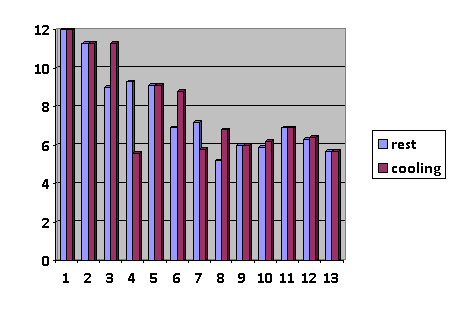
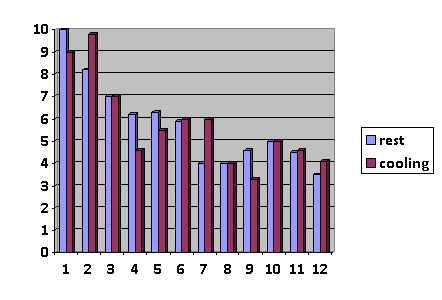
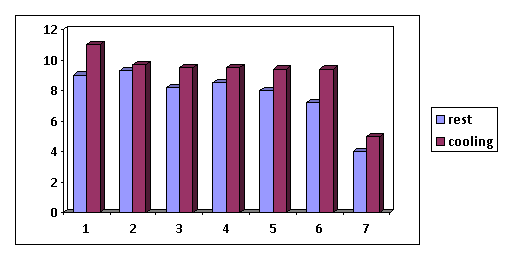
The cross-section
gradient of temperature at rest and cooling, (the difference between axillary and wrist temperature), shows that the
presence of gender and individual variations of thermoregulations (Pic.1, Pic.2
and Pic.3).
It is revealed that
in women the cross section gradient of
temperature at rest and
cooling is increased; but in men (age ≥ 25 years) decreased. Also a mild
increasing observed in young men (age ≤ 24 years).
The analysis
indicates, under identical
local action of cold stress, in women observed more drop of the temperature of the
skin in comparison with men of both groups.
Pic.1. Cross-section
gradient of temperature at rest and cooling
Surveyed ( males ≤ 24 )
Pic.2. Cross-section gradient of temperature in 1
Surveyed (males ≥ 25 )
Pic.3. Cross-section gradient of temperature at rest and cooling
Surveyed (females)