Kulakova L.S.- The
supervisor, Associate Professor,
Aisina R.A.–The
Master of the 1st year of study
Kostanai State University
named after A.Baitursynov Kostanai,
Kazakhstan
THE USE OF CHEMOTHERAPY
IN MALIGNANT TUMORS OF THE DOG BREAST
On the incidence of tumors,
carnivores are in the first place among pets. More over, breast tumors are leading among them.
Mammary tumors indogsranged from25% to 41% of all malignancies[1,2,3]. They occur, usually
in the second half of their lives when the animal is still fully operational and retains its reproductive quality[4].
Breast cancer-severe
progressiveand of tenirre versible form of pathology [5].
Approximately
50% of tumors are malignant. In the scientific and
industrial veterinary
clinic KSU named after A. Baitursynov for 2003-2009 atoutpatient
clinic 637 dogs with tumor pathology were examined, of which 312 dogswith tumors ofthe mammary glands,which is 49% [Figure 1].
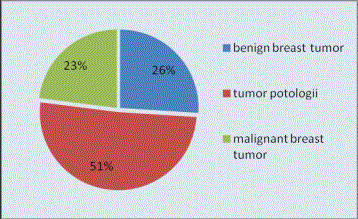
Picture1. Percentage of diseases with tumor pathology
Current state
veterinary oncology suggests that there are real opportunities to achieve
stable improvement of the patient or animal duration of remission in the
majority of cancer patients animals provided modern detection of malignant
tumors, as well as using the correct diagnostic and treatment
strategy [6].
An important fact is that dogs and cats on
certain aspects of life are closest to man, and that means clinical manifestations of the basic laws of the
tumor process in humans and these animals are much more characterized by
similarity [7].
Tactics and strategy in the
treatment of cancer in each case is determined by many factors: age of the
animal, aggressive neoplasm existing animal comorbidities, presence of
metastases.
In
veterinary practice, surgical excision has long been regarded as the sole
method of treatment of individual
tumors, both because of its
effectiveness, at least temporarily, and the limited use of other methods of
treatment. Thus, the surgical technique is the cornerstone
in the treatment of cancers and is likely to remain so in the future. But
incorrect surgery orhighmalignancy tumors there is a possibility for regrowth
(recurrence) in removing the tumor, or near, the more aggressive version [8].
Chemotherapy is indicated for
thetreatment of non-solid, i.e. not individual tumors without specific
localization (f.e. haemolymphatic) and some solid malignant tumors. It is
increasingly being used in practice due to the convenience and the cheapening of
the agents used, relief conditions of
hospitalization, as well as in connection with already accumulated
experience of using chemotherapy drugs.
In veterinary practicea
large number of chemotherapy
drugs are used, usually adapted from medical practice, which increases the life expectancy of cancer patients and reduces the chance of recurrence are moved tumors.Chemotherapy should not be considered as the
last means of treatment. Treatment of the disease in its early stages can
guarantee animal life without suffering for a long period of time [9].
Modern cytostatics presented the following drugs ( doxorubicin,
fluorouracil, hydroxyurea , cyclophosphamide ) . Cytotoxic drugs group of
anticancer drugs that cause necrosis of cancer cells. When necrosis damaged
shell, the core and other components of
the cell that leads to its death.
The
main direction of application of cytostatics - therapy of malignant neoplasms.
The most sensitive to the cytostatic effects of the rapidly dividing cells,
especially malignant tumor cells. This determines the basic use of cytostatics
in human and veterinary medicine - treatment of cancer, leukemia, lymphoma,
monoclonal gammopathy, and other malignancies [9].
Expediency
of their application and the amount of increase in life expectancy is discussed, so the development of approaches to improving there sults of
surgical treatment and
prolong the life
of animals through
effective systems and sparing chemotherapy, adapted from actual medical practice.
Analyzing these data, we can say that the incidence of breast cancer is 49%. Adaptings chemescytostatico factual medical practice, and that was the aim of our further research.
The
list of used literature:
1. Ponomarkov
VI Tumor / / Pr. : Diseases of dogs. M. Agropromizdat . - 1990 . - P.211 -228 .
2. Brodey R.S., Goldschmidt M.H., Roszel J.R. Canine mammary
gland neoplasms / / J. Amer.Animal Hospital Assoc. -1983. - V.19. - P.61- 90 .
3. Hellmen E. Mammary tumours in the female dog. A study of tumourhistogenesis and DNA ploidy in
relation to histology, prognosis and tumour progression.Dept.Pathol. Faculty of
Vet. Med. Swedish Univ. Agricult. Sci. Uppsala, 1989 .
4. Suhovolskiy O.K. Comprehensive treatment of tumors of the
breast and skin of dogs Avtoreferat doctoral dissertation .SPb , 2002 . -28 S.
5. Belov A.D. Dog
Diseases / A.D.Belov , E.P.Danilov, and others I.I.Dukur Moscow: Kolos , 1992 .
- S. 211-228 .
6. Baranov C.B. Diagnosis of tumors in dogs / /
Veterinariya. -1991.-No.6.- p.66 -68 .
7. Verevkina TS, NN Zubov Materials statistics tumors of dogs
and cats / / Proceedings of the USSR Academy of Medical Sciences . Problems of
Oncology, 1952 . - S. 1517 .8. http://www.zooproblem.net
9. http://ru.wikipedia.org/wiki/Anticancer drugs