“Педагогические науки”/
1.Дистанционное образование.
Shylenko R. V,
Sosenko L.V., Shylenko D.R.
Нigher medical
educational institution of Ukraine "Ukrainian medical stomatological
academy", Specialized secondary school No. 3
with deep study of the English language.
Prospects of inculcation
of innovative tutorials at different stages of education.
Educational activity is
characterised by the following structure: the
purpose, the subject maintenance,
means or means. The subject maintenance of educational activity is: mastering of knowledge,
mastering by the generalised ways of actions, working out the methods and
means, their programs, algorithms. Mastering - the central link of
educational activity. It is a phase intellectual process of preservation and reproduction. In its structure
there allocate such stages:
·
Formation of the relation to a teaching material;
·
Process of acquaintance which provides reception of
the information and interpretation of its value;
·
Active study of value;
·
Inclusion of a new material in available system of
knowledge;
·
Storing and preservation of an acquired material;
·
Application of the received knowledge, skills.
It is necessary to notice, that the above standard
modus of educational process provides close integration of the majority of
stages one in one and their correlation at different stages of training.
Working off of the received knowledge in practice, no less than formation of
special skills, according to the given concept, is provided only at a final
stage as their development depends first of all on the pupil, but from the
teacher: «It is possible to learn, but it
is impossible to teach».
The given concept should stimulate teachers to search new intensive
methods of training: perfection of the control of knowledge,
preparations of the educational-methodical documentation which includes working
out of methodical recommendations, grants, educational-methodical workings out,
complex programs for self-checking, practical works, symphosiums and scientific
conferences, lecture halls of a different sort.
It is the transfer of
knowledge by means of direct dialogue with an audience – lecture, that allows
in extremely clear and in the accessible form to inform the listener the
teaching material. At this stage especially important is the development
of interest at the pupil to the stated
material. The following can help:
·
Personal characteristics of the lecturer: its status,
publicity, charisma, the general popularity;
·
Availability of the statement of the material,
demonstration;
·
Understanding of possibility of fast application of
the received knowledge in practice.
Hence, the creation of programs of training of leaders
providing attraction (in those or other disciplines) lecturers
from foreign and domestic profile educational institutions, carrying out of
educational seminars and on-line conferences with leading
educational institutions of Ukraine and the countries of near and far abroad is
the realised necessity of modern education.
Inculcation of the given concept should be integrated
into all srages: school (secondary education), HIGH SCHOOL (higher education),
postgraduate higher school. Close correlation of teachers allowing to formulate
uniform modus of a question at different stages gives the chance to formulate
at the pupil its accurate representation, and easily to interpret the received
knowledge and abilities to the practical purposes and problems that creates
preconditions of the fullest disclosing and realisation of human potential.
Authors of the given work offer the scheme of interaction
of the educational centres at various stages of education allowing to integrate
them one into another and to create the continuous, accurate scheme of
preparation of qualified personnel.
The scheme consists of 4 stages (see the Scheme 1).
The scheme 1. Formation
structure
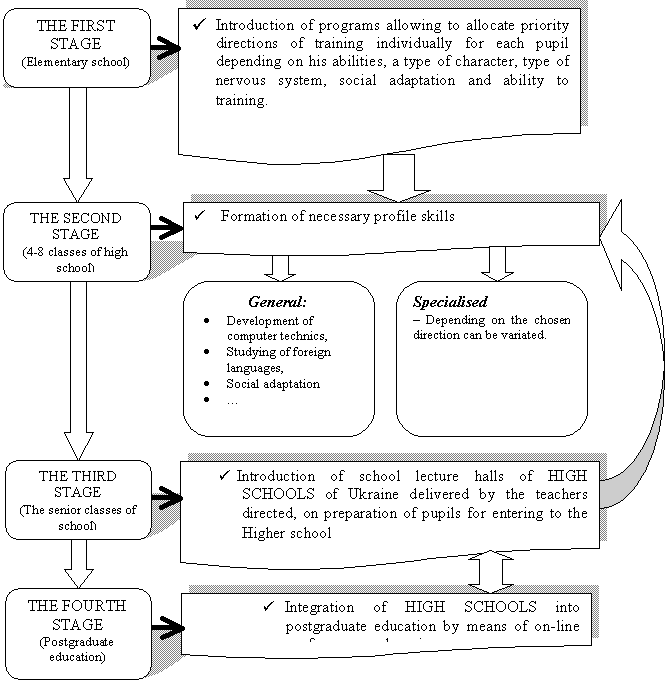

At the first
stage (elementary school) – it is necessary to inculcate introduction
the programs allowing to distinguish the priority directions of training
individually for each pupil depending on his abilities, a type of character,
type of nervous system, social adaptation and ability to training.
Now, it is offered the variety of tests, game
trainings and systems allowing to come to the conclusion on the abilities of
the pupil. They are widely presented in the literature [1,2,3] and do not
demand additional analysis and correction.
The second stage (4-8
classes of high school) is directed on formation of necessary profile (by
results of testing at the first stage) skills which will be required at the
subsequent stages of education.
They can be divided on:
Ø General – necessary in any branch of knowledge, as
mastering computer technics, studying foreign languages, social adaptation
etc., and
Ø Specialised – necessary for training continuation at the later
stages of education (at higher school) depending on the chosen direction and
specificity.
The list of specialised skills should be formed on the
basis of recommendations of methodologists of HIGH SCHOOLS and is modified on
terms depending on volume and complexity.
The third stage (senior
classes of school) – provides introduction of school lecture halls carried out
by the teachers of HIGH SCHOOLS of Ukraine on training of pupils for entering
the Higher school.
The third stage urged to replace existing system of
preparation for entering the HIGH SCHOOL. Preliminary courses owing to low
level of correlation with high school are not capable in sufficient measure to
prepare the entrant for entering as in many respects duplicated program of
training is not capable to place priority accents lumbering the swollen
curriculum.
The basic problem for introduction of the given stage
is the impossibility of appropriate division on groups of pupils depending on
the chosen HIGH SCHOOL and the direction of training at school. Besides,
frequently the HIGH SCHOOL and school in which he/she is trained are divided by
hundreds, and sometimes thousand kilometres. Besides, even within a city, in
the view of absence of
such big human resource high schools, which future graduates intend to enter,
are not able to provide all schools with lecturers. A modern communication
facility can help with the decision of the given problem - IP phone, Internet, Skype etc. Correctly thought over organisation on-line of lecture halls, with possibility
of direct bilateral dialogue distanced one from another audiences of the
pupils, separate pupils (joined to a lecture hall under own initiative) and the
lecture will allow to economized means (on moving, residing, transportation of
the lecturer) to capture as much as possible wide audience, it is as much as
possible capacious, evidently and clear to inform a teaching material according
to requirements presented by the higher school.
For introduction of the third stage we initiate
creation of the pilot project on introduction of the given innovative scheme of
training. Negotiations with methodologists of schools of the city of Poltava,
representatives of HIGH SCHOOLS of the city are carried on, there has begun the
formation of necessary material base.
The final, fourth stage provides close integration of HIGH SCHOOLS into
postgraduate education formation by means of on-line conferences and seminars. Introduction of the fourth stage
of the given scheme has found the reflexion in stomatology - in particular
introduction of programs OCIRS (the Open,
Continuous Internally-remote Seminar) in Russia
and CRTDS (Continuous Remote Training of
Doctors-stomatologists) in Ukraine [4, 5].
Experience of
introduction of these programs has shown, that the concept of remote training
allows to unite by means
of bilateral broadband communication two distanced one from other audience in
uniform educational society, that in turn gives the chance to the lecturer to
trace reactions of
audiences, to separate the basic
differences of reactions, that accordingly gives the chance to concentrate
attention to the most interesting and pressing questions and to introduce
corrective amendments in the maintenance of formation and training methods,
doing them
approached to the person.
Thus, for successful
introduction of the given program expedient:
·
To heads of schools, lycées, grammar schools to
begin the organisation of introduction of the first and second stages of the program; to allocate
profile directions of training, to focus attention in the course of training on
formation of the
generally necessary skills for the further training in the conditions of the
accepted program;
·
Methodologists and the heads of educational
institutions of all levels should carry on negotiations concerning introduction
of interactive lecture halls in educational process;
·
To initiate creation of the metodico-organizational
centres which will be engaged in management of information streams between
educational institutions of different levels and integration of their programs
for the purpose of creation of the unified knowledge base.
Literature:
1.
Амонашвили Ш. А. Воспитательная и
образовательная функции оценки учения школьников:
Экспериментально-педагогическое исследование. - М.: Педагогика, 1984. - 297 с
2.
Большаков В. Ю. Психотренинг:
Социодинамика. Упражнения. Игры. СПб.: "Социально-психологический
центр", 1996. – 380 с.
3. Григорьева
Е.А. Метод оценивания //Проблемы отбора и профессиональной подготовки
специалиста в вузах. Л.: ЛГУ, 1970, С. 62-85.
4. Леонтьев В.К., Прокушев В.Ю., Давыдов Б.Н.,
Бочковский И.С. Дистанционное обучение: как усовершенствовать постдиплом в
стоматологии // Клиническая
стоматология в Украине. – 2010. - № 4(6). - С. 68-69
5. Скрипников П.Н., Шиленко Д.Р. Внедрение программы Непрерывного Дистанционного
Обучения Врачей-Стоматологов в последипломное образование в Украине. // Клиническая стоматология в Украине. –
2010. - № 4(6). - С. 70- 73