Agriculture 4.
Technologies of storage and processing of agricultural products
Assoc. Prof. V.Yu. Ovsyannikov, graduate Ya.I. Kondrateva,
graduate student Yu.S. Kraminova. student T.S. Kirichenko
Voronezh State
University of Engineering Technologies, Russia
Method of techno - economic analysis of the
concentration of
low-temperature systems for liquid media
Techno – economic analysis of the plant operations low-concentration
liquid media by freezing is performed, as a rule, with the following goals [1,
2]:
a) to compare the concentrating installation of various types;
b) determine the optimum temperature concentration;
c) to determine the optimal speed of the refrigerant or brine.
The criterion for selecting the optimal operation mode of concentrating
the installation and comparison of the concentrating units between themselves
is part of the annual cost of the refrigeration unit (P), which refers to the
crystallizer and is variable. Such operating costs, such as salaries of staff,
heating and lighting plant, depreciation and repairs, overheads and other, are
not taken into account because they are not in this case constant and do not
depend on the mode of operation of concentrating the installation [3, 4].
Write the General equation for the reduced annual costs as follows:
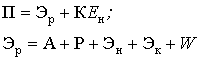 (1)
(1)
where Эр – operating
costs; К – capital costs; Eн – regulatory
efficiency ratio; А – depreciation expense equipment;
Р – the repair costs of the equipment; Эн and Эк – the
cost of electrical energy for driving the pump, the feed product concentration
and compressor refrigeration unit; W
– the cost of cooling water in
the condenser cooling water refrigeration unit.
Depreciation expense equipment А, р. consist
of the following components
 (2)
(2)
where Кк – the
cost of the mold – installation freeze concentration with installation and
average transport costs, р.; Кха – the cost of the refrigerant or cooling medium charged into
the cooling system, р.; Киз, Кн, Кк – с the price of thermal
insulation installation freeze concentration, feed pump and compressor
refrigeration unit, R.; τ – the lifetime of
the equipment, р.
The cost of the
refrigerant or coolant, filled into the mold, is calculated by the following
formula,
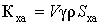 , (3)
, (3)
where V – the volume of
the corresponding part of the evaporator crystallizer – freeze concentration
installation, м3; γ – coefficient the filling volume of the liquid; ρ– the density of the liquid refrigerant or coolant,
kg/m3; Sха – the cost of the
refrigerant or coolant, p./kg.
It should be
appreciated that the cost of the refrigerant can reach a significant proportion
of the total installation cost.
The cost of thermal
insulation mold Киз, р., must be taken into account only in the calculation
of the mold - vymorazhivatelya formula
 (4)
(4)
where Fн.о – the total surface of the outer fence of the chiller
plant, m2; δиз – the thickness of
the insulation, m2; Sиз – the cost of shielding, p./m3.
This should take into account that the thickness of the thermal
insulation layer, determined by calculation should exclude condensation of
moisture from the air on its outer surface.
The costs of the
feed pump Кн, р. can be calculated from equation
 (5)
(5)
where bн – value of the
pump drive, referred to 1 kW power it, r./kW; Nн – of the pump
power expended on overcoming the hydraulic resistance (Δp) in the
crystallizer kW.
When using the intermediate brine component of the pump power required
to overcome the hydraulic resistance of the mold may be found by the formula
 (6)
(6)
where V – the pump
capacity, m3/s; Δp – flow resistance of the mold, Pa; η – efficiency feed pump and the motor.
The cost of the
compressor Кк, р it should also be attributed to the variable part of
the above annual costs. To implement the various temperature modes require
different sizes of compressors. However, this effect is small and the effect of
changes in the depreciation cost of the compressor can be neglected [4-6].
Expenses for the
repair of equipment Р, р. it can be estimated as a fraction of its value
 , (7)
, (7)
here p – percentage of the value of a piece of equipment for its repair.
The cost of power
consumed in the pump to the initial flow of the medium through the apparatus,
can be calculated using the following formula:
 (8)
(8)
where Sэ - the cost
of electricity p./kW·h.; Nн – power consumed in the pump, kW; τ – number of operating hours per year concentrator
installation.
Power consumed by
the refrigeration compressor will change when the mode of the concentrating
plant. With the constant changes in the useful cooling heat transfer rate it
will be linked to a change in the temperature difference between the
refrigerant and the medium to be concentrated.
At constant average
temperature of the medium entering the concentration, the temperature
difference between the refrigerant and be concentrated medium depends on
temperature changes of boiling and condensation of the refrigerant, determine
the power consumed by the compressor.
Increasing the
thermal equivalent of work expended by the pump to move the medium to be
concentrated through the working chamber concentrating plant results in
increased cooling capacity of the compressor, i.e. to increase the power
absorbed by the compressor unit of useful cooling [7].
Operating the
annual energy costs for the compressor can be calculated by the formula
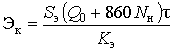 , (9)
, (9)
where Q0 – useful cooling capacity, kW; Kэ – specific cooling
capacity divided by the power consumed.
Consumption in the
cooling water for the condenser W, p.
/ year in general be expressed by the following equation
 , (10)
here Gω – water flow through the condenser, m3/h;
β – the ratio of the amount of
fresh water to the circulated (considering evaporation spraying and purging); Sω – , the cost of
water, p / m3.
Literature
1. Pap
L. Freeze concentration. Translation. with Hungarian, edited by O.G. Komyakova.
- M.: Light and Food Industry, 1982. - 97 p.
2.
Plotnikov, V.T., Filatkin, V.N. Dividing the chiller plant. M .:
Agro-publishing, 1987. - 352 p..
3. Antipov S.T., Ovsyannikov V.Yu., Ryazanov A.N., Yashhenko S.M. Development
of the model of analysis and forecast of the fundamental characteristics of the
process of cryoconcentration. Storage and processing agricultural. 2001. № 4.
pp. 36-38.
4.
Ovsyannikov V.Yu. Study of the process of freezing moisture from the extracts
of the endocrine and special raw material. Diss. cand. tech. the sciences.
Voronezh. State. tech. Acad., 2003. 184 p.
5.
Antipov S.T., Ovsyannikov V.Yu., Kondratyev Ya.I. Kinetics of the process of
concentration by freezing the cherry juice. Herald of the Voronezh state
university of the engineering technologies. 2014, № 4 pp. 44-48.
6. Ovsyannikov
V.Yu. Optimal modes freeze plasma concentration. Meat Industry. 2012. № 1. 65-68
p.
7. Antipov S.T.,
Dobromirov V.E., Ovsyannikov V.Yu. Heat- and mass exchange with the
concentration of liquid media by freezing. Voronezh. State. tech. Acad.
Voronezh, 2004. 208 p.