Karachun V.V.
National Technical
University of Ukraine “KPI”
FOCUSING
ENERGY OF AN ULTRASONIC BEAM IN GYRO
Focusing energy of an ultrasnic beam in gyro. We will show some original aspects of arising energy focusing of penetrating acoustic radiation. Let’s consider an average former (Fig. 1).
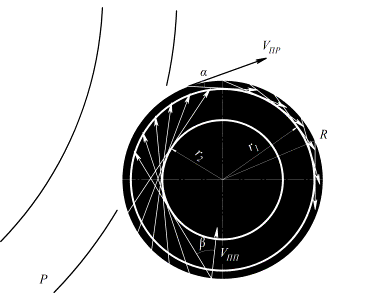
Fig.
1. Focusing energy of acoustic radiation
Suppose that the float is missing. A sound wave Р, which is falling from outside
on the ARS body, generates in the material circular (along the former circle) oscillations  , which extend in a parallel direction with velocity
  , i.e, along the lateral surface of the shell, and also bending (radial) oscillations
  in the plane of the former at velocity
  .
.
First
of all, let
us find out the mechanism of circular waves. Taking the lateral surface of the ARS body as a shell of a sufficiently large wave
size,
let’s
consider any separate element of the inner surface of the former as a plate of zero curvature, where the velocity of longitudinal
waves coincides with the circular velocity  of the shell.
If the
velocity of longitudinal waves  is greater than the sound speed
  in liquid, ie,
 ,
,
Then the wave traveling along the parallel will radiare a sound wave in liquid,
and the direction of its
propagation together with the vector velocity  will constitute
theangle
will constitute
theangle  , which is calculated by the formula (Fig. 1):
 .
.
As a result,
much of the sound wave energy will be focused around a circle of radius  (Fig. 1)
 .
.
For example,
if we take the radius of the inner cavity of the ARS body as  , take
aluminum alloy as
material (
, take
aluminum alloy as
material ( ,
, 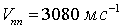 ), a liquid-and-static gimble - of glycerol (
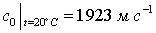 ),and the frequency of the ultrasnic beam f=42 кГц, then the wave size will
be 3,43.
),and the frequency of the ultrasnic beam f=42 кГц, then the wave size will
be 3,43.
It is not difficult to calculate the radius of the
caustic surface (Fig. 1) –
 .
.
It is clear that if  , the angle
  and the wave travelling along the parallel will radiate a sound wave (that crosses the axis of the device here) in liquid. Thus, aberration will disappear and the caustic surface turned to
the
geometric
locus of points of energy concentration that are located on the ARS axis. Similarly, if
and the wave travelling along the parallel will radiate a sound wave (that crosses the axis of the device here) in liquid. Thus, aberration will disappear and the caustic surface turned to
the
geometric
locus of points of energy concentration that are located on the ARS axis. Similarly, if  , then
  and the caustic surface is not
formed by a
bending wave. It is interesting to estimate the temperature impact on the degree of concentration of in a liquid-and-static part. The sound speed of in liquid at the temperature changes is calculated by the formula -
and the caustic surface is not
formed by a
bending wave. It is interesting to estimate the temperature impact on the degree of concentration of in a liquid-and-static part. The sound speed of in liquid at the temperature changes is calculated by the formula -
 .
.
For glycerol 
 . So when
  , the sound speed
in liquid-and-static
gimbal is
reduced to 1851
, the sound speed
in liquid-and-static
gimbal is
reduced to 1851  . On the contrary at the same time at
  the sound speed is increasing to
  . The manufacturer warrants a
continuous
operation at
. The manufacturer warrants a
continuous
operation at  within 7 minutes.
That is the sound speed in liquid equals
within 7 minutes.
That is the sound speed in liquid equals  . It follows thence that stable temperature creates conditions for a
process of "zone kaustikos"
and thus influences the ARS error in flight.
. It follows thence that stable temperature creates conditions for a
process of "zone kaustikos"
and thus influences the ARS error in flight.
For this reason, the transversal wave will result in energy concentration around the circular cylinder of
radius:
 .
.
Radius of the float equals  , so it is obvious that the caustic surface of radius
  disappears and the radius surface
  – will be left.
Caustic surfaces of
radius  and
and  clearly separate the areas of acoustic shadow in liquid.
Of course, when choosing a material for the body and liquid, we can affect the features of caustic areas to make them
discrete-continuous.
If we use the beam
acoustic
methods, one can classify this phenomenon as a kind of aberration (from the Greek aberration - a deviation from the
normal) sound waves. As we know, in aberration-free structures a caustic surface rotates around the axis,
and
therefore, in our example it will be located on the axis of
the body.