Mel’nick V.N.
National
Technical University of Ukraine “KPI”
APPROXIMEE DESIGN MODEL OF THE
SHELL OF THE ДУСУ GYRODEVICE
We will
analyze the impact of radial waves (in the former’s plate) of the shell of the
body of the ДУСУ gyrodevice of angle rate and the extending (parallel or
circular) springing waves, which appear at the impact of outer acoustic
radiation of a supersonic flight. The radial wave, generated in the ДУСУ body
and the wave, travelling along the parallel, will radiate sound waves in the liquid-and-stable
part of the float gimbal. At the wave coincidence they will be the reason of
formation of energy active zones (kausticos
zones) in liquid.
We will
build an approximee design model due to a large wave size  , which simplifies the initial factors in the analytical
structure of the phenomenon, replacing
the shell by a discrete-continuous complex of thin plates of zero curvature,
which radiate acoustic waves into liquid due to the bending motion
, which simplifies the initial factors in the analytical
structure of the phenomenon, replacing
the shell by a discrete-continuous complex of thin plates of zero curvature,
which radiate acoustic waves into liquid due to the bending motion  and stringing
oscillations
and stringing
oscillations  along the parallel
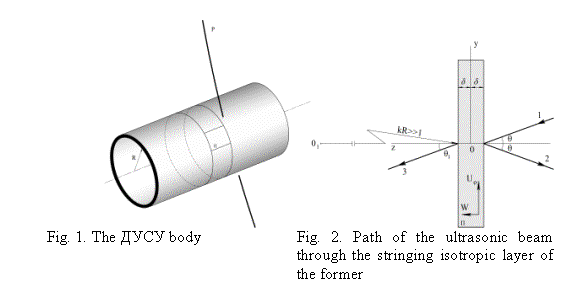
(Fig. 1). We begin with the study of the bending motion of the elementary
(flat) section of the inner surface of the shell.
along the parallel
(Fig. 1). We begin with the study of the bending motion of the elementary
(flat) section of the inner surface of the shell.
Radial (bending)
oscillations of the body surface at the action of ultrasonic radiation
The resulting condition of significant wave size of the body, i.e.
satisfaction of the ratio
 , (1)
, (1)
allows
consider any separate element of the body surface as a thin, stringing,
isotropic plate of a continuous length and thickness (Fig. 2).
We
assume that a flat sound wave "1" with the angle  falls on the plate.
The axis Ox is parallel to the
perturbation front. Let’s take pressure in the falling wave as
falls on the plate.
The axis Ox is parallel to the
perturbation front. Let’s take pressure in the falling wave as
 , (2)
, (2)
where  – a wave number of
the air environment outside the body;
– a wave number of
the air environment outside the body;  – pressure amplitude of the falling wave
"1". If we take the wave numbers of the front and shadow sides as equal,
then
– pressure amplitude of the falling wave
"1". If we take the wave numbers of the front and shadow sides as equal,
then  . If not, then you should use Snelius’s law:
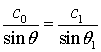 .
.
In our
case 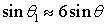 ;
;  .
.
The
pressure in the reflected "2" and passing "3" waves can be
written as –
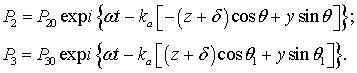 (3)
(3)
Apparently, there is a flat deformation of a layer in the plate towards  , because there is no third dimension х, (along this one the pressure is not changed).
It is known that oscillations of plates of hard materials in this case
are described by the equations of motion of thin plates in Lame form, but if the
length of the track of a falling wave is no less than six of plate thickness:
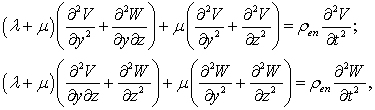 (4)
(4)
where  – stringing motions
towards axes
– stringing motions
towards axes  і
і  ;
;  – density of the
layer of material;
– density of the
layer of material;  – by Lame constants
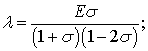
 ;
;
Е – Young's modulus;  – Poisson's ratio.
Acoustic pressure is written as the sum of symmetric  and antisymmetric
  components –


and find out the
ratio of their impact on forced oscillation of the plate "P".
Symmetrical components:

where 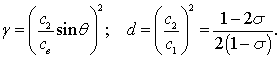
Antisymmetric component:
If we accept
quantities as small  і
і , then the function
  and
and 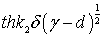 can be substituted by
the first two terms of the Taylor
row, i.e., –
can be substituted by
the first two terms of the Taylor
row, i.e., –
 This will simplify the expressions:
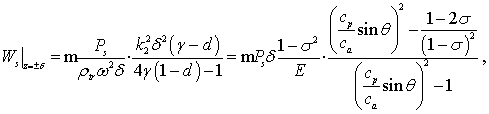 (5)
(5)
where 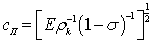 – the velocity of longitudinal
(circumferential in the body) waves in the plate "P" for symmetric
oscillations .
– the velocity of longitudinal
(circumferential in the body) waves in the plate "P" for symmetric
oscillations .
It is
the same at the antisymmetric load if you accept that  , we get –
 (6)
(6)
where  - cylindrical rigidity of the
plate "P";
- cylindrical rigidity of the
plate "P";  – specific weight.
The
formula (6) is a well-known expression of conformity of bending oscillations of
a thin plate.
Let us
determine the scope of application of (6) hard
and soft materials. A hard
material is such a material in which the velocity  circular (in formers) and
transversal
circular (in formers) and
transversal  are larger than the sound speed
  in the air. The ДУСУ body is
made of aluminum alloy, so let's assume it hard material, because for aluminum
in the air. The ДУСУ body is
made of aluminum alloy, so let's assume it hard material, because for aluminum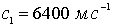 ,
, 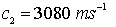 .
.
Researches
by Y.A. Nilender, E.S. Sorokin, Th.
Kristen, H.W. Muller et al. proved that the Young's modulus E of hard materials, measured in dynamic and
static modes, is not almost different in a wide frequency range. Therefore, it
can be assumed that the velocity values
 and
and  of wave propagation in circular direction
(along the parallel of the body) in the transversal plane does not depend on
frequency oscillations and they should be calculated by static measurements of Young's modulus and Poisson's ratio
of wave propagation in circular direction
(along the parallel of the body) in the transversal plane does not depend on
frequency oscillations and they should be calculated by static measurements of Young's modulus and Poisson's ratio .
.
Thus,
the oscillations of the obstacle made of a hard material under the action of a
falling wave can be described by the equations of motion of thin plates, if the
length of the track of a falling wave is no less than six times of the plate
thickness, i.e.
 .
.
Ratio
of losses in hard materials is very
small and can be considered as constant. Thus, for aluminum, the loss ratio at
frequency  is
is  , and in a construction is about zero.