Технические науки/13. Охрана
труда
M.Zharaspayev,
G.S.Bekturgаnova,
G.T.Ayapbergenova, N.Konysbay
Kazakh National Technical University named after K.I. Satpayev,
Republic of Kazakhstan.
An estimation of
intencivity magnitude of the dust spreading from disorganized sources
Abstract
In article intensity of
distribution of a dust in environment being allocated of unorganized sources of
pits is considered. For definition
использваны such indicators as the prtsentny maintenance of a dust on source
surfaces, speed of movement of a dust air stream and a dust content
indicator. The formula of determination
of radius of distribution of a dust is theoretically proved and given in
environment.
Key words: dust content, pit, intensity of allocation of a
dust, radius of distribution of a dust, environment.
The definition of the dust intensity which is left
from disorganized source in the environment is considered in this article.The airspeed
and essence of dustiness used for definition of a percentage of the dust on the
surface of the dust source. It is provided the formula that determines the radius
of dust extent in the environment.
The main cause of environment pollution by the dust of disorganized source
mining and smelting complexes is considered the blowing of a dust from the
surface of the dumps. Organizations are assumed the measures, such as the
establishment of the bounds of sanitary protection zones around the dumps, the
landing of hedgerows, supporting of labors by individual protective devices for
prevent the pollution of the environment and support of labor conditions at the
workplaces around the dumps. The high concentration of dust leads to specific
diseases of the respiratory system, skin, and having of the bacteria
may arise gastrointestinal, infectious and other
diseases. Dust of dumps can be spread over long distances causing of soil degradation
adjacent territory.
Ingress of dust to the air flow at the surface of
the source of dust release can be provided of a variety of physical phenomena.
Direct, diffuse and reflected solar radiation have an essential role among them,
as well as local arising potential difference on the surface due to charged
dust particles under the influence of these phenomena at the surface of the
source, even in calm weather formed a thin little layer of dust particles,
where the dust particles moving chaotically.
The process of blowing dust and its intensity depends on
many factors. Only some of the factors effecting to the process of dust release is included in the
calculations of many authors. Dust release is dependent on many factors thereby
it is advisable to use the methods of mathematical statistics. The dust air
flow occurs under the influence of the features storage dumps and atmospheric
phenomena at the source of pollution of the natural environment in which the
dust particles move irregularly. Therefore it is rationally to use the methods
of statistic physics for definition of the intensity of the dust release.
The intensity of the dust release source correspond a lot of dust particles
flying per time from unit of the area. The intensities of the dust release are measured in mg/m2с t.e mass of dust fliyng out
from the surface unit of the source in the time unit. The analogous quantities, such as the thermal radiation, the intensity of light, sound, radioactive
radiation is known in physics. These
quantities variable with distance due to the dissipation of energy is measured
in units of the transmitted energy of unit area to unit time source and are expressed
in J/m2,с.
From the
source of environment pollution assignable by substance is dust mass therefore
measuring of intensity release of the substances from dumps in mg/ m2с fully acquitted. Since the main
professional dust harmfulness is its weight and sizes. Therefore, the intensity
of dust release from the dump surfaces can be written as [1]:
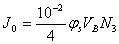 , (1)
, (1)
where J0 -
intensity of dust release, мг/м2с.; ™  - wight percent content of dust on the surface of dumps, %; VB –
accordingly mean value of modulus of the air speed, м/с; N3 - dustiness of atmosphere at the
dumps, мг/м3 .
- wight percent content of dust on the surface of dumps, %; VB –
accordingly mean value of modulus of the air speed, м/с; N3 - dustiness of atmosphere at the
dumps, мг/м3 .
Thus, the intensity of the dust release from the
dumps, characterizing by mass transport through the unit of area in unit time.
The decrease of intensity dust release
dJ with the distance is depend on
climatic conditions of dumps location area of mining and metals sector. Then
the change of intensity dust release with distance is described by differential
equation:
 , (2)
, (2)
where dJ – is the
change of intensity spreading of the dust at a distance dr from dumps of mining and metals sectors, мг/м2с.; J – primary intensity of
the dust spreading, releted to distance r; K- dispersion
coefficient of the dust influenced by climatic conditions of the dumps location
area, м-1.
It is possible to receive the formula of the
intensity distribution of dust, depending on the climatic conditions of the
area of dumps with a help of integrating expression (2)
 (3)
(3)
We have the following after
putting (1) to the (3)formula[1]:

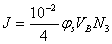
 , (4)
, (4)
Thus, any source of
environment pollution by the dust is characterized by intensity dust release and
intensity of a dust spreading. These sizes are measured in the same units, but absolutely
different in fact. Since, the surface area of a pollution source is considered
in the intensity dust release, and the surface area of environment, through
which to go the dust flow is considered in intensity of a spreading.
Dispersion
coefficient of a dust K should be determine from the expression [2]:
 , (5)
, (5)
where  =N2 –N1 – a dustiness change in the interval of
distance
=N2 –N1 – a dustiness change in the interval of
distance  , mg/m3;
  - the dustiness at a distance r1,
мг/м3; N2 - the dustiness at a distance r2 ,
mg/m3;
- the dustiness at a distance r1,
мг/м3; N2 - the dustiness at a distance r2 ,
mg/m3;  = r2 - r1 –the distance between points of
quartering in the environment, m. It is to be noted that N2 < N1
and therefore to take the dissipation coefficient K in modulus. It may be
concluded that the dissipation coefficient of a dust is a value characterizing
relative change of air dustiness from the distance.
= r2 - r1 –the distance between points of
quartering in the environment, m. It is to be noted that N2 < N1
and therefore to take the dissipation coefficient K in modulus. It may be
concluded that the dissipation coefficient of a dust is a value characterizing
relative change of air dustiness from the distance.
The received expression for determination of intensity
dust release from a source of air pollution by a dust allows to consider a
surface of a source and change of intensity dust release from distance which
decreases exponentially.
We carry out the solution of the integral equation (3)
concerning the radius of a vector г, for explonation
of border distance of sanitary
protection zones around an arrangement of dumps, as a result we will receive
[3]
 , (6)
, (6)
The received expressions allow to define area of
intensive pollution of working zones, and also to establish borders of sanitary
protection zones of the enterprise. The area of atmosphere pollution and
sanitary protection zone depends on dispersion of a dust and primary intensity
of a dust release from a source. The
settlement factor depends on dust dispersiveness, compound constitution, consistence
of the flour particles, as well as external factors.
It is possible to do the following conclusions as a
result of the analysis of dust release process from refuse dumps of mining and
metals sector:
- movement of fine silt at a surface of dumps
has disordered character which is caused by action of many factors, dominating
of which is the airspeed;
- the size of intensity of a dust release and
spreading is measured in system of СI kg/m2с. and characterizes
transfer stream of particles through unit of area in unit of time, that allows
to estimate a pollution of environment by a dust of dumps of mining and
metallurgical complexes;
- borders of sanitary protection zones are defined by size intensity of
dust release and spreading , which depend on physical and chemical properties
of a dust and atmospheric air of the dumps location area.
References
1
Innovation patent #11808 KZ. Way of determination of intensity of
allocation of a dust. Zharaspayev M., Nurgabylov U.Sh. Bayzakova A.A.;
15.08.2002. Bulletin-8. Committee on
rights of intellectual ownership of Justice Ministry of the Republic of
Kazakhstan.
2
Innovation patent #63779 KZ. Way of determination of radius of zones of
pollution by emissions of harmful substances. Zharaspayev M., Bekturganova G.
S., Zharaspayevа G. Zh.; 10.04.2009. Bulletin-4. Committee on rights of intellectual
ownership of Justice Ministry of the Republic of Kazakhstan.
3 Innovation patent #11950 KZ. Ways of
determination of coefficient of dispersion of a dust and gases in the
atmosphere from pollution sources. Zharaspayev M., Tazhigulova B. K.
Zharaspayeva E.M.; 16.09.2002. Bulletin-9. Committee on
rights of intellectual ownership of Justice Ministry of the Republic of
Kazakhstan.