А.V. Korolenko, D.D. Karputina, S.N. Teterina, М.V.
Karputina
National university of food technologies, Ukraine
Determination of microbiological and physicochemical characteristics of
sweet sorghum and wort on its base in the non-alcoholic drinks technology
Introduction.
Nowadays,
an important nutrition problem is the lack in the human ration of vitamins and
certain trace elements, which causes metabolic processes disorders and,
consequently, leads to the development of pathologies [1].
Non-alcoholic beverages may
become a valuable element of healthy nutrition. Since they contain a wide range of carbohydrates, organic acids,
mineral substances, vitamins and other biologically active components, due to
which they perform restorative effect on human body [2].
Drinks market analysts have
already predicted the shift of consumer preferences to products that have a
positive impact on health due to nutrients and functional elements content.
Despite the economy instability healthy drinks market continues to grow [3].
One of the main conditions for
non-alcoholic beverages production is the achievement in them the highest
possible nutritional and biological value level through the use of natural
plant raw materials [4]. In this study as such raw material was proposed to use
sweet sorghum juice, which contains a large amount of biologically active
substances, including vitamins, micro- and macroelements. During the research
was also considered the possibility of apple juice concentrate use in the
health beverages technology, which will expand the range and provide high
consumer properties of such drinks.
Purpose
of the work was to study microbiological and physicochemical characteristics of
sweet sorghum juice and unpasteurized wort on its base, diluted apple
concentrate, mixture of 70 % unpasteurized wort from sweet
sorghum juice and 30 % diluted apple concentrate.
Materials
and methods
For present purpose achievement in this study
as objects of investigation were chosen:
-
sweet sorghum juice cultivar
Nectarial, obtained by pressing method;
-
apple juice concentrate produced by
Döhler company (content of dry matter 65±1 %). The preparation of
concentrate for the investigation was made by the way of dilution to the dry
matter content (DM) of 10 % with sterile bottled water;
-
mixture of 70 % unpasteurized wort from sweet sorghum juice and
30 % diluted apple concentrate.
For the purpose of wort from sweet sorghum juice obtaining were used such enzyme preparations (EP):
-
enzyme
preparation Xylolad with temperature optimum 45±5оС, which is the source of
xylanase;
-
enzyme
preparation of fungal nature Tegamyl FAL with temperature optimum 53±2оС, which is the source of α-amylase and glucoamylase.
In the study analysis of
microbiological characteristics of the samples was carried out by their
dilutions inoculation with the use of such culture media: MPA, MPA with 10%
glucose, wort agar, Kessler’s, ENDO and MRS. After incubation in thermostat
colonies were counted, defined isolated morphotypes and made a research of
their morphologic-cultural and physiologic-biochemical traits.
For the research of
morphologic-cultural traits of morphotypes was used microscopy of wet mount
preparations. The investigation of physiologic-biochemical traits was carried
out by identification of capsule forming bacteria by Burry-Gins method and
determination of Gram stain type.
For the purpose of
physicochemical characteristics of sweet sorghum juice, unpasteurized wort on
its base, mixture of 70 % unpasteurized wort from sweet sorghum juice and 30 % diluted apple
concentrate determination in the study were used modern methods of investigation and commonly used
techniques of chemical and technological control of sugar and beer
non-alcoholic production [5]. Content of
vitamins in sweet sorghum juice was determined by means of capillary
electrophoresis system "Capel-105" with a high voltage source of
positive polarity. Recording and processing data obtained was carried out using
the software "MultyChrome" [6].
Results
In the study was made
physicochemical analysis of sweet sorghum juice and determined its chemical
composition. So, content of DM in juice is 18,0±0,2 %, total sugars – 12,7±0,1
г/100 cm3, reducing substances – 2,5±0,1 g/100 cm3. Total
acidity of sweet sorghum juice was 1,75±0,1 cm3 1N NaOH per 100 cм3,
active acidity (рН) – 5,3±0,1.
Furthermore, was determined
content in juice of such main vitamins of B group: B1 – 2,34 mg/dm3, B2 – 1,49 mg/dm3, B3 – 29,17 mg/dm3, B6 – 5,05 mg/dm3,
B9 – 0,21 mg/dm3,
Biotin (В7) – 0,42 mg/dm3,
Cholin (Bp) – 186
mg/dm3.
Considering that apple
concentrate and sweet sorghum juice are microbialy contaminated, it is
necessary to analyze the impact of their microflora on microbial contamination
of obtained wort.
Quantitative content of detected microflora is
performed at table 1.
After
analysis of morphologic-cultural and physiologic-biochemical traits of morphotypes isolated from sweet sorghum juice, identified bacteria by
the majority of traits can be referred to Lactococcus,
Streptococcus and Bacillus genera. Also there were detected yeasts of Sacharomyces аnd Rhodotorula genera.
Microflora of diluted apple
concentrate was performed with three morphotypes of cells, which by the majority of morphologic-cultural and physiologic-biochemical traits can be referred to Lactococcus,
Streptococcus and Saccharomyces genera.
Table 1
Microflora of sweet sorghum
and diluted apple concentrate
|
№ sample and its
characteristics |
Lactic acid bacteria |
Сoliforms |
QMAFAnM |
Sporeforming
bacteria |
Yeasts |
|
presence in 1cm3 |
CFU/cm3 |
|
|||
|
1 – sweet sorghum
juice |
+ |
- |
1,7∙105 |
8,3·103 |
1,6∙103 |
|
2 – diluted apple
juice concentrate (DM 10 %) |
+ |
- |
8,6∙10 |
2,2∙10 |
6,4∙10 |
As shown in the data above,
quantitative and qualitative composition of the microflora of diluted apple
juice and sweet sorghum juice are slightly different. This difference is
explained by differences in the composition of the native microflora of raw materials,
methods and periods of harvesting.
Further studies were directed
at analyzing quality characteristics of wort prepared from sweet sorghum juice
by enzymatic treatment of raw materials and mixtures of 70% wort from sweet
sorghum juice and 30% diluted apple concentrate.
Process of enzymatic treatment
of sweet sorghum juice was carried out the next way: in a preheated juice with
temperature 35°С was brought EP Xylolad in the amount of 0,5 dm3/t
of raw material, which corresponds to 1 unit/g of xylase activity. The duration
of hydrolysis process was 15-20 minutes at temperature 35±1°С. This
technological method facilitates lighting of juice and increases its filtration
rate through the hydrolysis of such high-molecular compounds as cellulose and
hemicellulose. The next stage of enzymatic treatment of juice consisted in
heating of it up to 55°С and bringing in EP Tegamyl FAL in the amount of 0,1 dm3/t
of starch, which corresponds to 5,5±0,1 unit/g of α-amylase
activity and 1,6±0,1 unit/g of glucoamylase activity. The duration of starch
hydrolysis process was 30-35 minutes at temperature 55±1°С.
The obtained wort was
filtrated, diluted with sterile bottled water up to content of DM 10 %,
acidified with citric acid up to рН 4,75 and determined quantitative composition
of unpasteurized wort microflora, and mixture of 70 %
unpasteurized and unacidified wort from sweet sorghum juice and 30 %
unpasteurized diluted to 10 % DM apple concentrate (table 2).
Table 2
Microflora of unpasteurized
wort samples
|
Sample and its
characteristics |
Lactic acid
bacteria |
Сoliforms |
QMAFAnM |
Sporeforming bacteria |
Yeasts |
|
|
presence in 1cm3 |
CFU/cm3 |
|
||||
|
wort from sweet sorghum
juice (DM 10 %) with the use of |
EP Tegamyl FAL |
+ |
- |
6,7∙103 |
- |
4,9·103 |
|
EP Xylolad |
+ |
- |
3,1∙103 |
2,4∙10 |
5,2·103 |
|
|
mixture of 70 %
wort from sweet sorghum juice and 30 % diluted apple juice concentrate (DM
10%) |
+ |
- |
8,4·104 |
5,9·103 |
1,2·103 |
|
As shown in table quantitative
composition of microorganisms in wort from sweet sorghum juice from different samples
is nearly the same, indicating the possibility of use of both methods of
hydrolysis. The presence of a large number of yeasts and mesophilic
microorganisms in both samples indicates about sufficient amount of
carbohydrates in free access that shows the effectiveness of both methods of
hydrolysis.
The analysis of unfiltered
wort from sweet sorghum juice showed that most of isolated morphotypes were
yeasts, which due to most of morphologic-cultural traits were similar to Saccharomyces and Rhodotorula genera. In smaller amounts were detected bacterial
morphotypes. After analysis of their morphologic-cultural and
physiologic-biochemical traits it was revealed that investigated morphotypes
due to majority of traits are similar to bacteria of Lactobacillus, Leuconostoc and Streptococcus genera (Fig. 1).
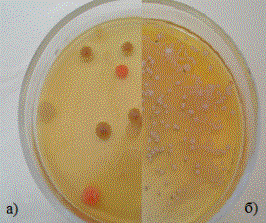
Fig. 1.
Micrflora of unfiltered wort from sorghum juice on medium: а) wort-agar, б) MRS
In
a mixture of 70 % unpasteurized wort from sweet sorghum juice
and 30 % diluted apple concentrate dominating were lactic acid bacteria,
which due to most of morphological, cultural and physiologic-biochemical traits
were similar to Lactococcus genus.
In the study were investigated
physicochemical characteristics of unpasteurized wort from sweet sorghum juice
and mixture of 70 % unpasteurized
unacidified wort from sweet sorghum juice and 30 % unpasteurized diluted apple concentrate (table 3). Content of dry matter for both samples
was 10 %.
Table 3
Physicochemical properties of unpasteurized wort samples
|
№ sample and its
characteristics |
General acidity, cm3 1N
NaOH per 100 cm3 |
рН |
Total sugars, mg/ |
Reducing substances, mg/ |
Amine nitrogen, mg/ |
|
1 – wort from sweet sorghum juice |
1,75 |
4,75 |
8,60 |
4,05 |
32,48 |
|
2 – mixture of 70
% wort from sweet sorghum juice and 30 % diluted apple juice concentrate |
1,90 |
4,57 |
8,45 |
3,31 |
25,71 |
Investigated
samples are characterized with complete composition considering content of dry
matter, reducing substances, amine nitrogen, acidity and pH.
Conclusions
As a result of study was
identified quantitative and qualitative composition of microflora and basic
physicochemical characteristics of sweet sorghum juice, diluted apple
concentrate and wort based on them.
Studied samples of wort due to
physicochemical characteristics are recommended for further use in the
non-alcoholic beverages technology.
Research results show that
diluted apple juice concentrate not only increase qualitative properties of
wort microflora, but contributes to their decline. This decline is due to
content of small amount of microorganisms in the diluted concentrate.
In order for further use of
unpasteurized wort from sweet sorghum juice and mixture
of 70 % unpasteurized and unacidified wort
from sweet sorghum juice and 30 % diluted apple concentrate in technology
of non-alcoholic beverages is recommended their heat treatment for quality and
safe products obtaining.
References
1.
Евдокимова,
О.В. Концепция формирования инновационной деятельности при производстве
функциональных продуктов питания / О.В. Евдокимова, Е.В. Лаврушина // Пищ. пром. – 2009. – № 3. – С. 50–51.
2.
Шатню, Л.Н. Обогащение напитков / Л.Н. Шатню,
А.В. Юдина // Пищ. индустр. – 2011. – Т. 4. – № 9. – С. 28–30.
3.
Roberts,
W. Benefiting Beverages / W. Roberts // Prepared Foods. – 2009. –
№ 9. – Р. 10–14.
4.
Сапронова,
Л.А. Карамельная масса на
основе сиропа сахарного сорго / Л. А. Сапронова, Г. А. Ермолаева, Л. Н.
Шабурова // Пищ. пром. – 2012. – № 4. – С. 58-59.
5.
Мєлєтьєв, А.Є. Технохімічний контроль виробництва солоду,
пива і безалкогольних напоїв / А.Є. Мєлєтьєв, С.Р.Тодосійчук, В.М. Кошова. –
Вінниця.: «Нова книга», 2007. – 392 с.
6.
Комарова, Н.В. Практическое руководство по использованию
систем капиллярного электрофореза «КАПЕЛЬ» / Н.В. Комарова, Я.С. Каменцев. – СПб: ООО «Веда», 2006. – 212 с.