Биологические науки / 8.
Физиология человека и животных
Peklo G.O., PhD in Biology
Lych I.V., D. Sci. Biology
Karpov A.V.
National University of Food
Technologies, city of Kyiv, Ukraine
Abzymy colostrum
Cow
colostrum is a benchmark not only nutritional value but also balance components
required for setting and support the immune system of the newborn and growing
organism [1]. Using cow colostrum components in the diet of the infant will
enable him to get a complete, easily digestible food, causing her body to
resist many diseases as colostrum cows contains a large number of biologically
active fragments of proteins.
The
protein composition of milk cows which includes protective components unstable
for several reasons. The most significant changes are observed him during
lactation.
Period
of lactation – the process of formation and the allocation milk with breast. On
average, cows he takes 305 days. It distinguish 3 stages: colostric and during
normal receiving milk from getting old milk.
Colostrum
and old milk considered normal milk, as the sharp change in the physiological
state of the animal at the beginning and end of lactation is accompanied by
formation of secretion, protein the composition of which significantly
different from the same indicators of normal milk (table 1) [2].
Table 1
Mass fraction of protein in milk at
different stages of lactation
|
Indicator |
Milk |
Colostrum |
Old
milk |
|
Mass fraction of protein |
3.2 |
15.2 |
5.3 |
Biologically
active fragments of proteins of cow colostrum provide a specific and
nonspecific immune defenses baby: formation of immunological reactivity and
protect it from invasion of pathogenic agents. Data immune properties are
lactoferrin, lysozyme, laktoperoksydaza and phagocytes. But of particular value
to the body of the newborn are catalytically active antibodies – proteins-abzymy.
They are mainly responsible for the development of the immune system of a
newborn child [3].
Materials and methods
Determination
of milk quality indicators conducted in accordance with DSTU 3662-97.
Quantitative changes in individual fractions of milk and colostrum and some
physical - chemical properties investigated to confirm the value of cow
colostrum and its indispensability in the diet, especially for infants. For
cow's milk and colostrum was important to examine a number of parameters:
density, acidity, content
of dry matter and the mass fraction of the protein [4].
Density
was determined by determining the density of milk according to GOST 3625-84.
Acidity was determined by the determination of acidity in milk according to
GOST 3624-92. Solids content was determined by the method of refractometric
index of refraction of light in accordance with GOST 3626-73. Mass fraction of
protein in milk were determined by refractometric method refractometer IRF – 464 in accordance
with GOST 25179-90.
Developing
the scheme allocation protein fraction from cow colostrum, which includes
catalytically active AT – abzymy-proteins that can stimulate
the development of the immune system of a newborn child [5].
Results and
discussion
One of
the important indicators of milk quality – density, which is used for converting liters to
kilograms of milk, determination of the milk solids and skimmed residue. In
addition, the rate of density reflects the naturalness of milk. In most cases,
the density of natural milk varies in the range of 1027-1032 kg/m3,
so the mean density of milk is taken as 1033 kg/m3. Density
colostrum – 1037-1055 kg/m3.
The
second important factor is titrated acidity, and is supported at a certain
level because of the content in the buffer substances (phosphates, citrates,
proteins). Titrated acidity of milk – characterizes the freshness of the product. The
acidity of fresh milk is 16-18 °T. It is caused by acid salts (9-13 °T), milk
proteins (4-6 °T), carbon dioxide and other acids (1-3 °T) [6].
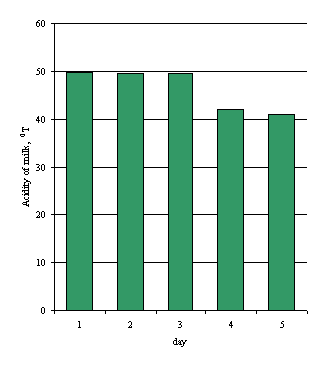
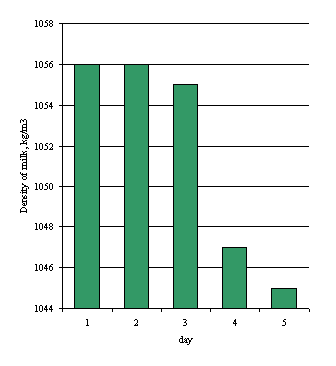
In fig. 1 presenting data determining the
density of milk (a) and acidity of
milk (b) from 1 to 5 days, which was
taken on colostric stage in lactation.
 a
b
a
b
Fig. 1 Density and
acidity of cow's milk during lactation
As can
be seen from the data in fig. 1 (a) 1
to 3 day observation density of cow's milk is 1055.0 kg/m3. Since 4
day study density falls dramatically (1055.0 kg/m3 for 1 day versus
1047.0 kg/m3 for 4 night and 1045.0 kg/m3 to 5 days).
Thus,
the density of cow's milk at 4 and 5 days was, if we take into account the
figure in the first 3 days, as samples 1 to 3 days were taken on colostric
stage of lactation. And, as noted earlier milk (colostrum) in this period has a
higher density, ie it varies in the range of 1037-1055 kg/m3.
Our
study (fig. 1 (b)) show that the
acidity of milk with 1 to 3 days is 49.8 °T. Since 4 day study acidity of milk
is reduced to 42.1 °T and have 5 night is T 41.0 ° T. If we analyze these data,
the lowest acidity had milk cows on day 5 of lactation, and the highest – for 1
day.
It
should be noted that some high acidity (50 °T), which is found in milk
(colostrum) the first 3 days colostric explained by the stage of lactation.
The
third important factor is the quality of milk content in the dry fat-free
residue. Average milk cows contained 87.5% water, 12.5% solids and about 70 cm3/l
gases. Dry matter, or dry residue (weight substances obtained after drying the
sample of milk at 102-105 0C) determine the nutritional value of milk.
The dry residue is fat-free milk 8.7% (ranging 6.6-10.3%). The protein content
averages 3.3-3.5% casein must be at least 2/7% and whey protein – not more – 0.7%
[7].
The
most important indicator of the nutritional value of milk – protein content.
Protein milk – valuable component of milk, which is about a quarter of the dry
matter and about a third of skimmed milk residue. Milk proteins presented
casein, α-laktoalbumins, ß-lactoglobulins, immunoglobulins,
proteoz-peptone, lysozyme, lactoferrin, laktoperoksydaz and amino acids,
without which the organism can not develop (lysine, methionine, tryptophan,
phenylalanine, valine, threonine, histidyn, leucine, izoleytsin). Without milk
normal development of the body of infants, adolescents and older people is
impossible [8].
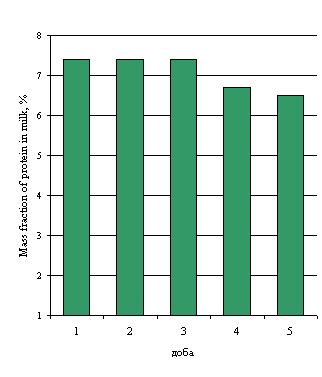
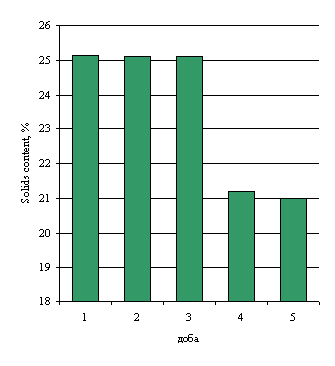
In fig. 2 presents the determination of the
content of skimmed milk remaining milk (a)
and the mass fraction of protein in milk (b)
from 1 to 5 days, which was taken on colostric stage in lactation.
 a b
a b
Fig. 2 Solids
content and mass fraction of protein in cow's milk during lactation
As the
materials are shown in fig. 2 (a), dry matter content in milk (colostrum) from 1 to 3
days is 25.5%. Since 4 days of observations content skimmed milk residue begins
to decline markedly and is 21.2% in 4 day, and 21.0% in 5 day.
We can
say that the first 3 days of skimmed milk content in cow's milk residue greater
compared with the results for the last two days of our research, since the
first 3 days – it colostric stage of lactation at which it is quantitative
change nearly all components milk (protein, fat, minerals and so on.).
The
data presented in fig. 6 (b) show
that the total protein content in the milk of cows 1 to day 3 of lactation
totals to 7.4%. Since 4 day mass fraction of protein in milk gradually reduced
and are in 5 days is 6.5%.
Therefore,
the mass fraction of protein in milk 1 to 3 day high, taking into account the
results of studies 4 and 5 days and reasonable to assume that the protein
content in milk decreased in subsequent samples. This phenomenon is explained
colostric stage of lactation. Thus, the content of skimmed milk residue
increases at this stage of lactation, respectively, and increased protein
content in milk.
Thus,
after examining samples 5 first 5 days after calving cows, found that the first
3 days – it colostric stage of lactation. At this stage, a cow giving
colostrum, which contains a large number of biologically active fragments that
contribute to the establishment and maintenance of immunity infants.
The
results of research quality indicators of cow's milk on colostric stage in
lactation make it possible to assert that:
§ First, cow's milk
colostric on stage during lactation is suitable for use in studies of protein
fractions allocation;
§ Secondly, posing as
a preliminary study to determine the mass fraction of protein, cow colostrum in
the first 3 days (3 samples) are the most enriched proteins (7.4%).
Therefore,
the protein fraction it would be isolated from cow colostrum, which was
obtained in the first 3 days after calving cows. Protein fraction was prepared
and purified according to the scheme, which is shown in fig. 3.
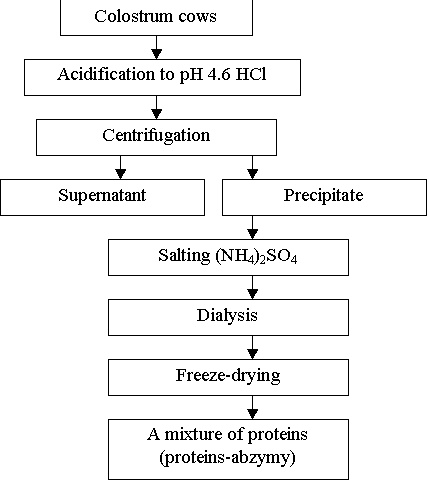
Fig. 3 Scheme of allocation protein
fraction from cow colostrum
Research
quality indicators of cow's milk on colostric stage during lactation according
enabled to make an overall assessment of the suitability of milk and colostrum
and use the information in these studies.
Due to the
fact that we have studied colostric stage of lactation of 5 samples studied
first 5 days after calving cows and found that the first 3 days – it colostric
stage of lactation. At this stage, a cow giving colostrum, which contains a
large number of biologically active fragments that stimulate the development of
anti-infectious immunity and provide antimicrobial defenses newborns [9].
Therefore, the protein fraction was isolated from cow colostrum, which was
obtained in the first 3 days of lactation. The protein fraction contains
proteins abzymy that have antibacterial properties and are activators of immune
infants.
Summarizing
the results obtained it is advisable to say that a child who is bottle-fed
using dry cow colostrum, rich in proteins abzymy receives not only valuable,
easily digestible food, but also due to the properties of antibodies in the
most vulnerable period of their lives restores, maintains and activates the
immune system [10].
References:
1.
Сучасні тенденції вигодовування немовлят та особливості взаємодії пари
«мати – дитина» / І. С. Семань-Мінько [та ін.] // Здоровье ребенка. – 2013. – №
3. – С. 46 – 48.
2. Изучения периода лактация коров / В. Р. Савран [та ін.] // Пропозиція. – 2010. – №
6. – С. 29 – 45.
3. Чернишов П.В. Cпецифічні імуноглобуліни до коров’ячого молока в
лікування дітей // Дерматологія. – 2008. – № 1. – С. 33 – 36.
4. Стапай П.В. Особливості хімічного складу і біологічної цінності
молока корів // Біологія тварин. – 2010. – Т. 12, № 1. – С. 18 – 27.
5. Harper W.J. Advances in chemistry of milk
// J.Pairy Sci. – 2010. – №4. – P. 713 – 722.
6. Горбатова К.
К. Химия и физика молока и молочных продуктов / К. К. Горбатова, П. И. Гунькова. –
Санкт-Петербург : ГИОРД, 2012. – С. 45 – 47.
7. Твердохлеб Г. Технология молока и молочных продуктов : [учеб.
пособ.] / Галина Твердохлеб, Георгий Сажинов, Римас Раманаускас. –М. : ДеЛи принт, 2006. – 616 с.
8.
Павлова Ж. Белковый состав коровьего молока / Жанна Павлова, Людмила Галун // Пищевая технология. – 2007. – №3. – С. 42 – 44.
9.
Оценка иммунной системы при массовых обследованиях / Р. В. Петров [та ін.] // Иммунология.
– 2005. – № 6. – С.51 – 62.
10. Романенко Г.О. Імунітет новонароджених дітей // Медичний журнал.
– 2012. – № 13. – С. 15 – 19.