Yudina N.,
Zaytseva A., Kozlova
T., Arlyapov V.
Development mediator
BOD biosensor and yeast Debaryamyces
hansenii
Tula State University, Russia, Tula
Worldwide industrial
biotech companies pay much attention to the development of new biocatalysts for
implementation in different areas of production. One of the fields of
application of biocatalysts is the creation of BOD biosensors. This research
sphere is important, because the conventional method for determining the
biochemical oxygen demand (BOD) is based on the tests with 5 days duration. The
advantage of using BOD - biosensors is reducing the analysis time from 5 days
to 20 minutes.
Greater attention
paid to the creation of amperometric biosensors based on using compounds, which
can transfer electrons from the active sites of enzymes to the electrode -
electron transport mediators. Neurotransmitters are able to interact not only
with isolated enzymes, but also enzyme in yeast cells. However the difficulty
of creating mediator biosensors based on yeast cells is eukaryotes enzyme
systems are localized intracellularly (in the cytoplasm), which makes
interaction with electron transfer mediators more complex. At the same time,
the use of yeasts as biocatalysts is more advantageous than the use of
bacterial cells as eukaryotic cells are resistant to unfavorable environmental
factors, and can operate for a long time.
Thus, mediator
biosensors can be used for the determination of organic compounds in the sample
(in particular the definition of the index BOD) and yeast Debaryamyces hansenii can oxidize a wide range of substrates.
Thus, the aim is to develop a mediator amperometric BOD-biosensor based on
yeast Debaryamyces hansenii for rapid
analysis.
Materials and methods.
Electrochemical measurements were performed using galvanopotentsiostat
«IPC-micro» («Kronas», Moscow, Russia), integrated with a personal computer.
Range of recorded currents 5 ηA - 20 μA. Two electrode system was
used for registration of sensor responses. The working electrode was a
carbon-paste electrode with immobilized yeast cells Debaryamyces hansenii, reference electrode – a silver - silver
chloride electrode. A constant potential was 250 mV, as it’s a redox potential
of electron transport mediator ferrocene. Measurements were performed with
phosphate buffer pH 6.8. When the substrates come into the measurement cell,
microorganisms oxidize it, generating current increase in the system.
Results and discussion. Firstly, working content of D.
hansenii cells in the receptor cell was defined in the maximum sensor response
with a constant concentration of the mediator. It is shown that working content of D.
hansenii yeast is 1.00 mg with a concentration of ferrocene in the paste of
10%.
Debaryamyces hansenii
yeast have a broad substrate specificity (fig.1) and oxidize alcohols,
carbohydrates, amino acids, carboxylic acids, aldehydes, nitrophenols and
sodium dodecyl sulfate, which is promising for determining BOD.
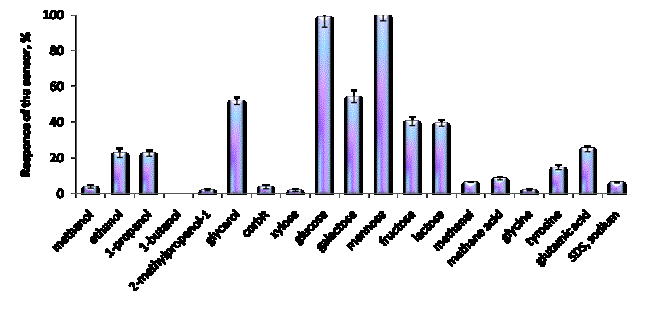
Fig. 1. Substrate specificity of yeast
Debaryamyces hansenii
as part of a mediator BOD biosensor
Using the
glucose-glutamic solution (GGS), analytical and metrological characteristics of
BOD biosensor yeast D. hansenii were
obtained. The range of linear relationship between sensor responses and the BOD
using a mediator-ferrocene was 25.2 - 320 mg/l. The
reproductively of the sensor was 2.5%. Time of the sensor without replacing the
receptor element is 39 days.
Analysis time using
this devise does not exceed 20 minutes, and measurements are not required a
highly specialized personnel.
Also it was determined BOD value of water and semi-fermentation products. It
was shown that the use of mediator biosensor
based on Debaryamyces hansenii: and ferrocene
produces data with high correlation to the conventional method.
Conclusion. In this research, it
was obtained of the functioning parameters of the mediator
biosensor based on Debaryamyces hansenii:
ferrocene concentration in the paste (10%), mass
of cells on the electrode (1 mg).
Analytical and metrological characteristics of BOD biosensor yeast D. hansenii were defined:
long-term stability (39 days), the range of detectable concentrations
of BOD (25.2 -
320 mg/l). Designed mediator biosensor based on Debaryamyces hansenii
yeast can be used for analysis of water samples and semi-fermentation products.
This work was supported by the RF Ministry of the state
task (project number 1714) and the grant of the President of the Russian
Federation (contract № 14.Z56.14.330-MC).