M.D.Abikayeva
PhD
student of KBTU, Kazakhstan
«Innovation Strategy of development of industrial enterprises»
The main task of the modern socio - economic
development of Kazakhstan is the country's output to an innovative way, the
maximum use of fundamentally new competitive products. The transition of the
economy to an innovative way of development requires extensive innovation
activity, especially at the enterprise level. The Republic of Kazakhstan has
sufficient scientific and technical potential. Correctly chosen innovative
development strategy will provide enterprises the flexibility to use the
country's resources, marketability and sustainability, including innovative. In
this regard, the issue of development of industrial innovation strategy of the
company is highly relevant in the context of the development priorities of the
Republic of Kazakhstan for the nearest years.
In its content, innovative strategy of development of
industrial enterprises in Kazakhstan considers major core processes in the company
and its external environment, opportunities for growth of the economic
potential. At the core of the development of innovative strategies and
practical implementation are strategic management decisions, which are focused
on the constant changes in the environment and within the enterprise of
attracting significant financial resources, extensive use of intellectual
potential and continuously evolving technology. At the same time, it is
necessary have considerable flexibility, because the development of innovative
strategies are always taken into account uncontrollable external factors now. For
strategic decisions at the company, most economists relates the choice of
enterprise location, reconstruction of production facilities, the change of the
legal form, the structure of production and management, forms of compensation
and benefits . In the development of an innovative project, the company needs
to determine the direction of development. Formulation of objectives is related
to the development of innovation strategy, the implementation of which in its turn
requires the target management of innovation. In formulating the goals and
strategies of innovation, there are principle differences. The first goals are
defined as the vector of development, the second are as diversion of resources
by this vector. Depending on the purpose of innovation, the type of control,
the nature of economic situation and many other factors can identify a large
number of different strategies. Advanced economies are increasingly focused on
innovation and the formation of such system of relationships between science,
industry and society, in which innovation is the basis for development of
industry and society, and they, in its turn, stimulates innovation and to
determine their directions in science activity. In other words, the overall
amplification of government, industrial and academic environment of the society
is built national innovation system, which combines the research environment
with high qualifications , as well as industrial competitive environment , the
subjects of which have the incentive to innovate, the ability of training,
absorption and adapting knowledge.
However, the majority of industrial enterprises in
Kazakhstan are not yet necessary experience to select the optimal strategy of
innovative development, which is one of the reasons for poor socio -economic
conditions of the country.
The innovation process is a complex system consisting
of a set of subsystems and components, having integrity and exposed to dynamic
changes. The innovation process is the result of human activities, with standing
of logical steps, starting from idea inception, the idea of
creating innovations in the implementation of its tangible or
intangible form before its sale to consumers and replacement by a more progressive
form.
Enterprise development strategies, including those
related to the material and technological innovation can vary the degree of
company aggressive or have a defensive character. With regard to innovation
management the degree of aggressiveness of innovative strategies associated
primarily with the degree of radicalism developed and introduced new features.
But equally important factors in determining the innovation aggressiveness of
enterprise is the speed of innovation, scope and funding of innovation and
investment activities and intensity of
marketing support innovation in the market.
Taking into consideration the fact that the material
and technological innovation inevitably but implemented through real investment
process, the following basic types of investment strategies for the enterprise:
·
innovation, providing technological
leadership through the development and innovation of high degree of
radicalism;
·
simulation-oriented to
dynamic reproduction of achievements of technological leaders and effective
development of free market segments;
·
Venture - strategy of using the
services of companies and units whose main product is an innovation.
In accordance with the methodology of systematic
description of innovation in a market economy, businesses can use the following
main strategies of innovation:
·
offensive (the development of new
products and technologies, the strategy of acquisition);
·
protected (improvement of products
and technologies, reflecting the response to the actions of competitors and the
needs of the consumer);
·
mixed
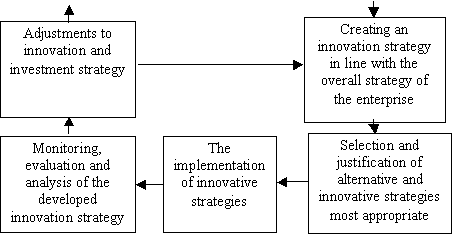
The main stages of the
development and implementation of innovative strategies of Industrial
Organizations:
Market Analysis Formulating the goal and mission of enterprise The formulation of the tasks that implement the goals


At detailed consideration of the types of innovation strategies it could
be concluded that the offensive is the most risky strategy that requires
specific skills from employees. In comparison with other kinds its return is
the highest. The use of protective strategies in its turn implies low risk and
application in enterprises that can make a profit in a competitive environment,
maintaining margins through lower costs.
In order to form a scientifically based, and meeting
the market-oriented influences the classification of innovation in the
enterprise need to define the purpose, methods of implementation and
application place of innovative. These three criteria will contribute creation
of system classifications. The goal, as it is known, the perfect mental
anticipation of the activity. As a direct motive, the purpose guides and
regulates human activity. Agreeing with this approach of leading researchers,
the target attribute classification is determined by a factor of innovation in
a particular industry in a particular enterprise, the solution of current or
strategic objectives. A well-chosen set of classification criteria allows determining
to which branch of the national economy and for which the scope of economic
relations is the innovation.
The methods and place of innovation application are directly dependent
on the choice of the scope of application of economic innovation and industry
definitions. In Kazakhstan, there is a need of building a national innovation
system based on the interaction of a single strategy and methodology of the
investment process, the mechanism and the law-legal framework, as well as
serving the organizational structure. It is necessary to guarantee necessary
orientation to the effect of motives and factors that can consistently make a
difference in the economy. It is necessary to have a system of measures on the
part of the state, contributing to enhance innovation enterprises. Prospects of
development of the national innovation system of Kazakhstan related to the
technological and structural changes in the industry.
List of literature:
1.
Republic
Kazakhstan. President (1991-2003; Nazarbayev) “Strategy of
industrial-innovation development of Kazakhstan for 2003-2015.
2.
“Innovation projects
management”, study guide, prof. V.L.Popov
3.
Plan of joint activities
of the Government, National bank and Financial Inspection Agency “For economic
stabilization and financial system for 2009-2010”.
4.
“Industry of
Kazakhstan and its regions” K.S.Abdiyev.
5. “Marketing Strategy”, Training course MBA,
O.Walker.