Development in-system objects of the type
"information REGISTERS" in "1C: Enterprise 8.2"
Ekaterina Ivanova, 4th
year student of the specialty "5V070300 - Information Systems" Sh.
A.Baitursynov
Irina Morozova, Senior
Lecturer, Department of Information Systems
KSU. A.Baitursynov
Information
register can be stored in the application decision arbitrary data in the
context of several measurements. For example, a registry can be stored exchange
rates to the currency or price of the enterprise in the context of the range
and type of prices.
The information in
the register information stored in the form of records, each of which contains
measurement values and corresponding
values of the resources. Register
measuring sections describe, in which information is stored, and the resources
of the register directly contain stored information. For example, the register
information prices Enterprises will have the following structure (Figure 1):
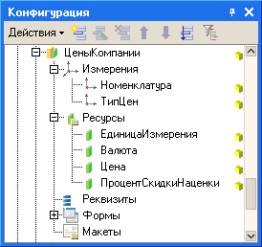
Figure 1. The
structure of the Register information
Together with each
entry, located in the register information, you can store additional arbitrary
information. For details of this is sensitive information.
One possibility is
to register the information storage section, not only in the specified
dimensions, but in the context of time. The developer can specify the minimum
frequency with which the records will be entered in the register. In this case,
for each registry entry will be added to the Period field that stores the date,
which have been made to write to the register. Using the periodicity of the
register information can not just store static data, but also to monitor their
changes over time. For example, the periodic information register The prices of
the Company can not only store information about what the price of a range now,
but also how it changed in the past (or will change in the future) (Figure 2)
Changes in the data
register can be done both manually and by means of instruments.
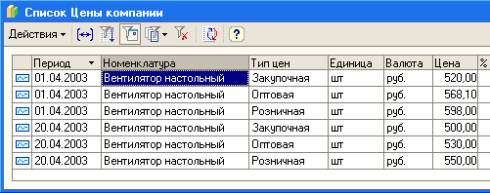
Figure 2.
Information registers «The prices of the Company»
When changes are
made in the register of information through documents, for each registry entry
is added a special field, which stores information about the registrar - the
document that is associated with this record. In the process of creating
application solutions developer specifies which recording mode will be used to
the register data (Figure 3).
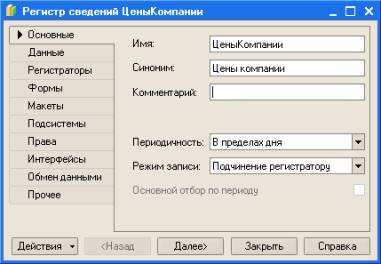
Figure 3. Template
Registry information
Using the recording
Submission registrar may require a case where the logic of the application
solution requires that changes made in the register of information were tightly
linked to the document recording the facts of economic activity. For example,
the change in prices of the company can only be a certain circle of people, and
each such change must be accompanied by a "paper" document. In this
case, you can use the mode of subordination to the receptionist at which price
changes can only be made by a special document Changes in prices of the company.
The system provides
control of the uniqueness of records stored in the data register. Thus, the
register information can not be two identical entries. Are considered identical
records with identical key record. Key entry is generated automatically by the
system based on the values contained in the
record fields, and depends on the type of sensitive information.
In order for a user
to view and modify the data contained in the register information, the system
supports multiple formats for the register. The system can automatically generate
all the necessary registration forms. In addition, the developer is able to
create their own forms, which the system will be used instead of the default.
To view the data contained in the register information, the shape of the list.
It allows you to navigate through the register, add, mark for deletion and
delete registry entries. The form allows you to sort the list and selection of
the information displayed on multiple criteria. To view and edit individual
records sensitive information using a form of the element.
As a result, it can
be said that the case of information allows you to create, edit, and delete
records, select the records in the specified range of the specified criteria,
to carry out selection of entries for the registrar to obtain the value of
resource records with the specified period and the values of the measurements.
List of sources
used:
1. "1C
Enterprise 8.2. Practical Manual Developer "Radchenko M.G., E.J.
Hrustaleva
2. "The
decision of the special applications of" 1C: Enterprise 8.2
"Goncharov D.I., Hrustaleva E.J. 2012