I.P.Torshina, Y.G.Yakushenkov
Moscow
State University of Geodesy and Cartography (MIIGAiK)
Gorokhovsky
by-str., 4, Moscow 105064, Russia
General Methodology of Modern
Electro-Optical Devices’ Computer Modeling
Electro-optical
systems are the devices which use optical radiation (optical signals) as a
carrier of information on the object being investigated or observed and convert
the energy of radiation into electric energy for preliminary data processing.
The electro-optical devices (EOD) engage with wide variety of applications, as
example, ground, air, and space based systems. Setting of the range performance
for the complex target-background situation is a difficult and expensive task
enough. Many traditional methods of designing don’t take account of complexity
and changeability of the target-background situation, the particular feature of
the concrete system, and other factors.
Therefore it has been proposed to utilize a computer modeling for
assessment.
A certain version of generalized EOD computer model (EOD CM) has been
worked out by the Electro-Optical Design Department, the Moscow State
University of Geodesy and Cartography (MIIGAiK). Our general methodology
of EOD CM construction has been stated
in [1,2,3]. The peculiarities of multispectral EOD modeling based on general
EOD CM has been marked in [4, 5].
The functional program ensuring of EOD CM may be divided into two parts:
1. composition of EOD CM, and 2. appraisal of its adequacy.
The structure EOD CM is the aggregate of its main blocks (submodels).
These submodels are: “Starting Data”, “Figures of Merit”, “Scenario”, “EOD
Structure”, “Result of Computer Modeling”, “Data Base of Computer Model”
(Fig.1). Due to modular structure of
the model it is possible to simulate a wide range of different EOD and
interactions between the EOD, the observed scene, its environment, and the date
processing algorithms.
The model executive
allows user to realize various conceptions of EOD operating and to modify these
conceptions working out in its details, or simplifying the model in accordance
with the available data bases and the requirements to model adequacy and
robustness.
For EOD 3th generation which are
named usually the devices working in two- or multi-spectral ranges with matrix
focal plane arrays, computer model may be formed on the basis of the general
EOD CM by means of addition special module “Correction of General EOD CM” supplementing of
“Data Base of Computer Model” [5].
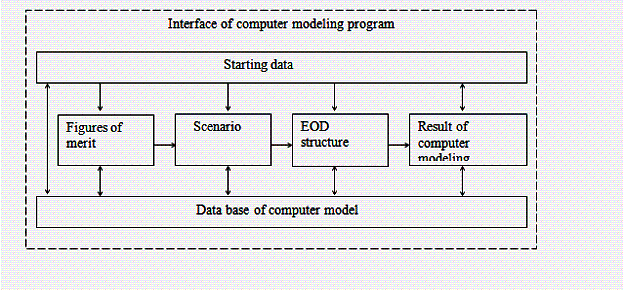
Fig.1. Structure of EOD general model
Individual subsystems of the “EOD Structure” submodel (“Optical
System”, “Detector”, “Electronic
Block”, “Display”, etc.) may be represented by their modulation transfer
functions (MTF). The functions as well as specific parameters of the EOD
elements may be packed into special blocks of submodel “Data Base of Computer
Model”. The MTF of the entire EOD is composed of a number of partial MTF. These
functions may be used to determine a noise bandwidth and others figures of
merit of EOD, for example, “Signal-Noise Ratio at EOD Exit”. The submodel “Data
Base of Computer Model” concludes a set of different blocks: “Radiators”,
“Atmosphere”, “EOD Elements and Algorithms Base Data” “EOD Figures of Merit”,
and many others. These blocks (data bases) may be realized as analytic forms,
for example, transfer functions of individual EOD blocks, as numeric, graphs,
tables, etc. Parameters and characteristics of many possible radiators and the
earth atmosphere have been packed into separate blocks. The block “Atmosphere” has been designed to incorporate
path transmission and path radiance for different EOD fields-of-view. An EOD
working scenario may be built by selecting required files and manipulating their
input parameters. This block architecture has been successfully implemented
using object-oriented engineering software techniques.
A structure and form of the
different blocks of the “Data Base of Computer Model” may be changed for the
various concrete EOD, for example, for different figures of merit. So for the
electro-optical warning systems the block “Atmosphere” may contain the data
about atmospheric transmission and radiation
only, and for the electro-optical servo systems with high spatial
resolution this block may contain the
data about atmospheric turbulence too.
After receiving results of modeling in
the form of demanded figures of merit it is necessary to find an adequacy of
the model using the criteria of adequacy to be selected.
Calculation algorithms of definition the reflection, the transmission,
and the absorption for various surfaces of targets, backgrounds, and obstacles
must take into consideration changing these physical quantities for different
wavelengths and orientations of the surfaces.
User can use such specific EOD-3 figures of merit as the spectral
contrast ratio, the difference of individual spectral signals, the spectral
ratio, the logarithmic spectral ratio.
At the first stages of EOD designing it is advisable CA
evaluation through the rejection
of EOD figures of merit from the
meaning to have been assigned. It may be convenient to evaluate an adequacy
with the help of numeral methods. So the meaning is depended on EOD parameters
and characteristics changes it is possible to use the method of exact
differential for CA calculating. Separate parts of the perfect differential (the partial derivatives) are determined by parameters of individual EOD
blocks. Forming the histograms of
figure of merit differences as a
functions of the input EOD parameters
it may be possible to find the partial derivatives of a figure of merit
function and calculate the
perfect differential as a CA.
BIBLIOGRAPHY
1. I.P.Torshina . “Computer Modeling of
Electro-Optical Preliminary Data Processing Systems”. - Moscow, Logos
Publisher, 2009.– 248 p. (rus.),
2. Y.G.Yakushenkov.
Electro-Optical Devices: Theory and Design. - Moscow, Logos Publisher,
2011.– 568 p. (rus.),
3. I.P.Torshina and Y.G.Yakushenkov. “Structure of General Electro-Optical
Systems’ Computer Model”.- Science-Technical
Herald of Sankt-Petersburg State University IFMO, 2009, № 6(64). P.5-9
(rus),
4. V.V.Tarasov, I.P.Torshina and Y.G.Yakushenkov. “Infrared Systems of 3-th
Generation”.- Moscow, Logos Publisher, 2011.– 240 p. (rus.),
5. I.P.Torshina and Y.G.Yakushenkov. Peculiarities of Computer Modeling for
Electro-Optical Systems of 3th generation. – Optical Journal (Journal of Soviet
Optical Technology), 2009, № 2, P. 87-89 (rus)
I.P.Torshina – Dr.Sc., Dean of Optical-Information
Systems and Technologies Faculty, the Moscow State University of Geodesy and
Cartography (MIIGAiK)
Y.G.Yakushenkov – Prof., Dr. Sc., Chief of Electro-Optical Department,
Optical-Information Systems and Technologies Faculty, the Moscow State
University of Geodesy and Cartography (MIIGAiK)