Современные
информационные технологии/3. Программное обеспечение
Zhuaspaev T.A
A.Baitursynov
Kostanai State University, Kazakhstan
DESIGN OF KNOWLEDGE TEST
Testing is used to assess the
level of knowledge in schools, in employment, to assess the qualifications of
personnel agencies. In other words almost all spheres of human activity. The subject is
asked a series of questions that he must answer.
Typically, each question is given several answers from which you must
select the correct. Each option corresponds to a specific response assessment.
Summing the ratings for the answers obtained a total score. Based on the total
score is concluded that the level of preparedness of the student's.
Objective of the study is to develop students' knowledge control module.
In this module should be laid ability to adapt to the characteristics of the
examinee.
As a programming language for the development of knowledge control
module was chosen object-oriented programming language Borland Delphi 7.
Because this language contains all the necessary conditions for the realization
of our objectives:
1) Building applications visually of software prototypes.
2) Scalable to build databases - Support for all popular database
formats.
3) Support for client-server technology. Compiler, built in Borland
Delphi 7, provides high performance.
In the target module, the control of knowledge, testing is carried out by means of bank jobs. Tasks are divided by level of difficulty. First asked the average complexity, and the answer affects the future assessment. Then selected and given a more difficult question.
If the answer is
given incorrectly, the student's score is reduced. As the next question again
offered an easier question. As defined more and more questions, more accurate
is the assessment of the student's level of knowledge. The test ends in two
cases: when the accuracy of the estimate reaches a statistically acceptable
level or when it is set to the maximum number of questions.
The structure of the software module is generated during the design of
the program module. The program control module consists of knowledge modules
and files. They are presented in tables 1 and 2.
Table 1 – List of modules
|
Module |
The original file and the shape |
Assignment |
|
Unit1 |
Test1.pas, AdaptivTest |
The shell that loads of adaptive test file
Test.doc |
|
Unit2 |
Test2.pas, Registration |
An application in which the user logs into
the system |
Table – List of files
|
File |
The original file and the shape |
Assignment |
|
Doc1 |
Reg.doc |
The file that stores the results of registration
and the scores after the test |
|
Doc2 |
Test.doc |
Bank of test items, divided into levels of
difficulty |
From the main form before undergoing the test is access to the module
registration. The data transmission between the modules and files may be
represented as follows.
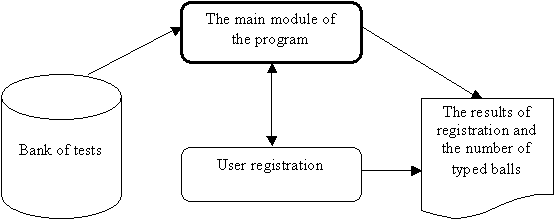

Figure 1 – Data
transmission between the modules and files
In the main module implements
procedures and functions. They are responsible for performing basic actions:
1) processing of the raw data;
2) function of student
registration;
3) link to the file bank of
test items;
4) link to the file
registration of students;
5) conclusion of questions and
answers on the screen;
6) calculation of test results;
7) saving outcomes;
8) output from the program.
The developed module control knowledge can be used to create a variety
of electronic systems used separately or as a standalone program for testing
students' knowledge.
Literature:
1. Аванесов В.
С. Научные основы тестового контроля знаний: учебное пособие. – М.:
Исследовательский центр, 1994 – 135с.
2. Благодатских В.А. Стандартизация разработки программных средств: Учеб. пособие. – М.: Финансы и статистика, 2003. – 288 с.
3. Архангельский
А.Я. Программирование в Delphi 7. – М.: ООО «Бином-Пресс», 2005. – 1152 с.