Kravets O.V.
THE RESEARCH OF SMALL BUSINESSES DEVELOPMENT
TRENDS IN UKRAINE
The economy of developed countries is currently based
on small and medium businesses, on the contrary, small and medium businesses
are not considered as a driver for Ukrainian economy, their real contribution to GDP is nearly 14 percent. In Europe
this indicator is higher by several times. In Denmark the entities of small
businesses, for instance, produce annually 80 percent of domestic product, in
Italy – 60 percent, and the average contribution of such enterprises to the
economy of Western Europe is 63-67 percent [2]. Europe has fixed small businesses
as an economic engine from the view of its nature. Multinational corporations
concentrate on average, unified customer, while small businesses fill the gaps
by selling products and providing services, when production is not profitable
for big players. The most furious and uncompromising competitive selection
occurs in the sphere of small businesses. Almost 80 percent of small enterprises
operate during only a several years or less.
The strongest and the most useful entities for society can survive in this
competitive struggle.
So, on the one side, only small
businesses are able to provide the country with that type of economy which it requires,
on the other side, small businesses are most vulnerable and needs protection by
means of the authorities [2].
The problem of small
entrepreneurship in Ukraine is studied by numerous scholars, among them are
Horynskiy M. [3], Lavrenchuk E., [5]
Turchak V.V. [7], Varnaliy Z.S., Vynogradska A.M.,
Hanenko O.V.,
Zhalilo Ya. A., Nazarenko N.S. Tkachuk O.M., and others. The research aimed at
utilizing integral index with a view to analyze subsystems was conducted by
Kardash O.L. [4], Artyuhova L.V. Rushchenko N.M.,
Zinchenko T.V. [2], and others. However, the pressing
issue about development trends of small businesses in a down economy requires
for further research.
The
aim of the study is to form an idea about up-to-date development
trends of small businesses in Ukraine under crisis conditions from the
perspective of integral estimation.
In order to form an idea about
development trends of small businesses in Ukraine, it is necessary to utilize
the methods of integral estimation based on normalizing statistical indicators,
which are relevant to the core and character of small businesses from the
standpoint of development, forming an integral indicator with acceptable region
ranges from 0 to 1. The use of integral estimation methods gives an opportunity
to find a development vector of small businesses’ structural components, to
switch numerous statistical indicators to informative and aggregate integral
indicator that characterizes certain development trend of small businesses in
Ukraine.
Taking into consideration that small
enterprises are a complex socio-economic system with a structural number of
interrelated indicators, we consider stage hierarchical scheme to calculate an
integral indicator of small businesses development in Ukraine [4, p. 264].
At the first stage, it is necessary
to select performance indexes of small enterprises, divide it into positive and
negative stimulators depending on the impact on integral indicator, and
normalize selected indices.
At the second stage, general
indicators should be calculated which characterize each subsystem of small
businesses. For this purpose, it is required to group valid statistical
indicators on the basis of corresponding directions and substantiate weighing
coefficient for each direction.
At the third stage, we perform final
calculations of integral indicator. We have formerly justified the level of
influence in terms of each direction on development integral indicator of small
businesses and take it into account during equation [4].
To assess the activity of small
enterprises in Ukraine, we have chosen such indicators:
-
Labour forces;
-
Financial resources;
-
Physical resources.
On the basis of data [1], above mentioned
statistical indicators were
analysed and development trends of small businesses in Ukraine in the period of
2006-2014 were identified. We will consider the dynamics of statistical
indicators with a view of labour forces in the context of small businesses in
Ukraine for the last three years, see the table 1.
Table 1
The
labour force allocation of small enterprises in Ukraine, yrs
|
Indicator |
Notation |
2012. |
2013 |
2014 |
|
Number of employees in the small enterprise/th |
x1 |
2051,3 |
2010,7 |
1675,9 |
|
Number of hired workers in the small enterprise/th |
x2 |
1951,6 |
1891,8 |
1572 |
|
Economically active population of working age/th |
x3 |
20393,5 |
20478,2 |
19035,2 |
|
Unemployed population of working age/th |
x4 |
1656,6 |
1576,4 |
1847,1 |
|
Economically inactive population of working age/th |
x5 |
7540,7 |
7552,2 |
7617,7 |
|
Population size by January 1/units |
x6 |
45560251 |
45439822 |
42953889 |
|
Number of small enterprises/units |
x7 |
344048 |
373809 |
324592 |
|
Need of employers for workers (at the year-end)/th |
x8 |
48,6 |
47,5 |
35,3 |
According to
the data of Table 1, we observe a persistent decrease of the indicator’s level
(comparing with previous year) in small businesses in Ukraine:
- number of
employees decreased on 2 percent in 2013 and 17 percent in 2014;
- number of
hired workers decreased on 3 percent in 2013 and 17 percent in 2014;
-
economically active population of working age decreased on 7 percent in 2014;
- population
size decreased on 0.3 percent in 2013 and 5.5 percent in 2014;
- number of
small enterprises decreased on 13 percent in 2014;
- need of
employers for workers decreased on 2.3 percent in 2013 and 25.7 in 2014.
On the
contrary, we have revealed the increase of such indicators (comparing with
previous year) in small businesses in Ukraine:
- unemployed
population of working age increased by 17 percent in
2014;
- economically
inactive population of working age increased by 0.86
percent in 2014.
Hence,
during 2014 a significant decrease of all labour force indicators was in focus,
which results in small businesses development, and, on the contrary, an
increase of indicators leads to decline of small businesses in Ukraine.
We
will consider the dynamics of statistical indicators with a view of financial
resources in the context of small businesses in Ukraine, see the table 2.
Table 2
The
financial resources allocation of small enterprises in Ukraine, yrs
|
Indicator |
Notation |
2012 |
2013 |
2014 |
|
Payroll costs of the small enterprise/mn of UAH |
y1 |
58644,8 |
60266,5 |
54047 |
|
Financial results before tax by economic activities
of the small enterprise/mn of UAH |
y2 |
-9254,0 |
-25057,9 |
-174493 |
|
Financial results before tax by industrial
activities of the small enterprise/mn of UAH |
y3 |
-1536,2 |
-3430 |
-13114 |
|
Average monthly wage at the year-end/UAH |
y4 |
3025 |
3265 |
3480 |
|
Small enterprises which made profit by economic
activities before tax/mn of UAH |
y5 |
39794,1 |
39640,9 |
49003,3 |
|
Small enterprises which absorbed losses by economic
activities before tax/mn of UAH |
y6 |
49048,1 |
64698,8 |
223496 |
|
Small enterprises which made profit by industrial
activities before tax/mn of UAH |
y7 |
3506,2 |
4051,1 |
4540 |
|
Small enterprises which absorbed losses by
industrial activities before tax/mn of UAH |
y8 |
5042,4 |
7481,1 |
17653 |
|
Software purchase costs of the small enterprise/mn
of UAH |
y9 |
167,8 |
151,9 |
- |
|
Net profit/loss by economic activities of the small
enterprise/mn of UAH |
y10 |
-14748 |
-29421 |
- |
|
Net profit/loss by industrial activities of the
small enterprise/mn of UAH |
y11 |
6409 |
4612 |
- |
|
Net profit by economic activities of the small
enterprise/mn of UAH |
y12 |
35296 |
35748 |
- |
|
Net loss by economic activities of the small
enterprise/mn of UAH |
y13 |
50045 |
65169 |
- |
|
Net profit by industrial activities of the small
enterprise/mn of UAH |
y14 |
49377 |
46679 |
- |
|
Net loss by industrial activities of the small
enterprise/mn of UAH |
y15 |
42968 |
42066 |
- |
|
Return on operating activities by economic
activities of the small enterprise/% |
y16 |
4,1 |
2,2 |
- |
|
Return on operating activities by industrial activities
of the small enterprise/% |
y17 |
0,7 |
-1,7 |
- |
|
Profitability of a small enterprise by economic
activities/% |
y18 |
-3,3 |
-6,2 |
- |
|
Profitability of a small enterprise by industrial
activities/% |
y19 |
-6,9 |
-13,6 |
- |
|
Fringe benefit expenses by economic activities/ mn
of UAH |
y20 |
15574 |
15738 |
- |
|
Charge on payroll by economic activities of the
small enterprise/mn of UAH |
y21 |
43071 |
44529 |
- |
In accordance
with the Table 2, we observe a persistent decrease of the
indicator’s level (comparing with previous year) in small businesses in Ukraine:
- payroll
costs decreased on 10 percent in 2014;
- financial
results before tax decreased by economic activities on 36.9
percent in 2013 and 14.4 percent in 2014,
and by industrial activities on 44.8 percent in 2013 and 26 percent in 2014;
- software
purchase costs in the small enterprise decreased on 9.5
percent in 2013;
- net
profit/loss by economic activities decreased on 50 percent and by
industrial activities on 28 percent in
2013;
- return
on operating activities by economic activities decreased on 46
percent and by industrial activities
decreased on 242 percent in 2013;
- profitability
of a small enterprise by economic activities decreased on
53 percent and
by industrial activities on 50.7 percent in 2013;
On the contrary, we have revealed the increase
of such indicators (comparing with previous year) in small businesses in
Ukraine:
- average
monthly wage at the year-end increased by 10.8
percent in 2013 and 10.6 percent in 2014;
- small
enterprises which made profit before tax by economic activities increased by 23.6
percent in 2014 and by industrial activities – 15.5 percent in 2013 and 12
percent in 2014;
- fringe
benefit expenses increased by 1 percent in
2013;
- charge on
payroll increased by 3 percent in 2013.
Consequently,
in 2014 we observed a significant slump of financial results before tax by
economic and industrial activities, decrease of profitability ratios. At the
time of 2013 net profit by economic activities has increased by 1.3 percent, on
the other side, net loss has also increased by 30 percent. As for financial
environment of industrial activities on the small enterprises, net profit
increased by 5.86 percent, net loss increased by only 2 percent. The positive
trend of average monthly wage indicators on the small enterprises, which made
profit in 2014, can be associated with economic crisis and currency
depreciation. The indicators of fringe benefit expenses and charge on payroll
were characterized by slight increase in 2013.
We will
consider the dynamics of statistical indicators with a view of physical
resources in the context of small businesses in Ukraine for the last three
years, see the Table 3.
Table 3
The
physical resources allocation of small enterprises in Ukraine, yrs
|
Indicator |
Notation |
2012 |
2013 |
2014 |
|
Sales volume of small enterprises by economic activities/mn of UAH |
z1 |
672653 |
670258,5 |
694423,6 |
|
Number of consumer goods markets at the year-end, units |
z2 |
2647 |
2609 |
2177 |
|
Number of retail stores (legal entities) at the year-end, th |
z3 |
47,2 |
45,5 |
38,7 |
|
Number of retail merchandising units and petrol station (legal entities)/th |
z4 |
15 |
14,3 |
11 |
|
Capital investment in tangible assets/mn of UAH |
z5 |
36136 |
38115,1 |
- |
|
Capital investment in intangible assets/mn of UAH |
z6 |
678,7 |
652 |
- |
|
Household incomes in Ukraine, mn of UAH |
z7 |
374962 |
382124 |
396760 |
|
Personal consumption expenditures in Ukraine/mn of UAH |
z8 |
306519 |
325117 |
322743 |
In accordance
with the Table 3, we observe a
persistent decrease of almost all the indicator’s level (comparing with
previous year) in small businesses in Ukraine:
-
sales volume decreased on 0.4 percent in 2013;
-
number of consumer goods markets
decreased on 1.5 percent in 2013 and 16.5 percent in 2014;
-
number of retail stores decreased on 3.6 percent in 2013
and 15 percent in 2014;
-
number of petrol stations decreased on 5
percent in 2013 and 23 percent in 2014;
-
capital investment in intangible assets
decreased on 4 percent in 2013.
We have
observed the increase of such indicators (comparing with previous year) in
small businesses in Ukraine:
-
sales volume increased by 3.6 percent in 2014;
-
capital investment in tangible assets increased
by 5.4 percent in 2014;
-
household incomes increased by 1.9 percent in
2013 and 3.8 percent in 2014.
It
should be noted that during 2014 we have
been observing a
significant slump of retail locations, including markets, stores,
retail merchandising units, and petrol stations. A slight increase of household
incomes in 2013-2014 and sales volume in 2014 are not
considered as a driver for development of small enterprises in Ukraine. Devaluation
of hryvna explains the boosting level of sales volume, in this linkage, the
population prefers to overstock, in some degree, invest in goods.
Since, we
have chosen the indicators of small enterprises performance that characterize
diversified subsystems of enterprises performance from the perspective of small
businesses and, consequently, indicators are viewed as non-homogeneous values
with various number of dimensions, in order to make calculations of integral
indicator, prenormalization becomes a required condition.
We perform the normalization of labour force and
physical resources indicators  and
and  on the basis of this formula (1):
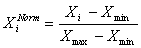 , (1)
, (1)
where:
 - normalized
indicator of labour force
- normalized
indicator of labour force
 - indicator
value of labour force
- indicator
value of labour force
 - minimum indicator value of labour force
 - maximum
indicator value of labour force
- maximum
indicator value of labour force
We perform the normalization
of financial resources on the basis of maximum indicator value . A maximum value is selected from a set of
values, and then
. A maximum value is selected from a set of
values, and then  is divided by
 , the calculations are based on this formula:
 , (2)
, (2)
where:
 - normalized indicator of financial resources
 - indicator value of financial
resources
- indicator value of financial
resources
 - maximum indicator value of
financial resources
- maximum indicator value of
financial resources
The
second stage of our proposed evaluation integral indicator scheme of small
businesses in Ukraine is connected with projecting general indicators. In this
linkage, indicators are considered as non-homogeneous and have different
influence forces on integral indicator, we have proposed to calculate each
weighing coefficient within the block of indicators [4, p. 269].
We
suggest calculating weighing coefficient of small enterprises in the following
order [4, p. 270]: 1 stage – to create correlation matrices; 2 stage – to
calculate factor weights and eigenvalues; 3 stage – to calculate weights.
At
the first stage, we will make correlation matrix calculations of small
enterprises in Ukraine by means of MS Excel and Statistica 6.0 – data
processing system – using Correlation matrices. Off-diagonal matrix elements
are
represented by correlation coefficient which
evaluate correlation ratios between indicators
which
evaluate correlation ratios between indicators  і
і  that caused by common reasons of their variation [4, p. 270].
Correlation matrices reveal the
hierarchy of interrelations between indicators of small enterprises’
development within the each block of indicators (labour, physical, and
financial), see Table 4-5.
Table 4
Correlation
matrix of labour force
|
|
|
|
|
|
|
|
|
|
|
|
x1 |
x2 |
x3 |
x4 |
x5 |
x6 |
x7 |
x8 |
|
x1 |
1,00 |
1,00 |
0,89 |
-0,43 |
0,35 |
0,98 |
0,71 |
0,92 |
|
x2 |
1,00 |
1,00 |
0,88 |
-0,41 |
0,31 |
0,98 |
0,68 |
0,93 |
|
x3 |
0,89 |
0,88 |
1,00 |
-0,79 |
-0,05 |
0,96 |
0,84 |
0,66 |
|
x4 |
-0,43 |
-0,41 |
-0,79 |
1,00 |
0,53 |
-0,59 |
-0,75 |
-0,09 |
|
x5 |
0,35 |
0,31 |
-0,05 |
0,53 |
1,00 |
0,18 |
0,06 |
0,59 |
|
x6 |
0,98 |
0,98 |
0,96 |
-0,59 |
0,18 |
1,00 |
0,78 |
0,84 |
|
x7 |
0,71 |
0,68 |
0,84 |
-0,75 |
0,06 |
0,78 |
1,00 |
0,57 |
|
x8 |
0,92 |
0,93 |
0,66 |
-0,09 |
0,59 |
0,84 |
0,57 |
1,00 |
The calculated correlation
coefficients of labour force indicators highlight the interconnection between
the number of employees and hired workers, economically active population of
working age, the population of Ukraine, the need of employees for workers. On
the contrary, inverse correlation is a distinctive feature of such indicators
as economically active and unemployed population of working age, unemployed
population of working age, and the number of small enterprises.
Table 5
Correlation
matrix of physical resources
|
|
z1 |
z2 |
z3 |
z4 |
z5 |
z6 |
z7 |
z8 |
|
z1 |
1,00 |
-0,96 |
-0,86 |
-0,93 |
-0,07 |
-0,62 |
-0,03 |
0,00 |
|
z2 |
-0,96 |
1,00 |
0,92 |
0,95 |
0,00 |
0,59 |
0,09 |
0,04 |
|
z3 |
-0,86 |
0,92 |
1,00 |
0,86 |
0,14 |
0,79 |
0,26 |
0,24 |
|
z4 |
-0,93 |
0,95 |
0,86 |
1,00 |
0,27 |
0,46 |
0,28 |
0,23 |
|
z5 |
-0,07 |
0,00 |
0,14 |
0,27 |
1,00 |
0,03 |
0,87 |
0,87 |
|
z6 |
-0,62 |
0,59 |
0,79 |
0,46 |
0,03 |
1,00 |
0,02 |
0,05 |
|
z7 |
-0,03 |
0,09 |
0,26 |
0,28 |
0,87 |
0,02 |
1,00 |
1,00 |
|
z8 |
0,00 |
0,04 |
0,24 |
0,23 |
0,87 |
0,05 |
1,00 |
1,00 |
Calculated correlation coefficients
of physical resources indicators highlight an inverse correlation between sales
volumes and number of consumer goods markets, number of retail stores.
Furthermore, a close direct relationship mark number of consumer goods markets
and number of retail stores, merchandising retail units, and petrol stations.
On the other side, household incomes and personal consumption expenditures are
characterized by a strong direct relationship.
Correlation
matrix of financial resources contain 21 columns and 21 rows, that is enough
bulky. Calculated correlation coefficients of financial resources indicators
have revealed a close direct relationship between payroll costs and monthly
average wage, fringe benefit expenses, charge on payroll; financial results
before tax and net profit, profitability of all small enterprises;
small enterprises which made profit and fringe benefit
expenses, and charge
on payroll.
On the
second stage, we will calculate factor weights and eigenvalues by means of
MS Excel and Statistica 6.0 – data processing system – using Correlation
matrices.
In order to select the most
influential factor, we will utilize scree plot to apply Cattel’s criteria. The
plot represented below (Fig. 1) was added by curve segments that connect close
eigenvalues to clarify the criteria. Hence, Cattel stated that from the view of
Monte Carlo technique, there is a point where the decrease of eigenvalues
becomes slower and after that the level of other eigenvalues shows only a
random noise. This point is corresponding to factor 3 in the plot represented
below (Fig. 1).
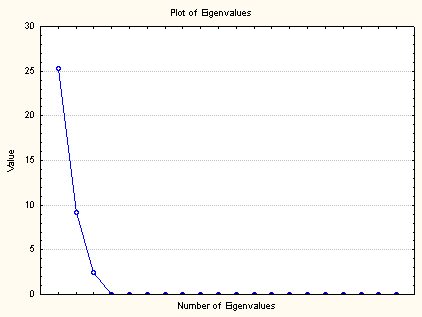
Fig. 1. Scree plot
As a result of calculations made by
data processing system – Statistica 6.0 on the basis of initial data, 3 factors
were identified that fully explain the variability of initial data
characterizes the small enterpsies development level in Ukraine (Table 6).
Table 6
Statistical
characteristics of principal components
|
Factors |
Eigenvalues |
Portion of total dispersion, % |
Cumulative eigenvalue |
Cumulative dispersion, % |
|
factor 1 |
25,30511 |
68,39219 |
25,30511 |
68,3922 |
|
factor 2 |
9,17850 |
24,80675 |
34,48361 |
93,1989 |
|
factor 3 |
2,51639 |
6,80106 |
37,00000 |
100,0000 |
The
calculations results of factor weights are presented in the table. Table 7
Indicators’
factor weights of small enterprises development
|
Indicator |
factor 1 |
factor 2 |
factor 3 |
|
Indicator |
factor 1 |
factor 2 |
factor 3 |
|
x1 |
0,99311 |
0,110996 |
0,037575 |
|
y13 |
-0,86989 |
0,486995 |
-0,078283 |
|
x2 |
0,98503 |
-0,168426 |
-0,036780 |
|
y14 |
-0,25825 |
-0,851577 |
-0,456207 |
|
x3 |
-0,96413 |
0,206506 |
0,166754 |
|
y15 |
-0,94552 |
-0,205500 |
0,252527 |
|
x4 |
0,99112 |
-0,132413 |
-0,012385 |
|
y16 |
-0,15395 |
-0,983280 |
0,097254 |
|
x5 |
0,86553 |
0,500294 |
0,023761 |
|
y17 |
-0,32198 |
0,095501 |
-0,941919 |
|
x6 |
0,99663 |
0,032956 |
0,075136 |
|
y18 |
-0,12384 |
0,991815 |
-0,031088 |
|
x7 |
-0,38633 |
0,686732 |
-0,615749 |
|
y19 |
-0,59676 |
0,800553 |
-0,054736 |
|
x8 |
0,96147 |
0,041130 |
-0,271832 |
|
y20 |
-0,96028 |
-0,219602 |
0,172173 |
|
y1 |
-0,96520 |
-0,240368 |
0,103036 |
|
y21 |
-0,96575 |
-0,248385 |
0,075004 |
|
y2 |
-0,44484 |
0,889940 |
-0,100631 |
|
z1 |
-0,94879 |
-0,155603 |
0,274939 |
|
y3 |
-0,84782 |
0,527944 |
-0,049805 |
|
z2 |
0,99815 |
0,054230 |
-0,027315 |
|
y4 |
-0,99690 |
-0,048699 |
0,061855 |
|
z3 |
0,85373 |
-0,519777 |
-0,031369 |
|
y5 |
-0,89481 |
-0,446390 |
0,006604 |
|
z4 |
0,99919 |
0,040075 |
-0,004604 |
|
y6 |
-0,86097 |
0,502213 |
-0,080731 |
|
z5 |
-0,92222 |
-0,377865 |
-0,082005 |
|
y7 |
-0,91210 |
-0,140674 |
-0,385082 |
|
z6 |
-0,48690 |
-0,787597 |
-0,377645 |
|
y8 |
-0,91771 |
0,368253 |
-0,148973 |
|
z7 |
-0,97711 |
-0,209217 |
0,038568 |
|
y9 |
-0,65531 |
-0,752810 |
-0,062009 |
|
z8 |
-0,98639 |
-0,153522 |
0,058948 |
|
y10 |
-0,49744 |
0,861783 |
-0,099423 |
|
eigenvalues |
25,30511 |
9,178497 |
2,516391 |
|
y11 |
0,57131 |
-0,557298 |
-0,602511 |
|
portion of
dispersion, % |
0,68392 |
0,248067 |
0,068011 |
|
y12 |
-0,92150 |
-0,388381 |
0,001803 |
|
|
|
|
|
We will continue to utilize
calculated matrix of factor weights, eigenvalues, and portions of dispersion
with a view to identify indicator weights of small enterprises development in
Ukraine.
The
calculation of weights will be performed in the following order [4, p. 274]:
1. We find
maximum absolute value of factor weight in each row of factor weights matrix:
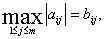
 (3)
(3)
where  – number of column where contains maximum value.
2. We calculate products of factor weights  and
portions of dispersion
and
portions of dispersion
which it explains
 :
:

 (4)
(4)
where  – table eigenvalues of
factor values,
– table eigenvalues of
factor values,  – indicators number of small
3. We
find addition of products in terms of all the factors:
 (5)
(5)
4. We calculate the weight of each indicators
by the formula:

 (6)
(6)
In
accordance with suggested method of weight calculations in terms of factor
weight, it possible to draw a table (Table 8).
Table 8
Coefficient
of factor weights
|
coefficient of labour force |
0,255572 |
|
coefficient of financial resources |
0,490128 |
|
coefficient of physical resources |
0,2543 |
To calculate the indicators of small
businesses development, we will apply additive convolution which for labour
force is:
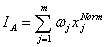 (7)
(7)
We will make similar calculations of
physical and financial resources [4, p. 275] (Table 9).
Table 9
Indicators’
calculated results of small enterprises development in Ukraine
|
Years |
Indicator values of small business development in Ukraine |
||
|
Labour force |
Financial resources |
Physical resources |
|
|
2006 |
0,214 |
0,124 |
0,141 |
|
2007 |
0,198 |
0,153 |
0,174 |
|
2008 |
0,169 |
0,251 |
0,209 |
|
2009 |
0,183 |
0,221 |
0,102 |
|
2010 |
0,165 |
0,244 |
0,102 |
|
2011 |
0,141 |
0,301 |
0,129 |
|
2012 |
0,125 |
0,343 |
0,136 |
|
2013 |
0,120 |
0,381 |
0,133 |
|
2014 |
0,032 |
0,241 |
0,067 |
Conducted analysis of small
businesses development in Ukraine has demonstrated the decline of all
significant indicators in 2014. Labour force indicators fell from 0.12 to 0.032
– the biggest drop. Generally, the lowering of labour force indicators was
rooted in 2010, instead of this, we observed slight growth of financial
resources indicators in 2011, on the contrary, these indicators dropped from
0.381 to 0.241 in 2014. The physical resources indicator has increased from
2011, but dropped significantly from 0.133 to 0.067 in 2014.
On the third stage during the
assessment of small businesses development in Ukraine, we will calculate
integral index of small enterprises development.
Since each of small businesses
development indicators has a various influence force on integral index of small
enterprises development, we will calculate weighing coefficient according to
the previous justified methodical basis of weights calculations [4, p. 277].
The results of indicators
calculations in integral index of small enterprises development are presented
in the Table 10.
Table 10
The
matrix of factor indicators of small businesses development in Ukraine
|
Indicators |
Factors |
||
|
Фактор 1 |
Factor 2 |
Factor 3 |
|
|
Labour force |
0,167068 |
0,025121 |
-0,00619 |
|
Financial resources |
-0,40277 |
0,004833 |
-0,01316 |
|
Physical resources |
-0,03991 |
-0,05204 |
0,004178 |
|
The portion of dispersion |
0,68392 |
0,248067 |
0,068011 |
Maximum absolute values of factor
weight are equal to the first and second indicators amounted 93.9 percent of
total dispersion. The first factor – 68.39 percent of total dispersion – includes
physical and financial resources, their factor weights are equal to 0.167 and
-0.402 respectively. The second factor explains 24.8 percent of total variation
and loads on physical resources, factor weight equals to -0.052.
We have multiplied maximum factor
weight of each indicator by factor value which explains it, and we have
products: 0,114; 0,275; 0,013. A portion
of products and their additions give an opportunity to calculate weighing
coefficient of indicators [4, p. 278]:
-
labour force - 0,284;
-
financial resources – 0,684;
-
physical resources – 0,032.
As a result of calculations, financial resources are characterized
by the highest weight, physical resources – by
the lowest weight.
Taking into consideration all the
calculated values of indicators of small enterprises development in a view of
weighing coefficients and utilized additive convolution, we have calculated
integral index of small businesses development in Ukraine. The dynamics of
small businesses’ integral indicator in Ukraine during 2006-2014 is represented
in the Figure 2.
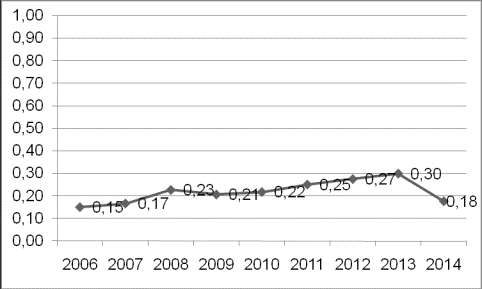
Fig. 2. The dynamics of integral
index of small businesses development in Ukraine during 2006-2014.
The dynamics analysis of small
businesses development in Ukraine indicates that during 2006-2008 there was a
tendency to increase by the level of 0.23. On the contrary, 2008-2009 is
characterized by the decline to 0.21 due to the influence of global economic
crisis and crisis transmission on Ukraine. However, in 2010 the level of small
enterprises development has been improved, integral indicators was
stage-by-stage increasing by -0.30 in 2013. The integral indicator of small
businesses development dropped to 0.18 in 2014 that almost equals to the level
of 2007 caused by economic and political challenges in Ukraine (anti-terrorist
operation, erosion of purchasing power, exchange rate fluctuations, and
increased level of tax burden) that essentially hinder the small business
development in Ukraine.
Generally, integral indicator’s
level of small businesses development in Ukraine (permissible value is from 0
to 1) demonstrates a low level of development as during the analyzed period the
indicator was showing the dynamics from 0.15 to 0.30, it is only a third of the
possible values.
Conclusions.
The study showed
the level of small business development in Ukraine analyzed by means of
statistical indicators that are corresponding to such directions of enterprise
operation as financial resources, physical resources, and labour force. For the
purpose of identifying the overall development trend of small businesses, we
have calculated integral indicator through justification for statistical
indicators of selected directions, further normalization of all the directions,
justification for weighing coefficients of each direction, and additive
convolution, as a result.
On the one side, we have revealed that development
indicator of physical resources demonstrates development trend from 0.141 in
2006 to 0.209 in 2008 and from 0.102 in 2009 to 0.133 in 2013, at the same
time, in 2014 this indicator reached 0.067. On the other side, the development
indicator of labour force showed a constant downtrend from 0.214 in 2006 to
0.032 in 2014. The development indicator’s level of financial resources
indicated an upward trend during the analyzed period, with the exception of
2008-2009 and 2014, in particular from 0.124 in 2006 to 0.251 in 2008 and from
0.221 in 2009 to 0.381 in 2013, during the 2014 this indicator dropped to the
mark of 0.241 (the level of 2010). The integral indicator calculations of small
businesses demonstrated downtrend in period of economic crisis and the
indicator is now within the range of 0.15 and 0.30 that signals about the low
level of small businesses development in Ukraine.
References
2. Артюхова Л.В., Рущенко Н.М., Зінченко Т.В. Узагальнені критерії якості в задачах
багатокритеріальної оптимізації / [Електронний ресурс]. – Режим
доступу: http://dspace.nuft.edu.ua/jspui/handle/123456789/11795
3. Горынский М.
Малый бизнес в Украине — тревожные перспективы / [Електронний ресурс]. – Режим
доступу: http://intercredit.com.ua/39/article6299
4. Кардаш О.Л. Науково-методичні засади вдосконалення оцінки продовольчої
безпеки України / О.Л.Кардаш // Моделювання та інформаційні технології в
економіці : Монографія / За заг. ред. В. М. Соловйова. – Черкаси, 2014. – С.
263-280
5. Лавренчук Е.
Обличчям до малого бізнесу / [Електронний ресурс]. – Режим доступу: http://news.finance.ua/ua/news/~/273161
6. Національна
економіка:підручник / П. В. Круш, С. О. Тульчинська, М. В. Шашина та ін.; за
ред. П. В. Круша. - 2-ге вид. - К. : Каравела, 2008. - 428 с.
7. Турчак В. В. Сучасний стан, проблеми та
перспективи розвитку малого бізнесу в Україні / В. В. Турчак // Молодий вчений.
- 2013. - № 1(01). - С. 39-44. - Режим доступу:
http://nbuv.gov.ua/j-pdf/molv_2013_1(01)__9.pdf
8. http://www.statosphere.ru/blog/108-statfactor.html