Современные информационные технологии/3.Программное обеспечение
Bilas O.
Lviv Politechnical National
University, Ukraine
Requirements
attribute and analisys tool for software specification
Requirements analysis is probably the most important,
hardest and most defect contained stage of software development. Quality
requirements analysis lets effective software develop without significant
modification and delays in schedule.
Every software system is defined data converter and
output results of converting. Requirements,
which define functions and variety types of data processing during execution of
this function, are raises to software development process. Requirements are
the subject for practical agreement between customer and system developer. In
general case as software requirements considered features which system should
has for adequate function fulfilment. It is a statement that identifies a necessary attribute,
capability, characteristic, or quality of a system in order for it to have
value and utility to a user. Requirements are also an important input into the
verification process, since tests should trace back to specific requirements.
Requirements
are typically divided into following categories [1]:
- Functional requirements describe the
functionality that the system is to execute. They are also called capabilities.
- Non-functional requirements describe
characteristics of the system that the user cannot affect or perceive.
Nonfunctional requirements are sometimes known as quality requirements.
- Constraint
requirements impose limits upon the design alternatives or project
operations. No matter how the problem is solved the constraint
requirements must be adhered to.
In software engineering this categorization
is useful because only functional requirements can be directly implemented in
software.
Quality requirements are very important for
succesful project realization. Requirements should meet following characteristics:
|
Characteristic |
Explanation |
|
Unitary
|
The
requirement addresses one and only one thing. |
|
Complete |
The
requirement is fully stated in one place with no missing information. |
|
Consistent |
The
requirement does not contradict any other requirement and is fully consistent
with all authoritative external documentation. |
|
Non-Conjugated
(Atomic) |
The
requirement is atomic, i.e., it does not contain
conjunctions. |
|
Traceable |
The
requirement meets all or part of a business need as stated by stakeholders
and authoritatively documented. |
|
Current |
The
requirement has not been made obsolete by the passage of time. |
|
Feasible |
The
requirement can be implemented within the constraints of the project. |
|
Unambiguous |
The
requirement is concisely stated without recourse to technical jargon,
acronyms (unless defined elsewhere in the Requirements document), or other esoteric
verbiage. It expresses objective facts, not subjective opinions. It is
subject to one and only one interpretation. |
|
Mandatory |
The
requirement represents a stakeholder-defined characteristic the absence of
which will result in a deficiency that cannot be ameliorated. An optional
requirement is a contradiction in terms. |
|
Verifiable |
The
implementation of the requirement can be determined through one of four
possible methods: inspection, demonstration, test or analysis. |
Requirements management is the process of documenting, analyzing, tracing, prioritizing and agreeing on requirements and
then controlling change and communicating to relevant stakeholders [2]. It is a continuous process
throughout a project. Different management tools are used for
storing and processing of the requirements. Important feature of such tool is
capability to parse a requirements document that has been exported from text
file, then elucidate each requirement line and produce a summary of the defects
it finds in the requirement. The defect
report is a measurement that can be used to assess the quality of a requirement
document. Then system analytic should look at the requirements with reported
defects and decide if he agrees with observation or not. If the author agrees
with remarks, he can edit the requirements.
Requirements management tool should provide a dynamic
report of the defects found within the requirements document.
When the requirements are correctly written, the
system analytic can assign other requirement information to complete the
building of the requirements specification document.
A lot of problems and potential defects can cause
indistinct or vague words or phrases [3]. Requirements management tool should
parse the documents to detect these indistinct words and identify them to the
analytic. System analytics may choose to ignore such identification of the
indistinct word, if they feel that the requirement statement is correct. The indistinct words should stores in a file,
can be edited and extended. The typical indistinct words are high, low,
probably, about, nearly, common, etc. Such words are not allowed in
requirements for reason of various defects. It could be recognised the
following potential types of defects:
1. Multiple
requirements in a line.
2. Possible multiple requirements in a line.
3. Not verifiable or testable.
4. Use of wrong word to define a requirement.
5. User defined defective word.

Fig.1. Defects of requirements report
6. Possible design constraint.
7. Incomplete sentence.
Requirements should be analysed and determined if the
items are defective.
Requirement creation wizard helps to build
requirements step by step with chosen appropriate atributes and
characteristics.
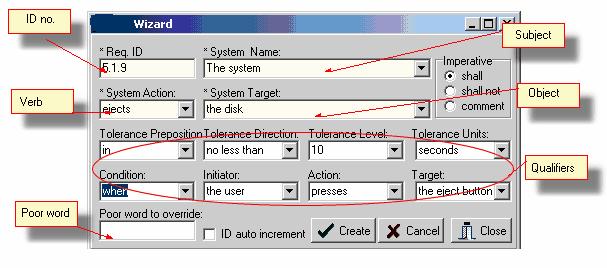
Fig. 2. Form for
requirements creation with atributes and characteristics
Sortware requirements specification document is formed
on the basis of discrete requirements. Requirements quality and their analisys
made effect on efficiency and succesful of whole project. Defects finded on the
requirements stage of project are easy and cheaper for correction.
Conclusions. Requirements engenireeng stage is one of the most important and
influential software project phase.
Requirements document agreed with
customer and developers. This document is
used as executives during tasks fulfilment on the software development
lifecicle.
References:
1.
Халл Э.,
Джексон К., Дик Д. Разработка и управление требованиями. Практическое
руководство пользователя.- М.: Telelogic, 2005.-229с.
2.
Вигерс К.
Разработка требований к программному обеспечению. Пер. с англ.-
М.:Издательско-торговый дом «Русская Редакция», 2004.-576с.
3. Standard for Software
Verification and Validation Plans(ANSI/IEEE standard 1012-1986).