Технические науки / 12. Автоматизированные системы
управления на производстве
Kulyk A.J., Kulyk J.A, Kulyk A.A.
Vinnytsia national technical
university, Ukraine
Аналіз впливу амплітудних спотворень сигналів The analysis
of amplitude distortion of signals
каналом зв'язку в базисі функцій Уолша communication
channel in basis Walsh functions
The literature shows that the analysis of influence communication
channel for the transfer process can be carried out not only the sine and
cosine, but also other types of orthogonal functions [1]. Using the sine basis
functions due to the simplicity of transient analysis for circuits with passive
elements, is invariant to time, which is the coil inductance, capacitors and
resistors. In this case the equipment can be described by differential
equations with constant coefficients. Sine voltage is applied to the entrance
of such a scheme, as shown on the output voltage amplitude with a lower phase
shift, but the S-shape and frequency are stored. In practice, the transfer of information
technology, mainly used rectangular signals. It is reasonable and cross-impact
communications and signals when transmitting information to bases in rectangular
orthogonal Walsh or the Haar functions [2]. A similar analysis for synusopodibnyh
functions is quite common [3, 4], although not always convenient.
Any complete system of orthogonal functions f(j, θ) can be divided
into even functions f s (j, θ), odd fs (j, θ) and the permanent
component of f(0, θ). For Walsh functions basis functions are
paired cal ( j , θ ), odd – sal ( j , θ ), and the constant component – wal (0,
θ ). In this case the input entrance
of Fвх(θ) may be filed as

Ratios a c and a s are based on equations
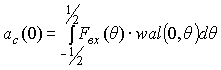

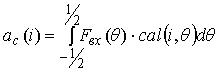 ,
,  ; (2)
; (2)
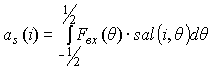 ,
,  .
.
Given the specific
features of Walsh functions to replace the integral representation of bounded
time function signal entrance of F вх ( θ ) a sum of components
[2]


 .
(3)
.
(3)
Given that
 , (4)
, (4)
where K ( θ ) – coefficient of
transmission channel.
In the simplest case channel carries only the amplitude distortion
(attenuation or gain). This factor K ( θ ) can be represented as a number of composition is also determined basis
Walsh functions
 . (5)
. (5)
Let this number is
limited to a constant component and the first even harmonic

Then the output channel signal
will be


 (7)
(7)
Given the rules of transformation products of odd and even Walsh
functions described in the literature [2], expression (7) can be represented as


 (8)
(8)
If the number that
describes the rate of conversion of feed to restrict only to the first
component and odd harmonics
 , (9)
, (9)
then the signal on the output
channel will look like



 (10)
(10)
If the specified limited
number of fixed component and the first odd and even harmonic
 , (11)
channel output signal takes
the form





 . (12)
If the number is limited only
even harmonic
 , (13)
the reference signal channel
expression can be described



 . (14)
Similarly you can
define output for the case when the number is limited only odd harmonics
 ,
(15)
,
(15)


 . (16)
The expressions show that in all cases, changing only the frequency components
of the signal spectrum, unlike the case when the test is done in Fourier basis
functions. The latter is formed without the final number of components that
precede and late in relation to the informative signal [5]. Thus, the analysis
functions in the basis Walsh functions greatly simplifies the process of
transfer and construction of hardware and software in this basis to release the
channel from echo signals which significantly complicate the process of
transmitting information.
REFERENCES:
1.
Хармут Х.Ф. Теория
секвентного анализа. Основы и применения. – М.: Мир, 1980. – 574 с.
2.
Хармут Х.Ф. Передача
информации ортогональными функциями. – М.: Связь, 1975. – 272 с.
3.
Квєтний Р.Н., Компанець М.М., Кривогубченко С.Г., Кулик А.Я. Основи техніки
передавання інформації. – Вінниця: УНІВЕРСУМ-Вінниця, 2002 – 358 с.
4.
Кулик А.Я., Компанец
Н.Н., Кривогубченко Д.С. Энергетический спектр сигналов при передаче информации
оптическими линиями связи // Вимірювальна та обчислювальна техніка в технологічних
процесах. – 2000. – № 1. – С. 50 – 51.
5.
Кулик. А.Я. Аналіз впливу каналу зв’язку на процес передавання інформації.
// Оптико-електронні інформаційно-енергетичні технології, 2002. – № 1. – С. 170 – 173.