Assoc.
Prof. V.Yu. Ovsyannikov, graduate
student A.A. Avilov
Study
of main regularities of reproduction of bakery yeast
The study of the physiology
and biochemistry of yeast in the interests of their industrial use is fraught
with great possibilities. It is thanks to the use of the biological potential
of yeast that the achievements of the last decade in the field of the
construction of yeast-producing devices and aeration systems were realized,
which enabled a sharp increase in the concentration of processed molasses,
increased biomass accumulation and the removal of products from production
equipment.
In the present work, the
patterns of reproduction of baker's yeast and their relationship to the
accumulation and release of biomass have been studied.
The yeast multiplication was
studied in three main stages: anaerobic, weak aerobic and aerobic cultivation.
The cultivation cycle began with an anaerobic or slightly anaerobic stage. The
initial sequence was followed by three successive stages of aerobic yeast
growth. The initial stage was carried out in a high medium layer without mixing
(partial anaerobiosis) or with a weak periodic or
continuous aeration of the medium. The duration of the stage is 12 hours.
Cultivation in aerobic stages was conducted under the same conditions on a
laboratory installation by an air-supply method using a 10-hour regimen.
The nutrient medium in all
experiments was molasses wort, clarified by the
acid-hot method for the initial stage and by the acid-cold method for all
aerobic stages. Ammonium sulfate and diammonium
phosphate were used as sources of nitrogen and phosphorus, the pH during the
growing process was regulated with ammonia. The culture temperature was 30 ° C.
Studies
were carried out with the yeast of the Saccharomyces cerevisiae race used in industry. The seeding material
for the first stage was yeast from malt wort after 24
hours of cultivation at
At all
stages of cultivation, samples were regularly taken to determine the
accumulation of biomass, counting the total number and number of budding cells.
The final yield of biomass at each stage was expressed as a percentage of the
molasses consumed. Based on the accumulation of biomass, for each stage, the
average specific growth rate μ, g./h, the number of generations n, pcs, and the mean duration of generation q, h, were
calculated for the following formulas:
 ; (1)
; (1)
 ; (2)
; (2)
 , (3)
, (3)
where m0 - amount of seed yeast,
gr. (25 % dry matter); m1- amount of yeast at the end of the stage, gr.; t1 – t2 – duration of the stage, h.
In Fig.
1 shows the dynamics of accumulation and release of biomass in four consecutive
stages of cultivation, where the initial was the anaerobic stage. The obtained
data indicate that the accumulation and yield of biomass in conditions of
partial anaerobiosis are low. These indicators
increase sharply in the first aerobic stage and continue to increase in the
second, but in the third stage, the accumulation and yield are reduced.
Accumulation and yield of biomass decrease with long-stored molasses and yeast
(curve 1), they increase when fresh molasses and a newly isolated yeast strain
(curve 2) are used. After the transition to a continuous supply of carbohydrate
nutrition in comparison with the batch feed in the first two cases, the biomass
accumulation and yield increased again (curve 3), however, the established
dynamics of their growth at different stages persisted. In an optimal variant,
the yield by stages (average data from six experiments) was 9, 74, 85 and 80%,
respectively.
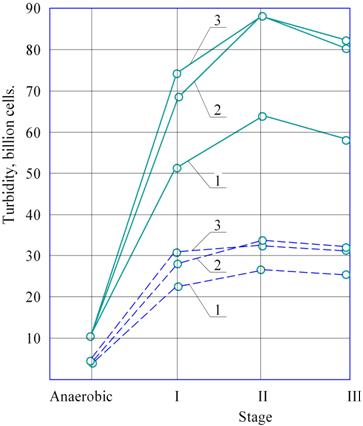
Fig. 1. Change in the accumulation
and yield of biomass in yeast growing:
–––– exit, %; – – – accumulation of
biomass, gr.
The
accumulation and yield of biomass in the aerobic stages varied in accordance
with the growth rate of yeast (Fig. 2). Simultaneously, the number of
generations changed, in inverse relationship - the generation time.
Thus,
the intensity of yeast multiplication is different in three consecutive stages
of aerobic growth, which are the same in terms of nutrition and aeration. After
the stage providing the maximum accumulation and yield of biomass, the further
multiplication of yeast proceeds less intensively.
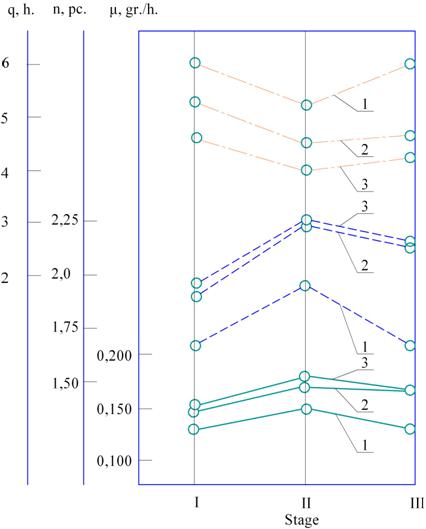
Fig. 2. Change in the average
specific growth rate, generation number and generation time of yeast in
successive aerobic stages:
1 - using long stored molasses and
yeast strain; 2 - fresh molasses and a newly excreted strain of yeast; 3 - the
same in conditions of continuous supply of carbohydrate nutrition;
––––– biomass
growth module; – – – number of
generations; – · – · – duration of generation
n yeast, there is a
period of decline in biosynthetic abilities, leading to a decrease in the
accumulation and release of biomass. It follows from Fig. 1 and 2, this pattern
clearly manifests itself at different levels of the biosynthetic capacity of
yeast. The reason for this phenomenon is a change in the metabolism of yeast at
these stages of development.
It should be noted
that, despite the absence of clear indications in the scientific literature of
this pattern, industrial technology is empirically constructed on this
principle, according to which the maximum multiplication and yield of yeast is
reached only in the last, commodity stage.