V. Levykin, Doctor of Technical
Sciences, Professor
I. Iuriev, Ph.D. student
Kharkiv National University of Radioelectronics, Ukraine
Stages and results of
typical project on development of IT organization strategy
IT strategy is a strategic
plan of management of the information technology development of the company,
which is aimed at meeting requirements of business and achieving desired goals
on development of the information technology used in the company. Basically, IT strategy is a part of the general
strategy of company development, where it is stated how, in what period, at the
expense of which technologies and means a company can improve its business
efficiency. It answers the question how a company should conduct business in
the context of information technology in order to achieve desired goals.
The lack of IT strategy in the
company leads to a quite low benefit from implementation of IT projects due to
the non-compliance with business requirements[1]. It gives rise to complaints
against work of IT service from the management, consideration of IT service not
as a full business participant but as a subdivision, providing services to the
business, in other words executing only helping function. In this case,
investments made into IT are seen as a waste and IT service carries out
projects which are not associated with strategic goals of the company [2]. In
its turn, IT strategy allows to develop IT infrastructure of the company on the
basis of distinctly developed requirements and the strategy turns up to be a
starting point for tactical decisions, which correspond to business goals of
the company.
The development of IT strategy
of the company is described in the form of the sequence of stages, stating
tasks and appropriate results [3]:
1)
Stage 1. Project preparation.
2)
Stage 2. Analysis of the main strategic goals and the
company.
3)
Stage 3. IT strategy development.
At the first stage it is necessary to carry out the following tasks:
̶
Form task description and organize
project team;
̶
Agree upon the structure of data
collected and adapt templates;
̶
Define project frames, its structure
and all the necessary reporting documents;
̶
Develop and agree upon the project
charter;
̶
Prepare and approve detailed work
plan.
As a result of the execution of this stage the company will get: project charter and calendar work plan; approved scheduled plan of the necessary interviews,
approved scheduled plan of the necessary business
trips, templates and forms for collecting primary information, structure of
reporting documents agreed upon.
At the second stage it is necessary to carry out:
- Analysis
of the structure and technological condition of used information systems and
principles of their integration;
- Analysis
of the integration level of information systems;
- Analysis
of the structure and technological development level of IT infrastructure of
the company;
- Analysis of the structure and the development level
of IT management system;
- Formation
of the integral estimate of the current condition of the information
technology;
- Formation
of general conclusions and main directions of development.
As a result the company will get the following documentation: expert
conclusion on the development level of information system, IT infrastructure, integral
estimate of the current condition of the information technology, report with general
conclusions and main directions of IT development.
At the third stage it is necessary to carry out the following tasks:
- Development
of the goals of information technology development;
- Development
of business principles of information technology development;
- Development of perspective structure of the
corporate information system of the customer;
- Development
and explanation of the choice of strategy of information technology development;
- Development
of the list of necessary IT solutions;
- Estimate
of the budget of the strategic plan;
- Estimate
of efficiency of IT projects implementation;
- Development
of approaches to management and implementation of IT strategy.
After completing this stage the following will be determined: goals, tasks,
IT development principles, prospective structure of corporate information
systems, target architecture of all IT elements, budget of planned events,
options for managing, monitoring and controlling implementation of IT strategy.
In general, the relationship of the company's IT strategy, with information
systems, is presented in Figure 1.
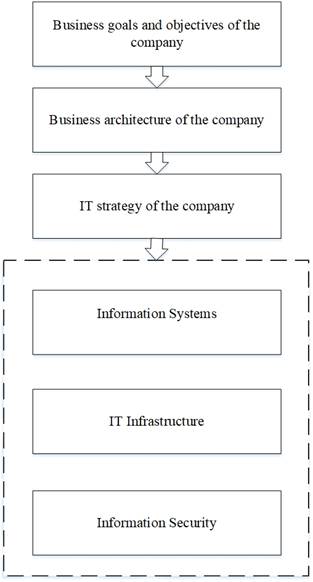
Figure.1. Connection of IT strategy with information systems
Conclusion. The lack of IT strategy usually results in the fact
that IT department is mainly engaged in the execution of projects that are not
directly related to the strategic goals of the company. At the same time, the benefit
from investments made into such projects, as they are executed without
considering the requirements of business development, may turn out to be more
than questionable.
The availability of IT strategy represented
in the form of a formalized document allows us to develop IT infrastructure efficiently
on the basis of a correct presentation of the requirements that should be
implemented for the successful business development of the company, as well as
to carry out pre-planned steps, moving towards achievement of desired goals.
The strategy should be a tool for making tactical decisions that correspond to
business goals of the company.
It is worth mentioning that IT strategy
can also be modified in conditions of an ever-changing market, this being said such
process also requires appropriate formalization.
References
1.
Hofmeister, H. Applying
service-orientation through a reference architecture [Text] / H. Hofmeister, G.
Wirtz // Journal of systemics, cybernetics and informatics. – 2008. – Vol. 6,
Issue 1. – P. 80–90.
2.
Martini, B. A Service-Oriented Approach
for Dynamic Chaining of Virtual Network Functions over Multi-Provider
Software-Defined Networks [Text] / B. Martini, F. Paganelli // Future Internet.
– 2016. – Vol. 8, Issue 2. – P. 24. doi: 10.3390/fi8020024
3.
Meena, M. Architecture for Software as a
Service (SaaS) Model of CBIR on Hybrid Cloud of Microsoft Azure [Text] / M.
Meena, A. R. Singh, V. A. Bharadi // Procedia Computer Scienc. – 2016. – Vol.
79. – P. 569–578. doi: 10.1016/j.procs.2016.03.072