Anna Masliukivska
Taras Shevchenko National University of Kyiv, Kyiv
The personnel component of the
scientific and
technical potential of Ukraine
Scientific and technical potential is a significant developmental
indicator of economic system of the country, implementation of innovative and
scientific and technical solutions in all economic spheres that, in its turn,
will provide its strength and
competitiveness on the world market and attractiveness for foreign
investors. Scientific and technical potential is grounded on scientific and
technical progress that is defined as a ongoing and continuous process of
fundamental qualitative and quantitative changes in all directions of human
labour activity.
Anyway,
nowadays scientists pay insufficient attention to the issues of formation and
current development of scientific and technical potential of Ukraine. The issue
of system management of its separate structure components and the issue of
scientific manpower preparation and development as a basic insuring element of
formation of powerful base of scientific researches and carrying out scientific
activity have been left unattended. Clear mechanism analysis of interaction and
mutual influence between subsystem components of scientific and technical
potential of Ukraine is absent.
Potential
(from Lat. potentia – strength, power) is available means, stock, sources and
opportunities that can be used in achieving specific goal, solving certain task
and also capability of separate person, society and state in general; it is a
complex of the necessary for system functioning or development of different
resource kinds [5].
Scientific and technical potential is a complex of human, material,
organizational, financial and information resources, which even and
interdependent development provides opportunities and creates preconditions for
performing its basic functions by science: social and cultural, cognitive and
economic. As scientific term “a scientific potential” (later “scientific and
technical potential”) was used for the first time at the end of 1960s in works
of scientists of Kyiv science of science school, representatives of which
defined it as a complex of parameters characterizing ability of scientific
system to solve the current and future problems of scientific and technical
development [2].
At the present stage there are objective conditions for development and
implementation of active state scientific and technical policy in Ukraine:
powerful personnel potential of academic, institutional and sectoral science,
technical and manufacturing potential of many leading enterprises, in
particular, science-based productions in industrial complex allowing to
manufacture and output competitive products owing to conversion, are
functioning.
Native statistical data proves high level of development and efficient
functioning of personnel constituent. Thus, during 2013 scientific and
scientific and technical works were carried out in 1143 enterprises and they
were done by almost 123.2 th. of
workers (without taking into account ones holding several employments)
that is, however 5.2 % less in comparison with 2012. Number of direct executors
of scientific and scientific and technical works (researches, technicians and
supporting personnel) also 5.1% decreased and amounted to 100.5 th. of persons
(table 1). Such, although insignificant but anyway index decrease proves a
range of certain problems present in science sector which we will further try
to define within our research [1].
In comparison with 2012 the number of Doctors of Science
who performed scientific and scientific and technical works 1.0% increased,
Candidates of Science – 0.2 % decreased. Herewith, their share in total number
of executors of scientific and scientific and technical works increased and
amounted to 20.3 % [3].
Basic executers of fundamental researches in 2013 remained organizations
of state sector (88.9 % of scope of these works); applied researches –
organizations of state (62.8%), business (23 %) sectors and higher education
sectors (14.2 %); scientific and technical developments and scientific and
technical services – business sector organizations (91.8 % and 72.2 %
accordingly) [4]. Thus, we can state that fundamental researches still
remain a business of state sector institutions. Basic explanation for this is
high cost of such kind of researches and because of it these business sector
institutions are often not able to cover expenses for these researches
financially or are not interested in their implementation.
Table 1.
Employee distribution of
scientific organizations by personnel categories*
|
|
2012 |
2013 |
|||
|
Total, persons |
in % to general
amount |
Total, persons |
in % to general
amount |
in % to previous
year |
|
|
Total |
129945 |
100,0 |
123219 |
100,0 |
0,95 |
|
researches |
68599 |
52,8 |
65641 |
53,3 |
0,96 |
|
technicians |
13433 |
10,3 |
12212 |
9,9 |
0,90 |
|
supporting personnel |
23866 |
18,4 |
22649 |
18,4 |
0,95 |
|
others |
24047 |
18,5 |
22717 |
18,4 |
0,95 |
|
including |
|
|
|
|
|
|
Doctors of Science |
4489 |
3,5 |
4533 |
3,7 |
1,01 |
|
Candidates of Science |
15963 |
12,3 |
15919 |
12,9 |
0,99 |
*Source: the author built it on the basis of data of the
State Statistics Service of Ukraine
Concerning work of such personnel subsystem constituent of both
postgraduate training programme and doctoral training 518 institutions prepared
postgraduates in 2013 that is 3 units (0.6 %) less in comparison with the
previous year. Number of doctoral trainings 5 units or 1.8 % increased. 276
institutions prepared candidates for a doctor’s degree, whereof 172 higher
educational establishments and 104 scientific and research institutes [1].
In 2013 number of postgraduates 6.4 % decreased in comparison with 2012 and amounted to 31482 persons, candidates
for a doctor’s degree – 0.9 % increased and amounted to 1831 persons.
In
2013 8320 postgraduates were prepared
that was 179 persons or 2.1 % less than in the previous year and 578 candidates
for a doctor’s degree that was 154 persons or 36.3 % more than in 2012. Thus,
we see that tendency to increasing of number of Doctors of Science, that is to
say, experienced scientists who make a basis of scientific and technical
potential of the country and form basic tendencies and directions of its
development [3].
As of the end of 2013 16450 Doctors of Science worked in economy of
Ukraine that is 5.5 % more than at the end of 2012. Herewith, number of men 3.3
% increased and women – 12 % (Fig. 1)
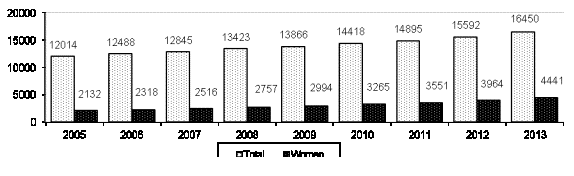
Fig. 1. Quantity dynamics of Doctors of Science who are working in
economy of Ukraine, persons [3]
In 2013 Diploma of Doctor of
Science was received by 1105 persons, of which 33.9% were heads of enterprises,
institutions, organizations, manufacturing or functional subdivisions; 24.2 % -
professors of chairs, 25.8 – associate professors, 12.3 % - research
associates. Average age of male Doctors of Science at the moment of diploma
receiving was 49 years old, female – 45 years old, average time of work for
thesis – 8 and 7 years accordingly. Average age of Doctors of Science in 2013
for men amounted to – 61.7 years old; female – 54.9 years old [4].
Over the past year, 7024 persons withdrew from Candidates of Science,
engaged in economy, for various reasons, of which 27 moved abroad. It should be
mentioned that the number of Candidates of Science, who moved abroad for
permanent residence over the last five years, amounted to 182 persons, of which
22.0 % moved to the USA, 16.5 % - to Russia, 14.8 % - to Germany, 6.0 % - to
Canada, 3.8 % - to Poland [1].
Having analyzed the foregoing data, it may be concluded that one of the
most important problems of provision of the personnel potential of scientific and
technical potential in Ukraine is moving of young scientists abroad,
disinterest in scientific work among youth. These problems are connected with
the low level of financing of the region of science, high level of its
bureaucratization and information asymmetry in the branch concerning scientific
and technical works and elaborations, their duplication, low social status of
research worker and scientist in the country, which makes it unattractive for
young people.
As for specific ways to solve this problem, the National Academy of
Science of Ukraine, which is the leading institution in the sphere of science
and technology development and formation of scientific and technical potential,
is deeply involved in search of the ways to solve existing problems. One of the
specific steps on this way can be the Council of young scientists, created at
the National Academy of Sciences of Ukraine [3]. Such decision was
adopted, keeping in mind the necessity of enhancement of the role of young
scientists in formation of the scientific policy, restoration of scientific
potential of the state, multiplying of work with scientific youth for the
solution of issues of social and professional development and involving of
young scientific staff in the scientific institutions of the National Academy
of Sciences of Ukraine.
Key tasks of the Council are: association of young scientists,
coordination of their activity and protection of their interests; promotion of
scientific activities, career advancement, fulfillment of creative potential,
informational and administrative support of young scientists of institutions of
the National Academy of Sciences of Ukraine; activity coordination and support
of young scientists of scientific institutions of the National Academy of
Sciences of Ukraine in carrying out of common scientific and administrative
events [3].
The most important areas of activity of the Council are: representation
of young scientists in the meetings of Presidium of the National Academy of
Sciences of Ukraine, in state authorities, social organizations and messaging
of the attitude of young people to their professional activity and promotion in
solution of other problems of scientific youth, closer cooperation with
scientific institutions of the National Academy of Sciences of Ukraine and
higher educational institutions in Ukraine and abroad; information interchange
among scientific youth, distribution of scientific and other information;
supplying information on job opportunities, bonuses, scholarship, grants,
funds, conferences, schools and other measures, concerning scientific youth
support, organization of meetings with representatives of foreign scientific
institutions for more intensive scientific cooperation, etc.
Summary. Personnel
component of scientific and technical potential of Ukraine plays very important
role in its formation, since it is its basis, its foundation, which provides
its effective accumulation and application in order to assure scientific and
technical and innovative development of the country. Scientific work in
academies and higher educational institutions develops rapidly, within which
the training of candidates and postdoctoral students is performed, the
representatives of business sector of the economy carry out successfully
R&Ds and implement their results in practice, putting up their own
funds, number of scientists of young
and average age increases.
References:
1.
Annual summary reports of the National Academy of Sciences of Ukraine
[Electronic resource]. – Access mode: http://www.nas.gov.ua/UA/Results/Pages/Reports.aspx
2.
Cross-disciplinary dictionary in management / Edited by D.М. Chervanov,
О.І. Zhylinska. – К.: Nichlava, 2011. – 624 p.
3.
Express edition of the State Statistics Service of Ukraine [Electronic
resource]. – Access mode: http://ukrstat.org/uk/express/expres_u.html
4.
Scientific and innovative activity in Ukraine (2012) [Electronic
resource]. – Access mode: http://www.ukrstat.gov.ua/
5.
Zakharchenko V. І., Korsikova N. М., Merkulov М. М. Innovative
Management: theory and practice in the context of transformation of economy.
Instructions. – К.: Centre for educational materials, 2012. – 448 p.