Kerimbayev
A.R.
al-Farabi Kazakh National University, PhD student
Issues of compulsory retail insurance in
Kazakhstan. How to stimulate interest in retail insurance?
Introduction
The article raises issues of retail insurance
in Kazakhstan. The article describes the current state of the market and its
concealed systemic problems and proposes ways out of the current situation. The
author analyzes official data on the insurance market, assesses the economic
losses to market players, and identifies the possible causes of the systemic
problems of retail insurance. The author omits an analysis of other areas of
the insurance business, such as corporate insurance and voluntary insurance. The
article discusses only compulsory insurance of civil liability for vehicle
owners (hereinafter "Auto Insurance"), the largest category of
insurance in Kazakhstan, which covers over 3 million citizens in the country.
Glossary
"Transit insurance" means insurance
for nonresidents of the Republic of Kazakhstan who enter the country in their
personal vehicles.
"MCI (Monthly Calculation Index)"
means the index used in Kazakhstan to calculate pensions, benefits, and other
social payments, as well as penalties, taxes, and other payments.
"Insurance Agent" means a broker
(an individual or legal entity) that provides services involving the execution
of insurance agreements (insurance policies) and that represents the interests
of an insurance company.
"Agent's Fee (or Commission)" means
the portion of an insurance premium (or insurance rate) under an insurance
agreement. This is the fee paid by the insurance company to the insurance agent
for finding policyholders (signing insurance agreements).
"Policyholder" means an individual
or legal entity that is the client of an insurance company.
"Seasonal Vehicle Operation" means
when a vehicle is used for less than the full calendar year (for example, only
in the summer). In this case, the policyholder may purchase a short insurance
policy.
"Short Insurance Policy" means an
insurance policy with an insurance term of less than 12 months.
"Valid Insurance Policy" means an
insurance policy under which an insurance company is liable as of the date of
review.
"Reissuance of an Insurance Policy"
means a compulsory procedure to terminate a current insurance policy and enter
into a new policy, with changes in the terms of insurance (replacement of the
vehicle, change in the list of insured persons, etc.).
The current growth in the automobile insurance market is attributable
mainly to Auto Insurance. For example, in the first 11 months of 2014,
insurance companies collected 30.7 billion tenge in insurance premiums for Auto
Insurance, which is 8% more than in the same period of 2013 [1]. Since 2010,
the Auto Insurance market has grown by an average of 16%. However, the level of
insurance payouts has remained fairly low, no more than 40% of the total amount
of insurance premiums collected. It must be noted that the cost of an Auto
Insurance policy is linked to the MCI, which increases each year. The trend in
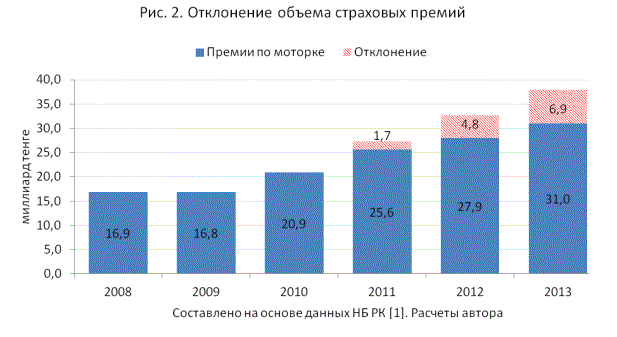
sales of Auto Insurance is shown in figure 2 ("Auto Insurance
Premiums").
Is everything really going so well? Can it be said that Auto Insurance
is a high-margin type of business?
Insurance companies that offer Auto Insurance ended 2013 with losses of
over 1.2 billion tenge (consolidated loss), while the corporate insurance
business shows a large profit of 21.4 billion tenge in 2013 [2].
Today, retail insurance companies pay brokers (insurance agents) fees of
30-35% for bringing in clients. It is no secret that the agent's fee is both a
discount to the client and income to the insurance broker.
Comments by
Vladimir Li, Deputy Chairman of the Management Board of Salem Insurance Company
JSC:
"In my view,
the high broker fees are an incentive for policyholders to terminate and then
obtain new insurance policies. This may involve collusion between the
policyholder (client) and the insurance agent (broker), or fraud by an
insurance agent, which raises the level of corruption in the insurance
market."
The problem with compulsory retail insurance is that the Policyholder
needs (or demands) a constant discount. Policyholders are increasingly buying
short (inexpensive) insurance. I propose to analyze this assumption in detail.
Have you not noted that the number of current insurance policies for
Auto Insurance is always smaller than the number of insurance policies issued
over the past 12 months [3]?
In terms of classical insurance, the standard insurance term is 12
months. This means that by the end of the year, the number of current policies
should coincide with the number of policies issued during the same year. But
this is the ideal situation, when the policyholder does not terminate the
insurance policy and obtain a new one.
The Law of the Republic of Kazakhstan "On Compulsory Civil
Liability Insurance for Owners of Vehicles" lists the possible terms of an
insurance policy:
1. 12 months (standard insurance);
2. Less than 12 months, but not less than 6 months (for seasonal operation
of a vehicle);
3. Not less than 5 days (transit insurance).
Because all of these terms exist in insurance, it must be acknowledged
that the number of valid insurance policies will be less than the number of
insurance policies issued in a year. What is the proportion of standard
insurance policies (with a term of 12 months)?
Let's take a look at figure 1. The figure shows the ratio of the number
of valid insurance policies to the number of insurance policies issued over the
previous 12 months before the reporting date. Due to statistical errors, figure
1 does not show data for three periods (the "average premium per
policy" parameter).
Based on data from the National Bank of
the Republic of Kazakhstan [3] Fig.1 valid/issued (auxiliary axis) average premium per policy

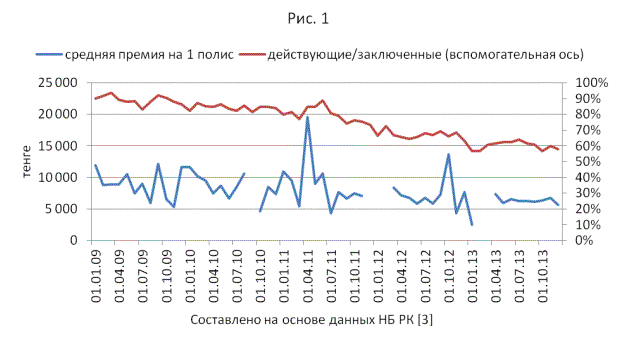
Figure 1 shows that, beginning in 2009, the ratio of valid insurance
policies to issued policies is consistently falling. In 2013, this figure fell
to 60%. The average insurance premium per insurance policy is also declining.
The decline in these indicators means one thing: the average insurance term of
all insurance policies is becoming shorter. I will attempt to ascertain the
causes.
Reissuance of insurance policies. This procedure is necessary when a
vehicle is bought and sold and when the terms of the insurance change. For
example, if I purchase a car in January, I must obtain an Auto Insurance
policy. If I decide to sell the car and buy a new one, for instance in May of
the same year, I terminate the first insurance policy (when the vehicle is
sold) and obtain a new insurance policy for the new car. It must be noted that
the term of the new policy will be 12 months. Thus, the insurance company has
one client for the year, but two issued insurance policies. Therefore, our
analysis must take this discrepancy into account. Let's evaluate this
discrepancy.
For evaluation, let's take the number of passenger cars in 2012-2013 (official
data from the Committee on Statistics of the Republic of Kazakhstan). On
average in 2012 and 2013, the number of passenger cars (owned by individuals)
has fluctuated between 3,450,000 and 3,750,000 units. In order to understand
the methodology used, let's look at table 1.
Table 1.
|
Report date |
Number of vehicles on
the date, units |
Registered in the
month, units |
Loss, units (terminated) |
Gain, units (issued) |
Balance, units |
Reissuance of policy |
|
1 |
2 |
3 |
4 |
5 |
6 |
7 |
|
05/01/2013 |
3,671,657 |
63,459 |
127,850 |
63,459 |
-64,391 |
63,459 |
|
06/01/2013 |
3,668,046 |
59,848 |
63,459 |
59,848 |
-3,611 |
59,848 |
|
07/01/2013 |
3,650,827 |
42,629 |
59,848 |
42,629 |
-17,219 |
42,629 |
|
08/01/2013 |
3,674,434 |
66,236 |
66,236 |
89,843 |
23,607 |
66,236 |
|
09/01/2013 |
3,667,582 |
59,384 |
66,236 |
59,384 |
-6,852 |
59,384 |
|
10/01/2013 |
3,679,905 |
71,707 |
71,707 |
84,030 |
12,323 |
71,707 |
|
Etc. |
||||||
|
Source of data [4] |
||||||
The point of this table is to calculate the potential
number of reissued insurance policies. The "loss" category (column 4)
in July 2013 (see the date 08/01/2013) may be interpreted to mean that 66,236
cars were sold. A portion of the 89,843 cars "gained" may be
interpreted as cars purchased (the same 66,236 that were sold). The remaining
23,607 may be imports into the country. Thus, we see that in July 2013, 66,236
policies were re-issued.
According to the reports of the National Bank of the
Republic of Kazakhstan, in July 2013 432,920 insurance policies were issued
[3]. In other words, 15% of all policies in effect in this period were
reissued.
Continuing the analysis and finding the average share
of reissued insurance policies, we arrive at a figure of 15%.I.e. the
discrepancy of 15% is the norm.
We see that if the ratio of valid policies to issued
policies is 85%, this is the norm. However, figure 1 shows that in 2013 this
indicator was 60%.
What happened to the other 25%? I noticed that certain
insurance companies have a very high proportion of short insurance policies,
25-30% of the total number of insurance policies. The sales department explains
that this is because the policyholder cannot afford to buy full (12 month)
insurance. Therefore, the policyholder purchases an insurance policy with a
term of less than 12 months (this type of policy is less expensive).
How is this reflected in the insurance market?
Essentially, the insurance market under-collects insurance premiums because the
amount of the insurance premium becomes lower, but the insurance payout (the
amount of the insurance company's liability) does not change. With short
insurance, the insurance premium is calculated PRORATA (in proportion).
However, the level of insurance risk remains the same. With classical
insurance, when the insurance term becomes shorter, the insurance rate should
not change in proportion to the term. According
to my calculations, since 2011 the insurance market has lost 13.4 billion tenge
in insurance premiums, which is equivalent to half of the yearly revenue of the
insurance market (see figure 2). In the calculations, an additional
amendment for actual short insurance was made in the amount of 5%. So 80% is
taken as the norm (the ratio of valid to issued policies). In figure 2, "Deviation" means the lost
profit of insurance companies in the form of uncollected insurance premiums.
Insurance premiums were not received due to clients obtaining short insurance
policies. So if we combine the "Auto Insurance Premiums" and
"Deviation" columns, we get the full scope of the insurance market.
Based on data from the National Bank of
the Republic of Kazakhstan [1]. Author's calculations Deviation Fig.2.Deviation in amount of insurance
premiums Auto Insurance Premiums

I offer a forecast of the payout ratio (the ratio of insurance payouts
to insurance premiums) assuming full insurance. Figure 3.This ratio determines
the potential profit of insurance companies.
Based on data
from the National Bank of the Republic of Kazakhstan [1]. Author's
calculations payouts/premiums actual payouts/premiums forecast degree of loss (main axis) Fig.3.Deviation of Loss Ratio of Auto Insurance

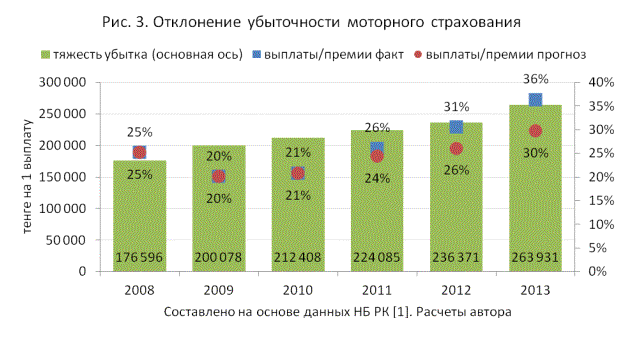
The figure shows that the ratio of payouts to premiums should be 30%
rather than 36%. In other words, insurance companies could be 6% more
profitable than they actually are.
Today, we are deceiving ourselves with the growth in auto insurance. In
fact, the annual growth in sales is linked to the growth in the MCI and the
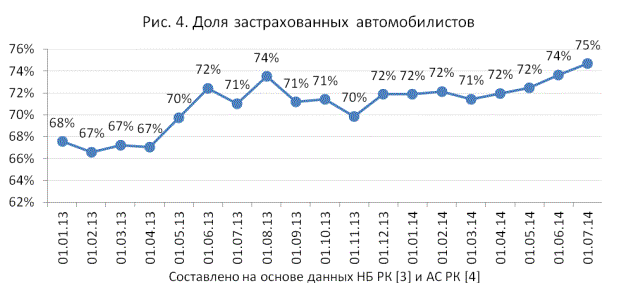
growth in the number of policyholders. For example, at the beginning of 2012,
the number of valid policies was 2,349,979 [3]. However, the number of
passenger cars was 3,553,814[4], i.e. 66% of motorists were covered by
insurance. The market did not reach its maximum of 75% until 2014 (Figure 4).
Based on data from the National Bank of the Republic of Kazakhstan
[3] and on motor vehicles in the Republic of Kazakhstan [4]. Fig.4. Proportion of Insured Motorists
Conclusion
The problems of the market that have been
described are systemic and require deep analysis, both by the regulator (the
National Bank) and the insurance market itself. I believe that the following
steps must be taken to resolve the problem:
Step 1. Establish an institute of the
insurance agent, which would be regulated by the National Bank. In other words,
in order to operate as a broker, an insurance agent (a broker providing
insurance services) should be accredited by the regulator. This measure would
make it possible to identify active and inactive (or fictitious) insurance
agents and would enhance the quality of an insurance agent's identification
data;
Step 2. Eliminate the restrictions on the
activities of insurance agents, specifically the restrictions on the amount of
commissions for signing insurance agreements for compulsory categories of
insurance. Today, the restrictions on the amount of an insurance agent's
commission are 10% for individuals and 15% for legal entities. The market
itself should regulate the cost of brokerage services, but how can this happen
when commission expenses are hidden in companies' financial statements?
Step 3. Eliminate the restrictions for
insurance agents to accept insurance premiums in cash under insurance
agreements for compulsory categories of insurance;
Step 4. We must assess the buying power of
the public and take this factor into account in setting prices for insurance
products. If the public cannot afford to purchase insurance, we will never be
able to grow the insurance market (today the insurance sector represents less
than 1% of GDP in Kazakhstan);
And most importantly, we must promote the
idea of insurance. Help the public understand the fundamental principles and
the essential meaning of insurance. This task should certainly be undertaken by
the government, because insurance can address many social needs (medical
insurance, pension insurance, property insurance, insurance against liability
to third parties, etc.).
Sources of Data
1. Official data on the insurance market "Receipts of Insurance
Premiums by Sectors and Categories of Insurance." National Bank of the
Republic of Kazakhstan http://nationalbank.kz/?docid=1077&switch=russian
2. Official data on the insurance market "Information on Insurance
(and Reinsurance) Organizations in the Republic of Kazakhstan." National
Bank of the Republic of Kazakhstan http://nationalbank.kz/?docid=1077&switch=russian
3. Official data on the insurance market "Summary Report on the Scope
of Obligations of Insurance (and Reinsurance) Organizations." National
Bank of the Republic of Kazakhstan http://nationalbank.kz/?docid=1071&switch=russian
4. Official statistical data "Registration of Passenger Automobiles in
the Republic of Kazakhstan." Committee on Statistics of the Ministry of
the National Economy of the Republic of Kazakhstan http://stat.gov.kz/faces/wcnav_externalId/homeNumbersTransport?_afrLoop=1045920119959048#%40%3F_afrLoop%3D1045920119959048%26_adf.ctrl-state%3D14htq7fqy6_50