AESTHETIC AND
FUNCTIONAL ASPECTS OF RHINOSEPTOPLASTY IN VARIOUS
NASAL PATHOLOGIES
J. Kholmatov, M. Ikromov *, K. Azizov*,
A. Abdukhalilov*, R. Murodov*
Department of Otorhinolaryngology of the
Tajik State Medical University;
*National Medical Center of the Republic of Tajikistan
The article
based on ENT clinic contains results of rhinoseptoplasty aimed to restore both
shape of external nose and a range of functional properties of the nasal cavity
and paranasal sinuses. It is determined that in various nose deformations not
only its appearance goes bad, but nasal breathing is difficult, transporting
and olfactory functions deteriorate, and in disorder of ventilation function of
auditory tube conductive hearing loss grows. In this regard, a joint survey
with interested specialists and a treatment of patients with nose deformations
can lead to good aesthetic and functional results.
Keywords: nose
deformation, hypertrophic and vasomotoric rhinitis, mucociliary transport, rhinoseptoplasty,
vasotomy, submucosal resection of the nasal septum.
Introduction. It is well known that aesthetic rhinoplasty
covers broad range of surgical interventions aimed at restoration of both
congenital and acquired deformations of external nose [2,4,5,9].
However, a
physician who aims to restore a shape of external nose of a patient, during the
surgical intervention is obliged to simultaneously undertake operations
restoring nose functions (respiratory, olfactory, transport, etc.) [3, 6, 7,
10]. Therefore, aesthetic surgery on nose must be performed by otorhinolaryngologists
who unlike physicians of other specialties (dentofacial surgeons, cosmetologists,
dentists) master more sparing endonasal techniques [1,2,5,7-9].
Unfortunately,
recently majority of otorhinolaryngologists actively involved into endonasal
surgery ceased to perform operations aimed at elimination of external nose
deformations. In these circumstances, more dentofacial surgeons became involved
in aesthetic rhinoplasty who are professionally limited to only elimination of
deformation of external nose. They are unable to operate to correct endonasal
functions aimed at restoration of above mentioned nasal functions that are encountered
in majority patients, as a result of what patients are forced to repeatedly
undergo an operation by otorhinolaryngologists.
Majority of foreign countries already improved the
situation. For instance, in the United States 85% of rhinoplasty is performed
by otorhinolaryngologists [1,2]. They simultaneously perform intranasal
operations to restore respiratory functions and correct the nose shape. Another
equally important aspect of the rhinoplasty is examination of disorder of the
mucociliary clearance – most important link in nonspecific protection of upper
respiratory tract resulting from majority of pathologic processes in nasal
cavity and paranasal sinuses (PNS).
Up-to-date morphological methods and the latest software
make it possible to not only assess such an important indicator affecting
condition of the mucociliary clearance system as beat frequency of ciliums, but
also examine character and synchronism of movement in more details, as well as
to assess degree of dequamation (extrusion) of epithelial cells in chronic
process [5,6,9,10].
Experience shows that to eliminate the nose deformation and
its insufficiency, a surgical intervention aimed to reduce the size of inferior
nasal turbinates, is required [5,6,9,10].
There are different methods of similar interventions.
However, the most widespread is a correction of external nose with submucosal
vasotomy (with associated vasomotor rhinitis) and lower sparing conchotomy
(with associated chronic hypertrophic rhinitis) [6,10].
Assessment of effectiveness of the surgical treatment of
these nose pathologies is complicated not only from the clinical point of view.
From the morhological side it makes it even more urgent and necessary to
examine all structure of both external and internal nose in details. Results of
the studies may serve as an objective criteria for degree of evidence and
reversibility of changes in endonasal structures after rhinoplasty with
adequate endonasal surgery in various pathologies of nose and paranasal sinuses
[2,5,7,9].
Present paper aims to study
aesthetic and functional condition of nose before and after the rinoseptoplasty
in patients with deformed external nose associated with vasomotor and chronic hypertrophic
rhinitis and nasal septum deviation.
Materials and methods. Over a period September to December
2010, 36 patients with various types of deformations of external and internal
nose commonly associated with vasomotor and chronic hypertrophic rhinitis aged
18 to 55 years were operated in the ENT clinic under the TSMU. Among those
examined 18 patients were re-operated due to iatrogenic complications arising
in other clinics of the country. There were 26 men (72.3%) and 10 women
(27.7%).
The patients
complained of difficulty in nasal breathing and deformation of external nose.
They were then screened in clinic that included ENT examination, determination
of respiratory, olfactory and transport functions, functions of auditory tube,
audiometry, computer tomography (CT) of the nasal cavity and side shot of
nasopharynx, as well as photo, endofoto documentation and anthropometric
measurements.
Results and their discussion. Through the
rhinoscopy range of grave disorders have been detected in the nasal cavity and
nasopharynx (hyperaemia, edema of the nasal mucous, hypertrophy of inferior
nasal conchas, muco-purulent nasal, adenoid vegetation in the nasopharynx).
There are some shots of endovideorhinoscopy for demonstration (Fig. l a-f and 2
a-f).
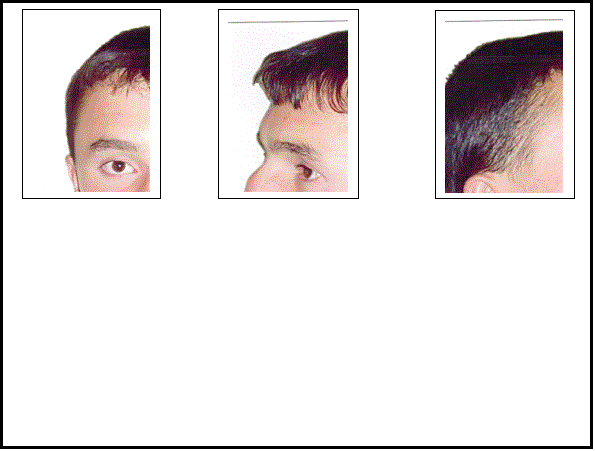

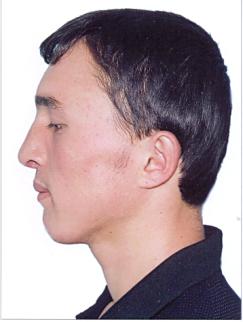
a b c

Figs 1.
d e f
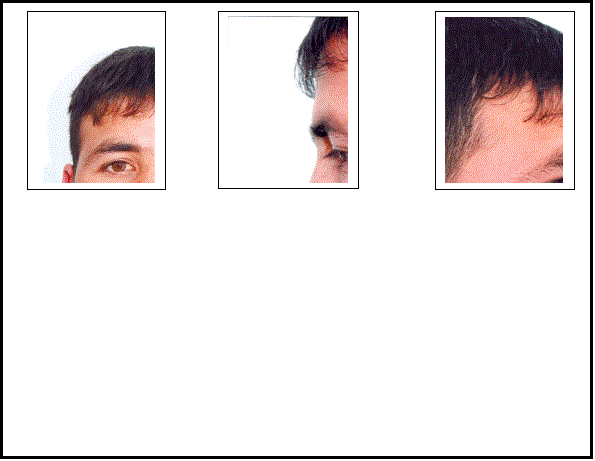
a b c
a b c

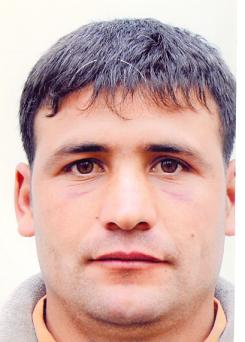
a b c
Figs 2.
d e f
After a
thorough examination in the hospital and patient’s familiarization with the
operation’s aim a rhinoplasty followed by a single-stage submucosal resection
of nasal septum, vasotomy of lower and middle turbinates and osteotomy of nasal
bone were carried out by indications.
During a
comprehensive ENT examination and surgical intervention on the nose and
intranasal structures with adequate local and general conservative treatment
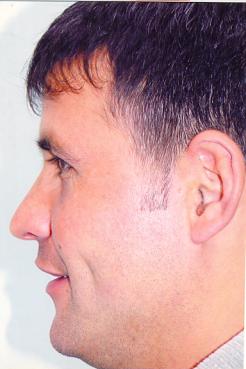
generally satisfactory results were achieved. Appearance of the external nose
in operated patients became of correct and proportional shape with restored
respiratory, olfactory and transport functions of the nasal cavity. State of
the transport function of the nasal cavity before and after the surgery is
demonstrated in tables 1 and 2.
Tables 1.
The distribution of patients according to the degree of
nasal mucociliary transport before surgery
|
The degree of muco-ciliary transport |
Norma |
I |
II |
III |
|
The number of patients |
0 |
2 |
8 |
26 |
Tables 2.
The distribution of patients according to the degree of nasal
mucociliary transport after surgery
|
The degree of muco-ciliary transport |
Norma |
I |
II |
III |
|
The number of patients |
30 |
4 |
2 |
0 |
Data
presented in the table demonstrates significant improvement of transport
function of the nasal cavity after the surgery.
Thus, having performed the rhinoseptoplasty, especially on the
cartilaginous section of external nose, one should remember of the need for
correction of the nasal valve aimed at restoration of its normal size.
To restore
nasal breathing we apply various operations on the nasal septum and turbinates
held simultaneously with the rhinoplasty. This is an important condition.
Practice
shows that separation of two interventions – aesthetic surgery to restore shape
and function of the nose, and functional – to restore respiratory and other
mentioned functions of the nose – is wrong. Both shall be performed
simultaneously. We believe that having properly assessed every individual case,
it is feasible to perform necessary interventions keeping to the maximum extent
possible the tissue structures, architectonics of the nasal cavity and not only
restore nasal patency, but to seek to restore its proper aerodynamics.
References
1. Walter K.
Complications of rhinoplasty / K.Valter// Rus. Rhinology. -1995. - № 2. -C.
4-16
2. Walter K.
Evolution of rhinoplasty / KValter// Rus. Rhinology. -1996. - № 1. - P.5-16
3. Iskhaki Y. B.
Allergy in Otorhinolaryngology / YB Iskhaki. Dushanbe: lrfon,-1980.-169 with.
4.
Kurbanov U. A. Rhinoplasty in posttraumatic nose deformations / UA Kurbanov, AA
Davlatov, MS Odinaeva, SM Dzhanobilova // Bulletin Avicenna-2008.-Ns2. -C.
13-22
5.
Palchun V. T. Mucociliary clearance and its parameters as
performance criteria of spare inferior turbinotomy in patients with
hypertrophic rhinitis / V.T. Palchun, D. A. Turusov, M.E. Artemev,
E.A.Ruzhitskaya // "Vestnik otorinolaryngologii." Annex. Materials of
the VI All-Russian Conference of otolaryngologists. M. - 2007. - № 5., P.173
6.
Palchun V.T. Comparative characteristics of mucociliary clearance in patients with
chronic hypertrophic and chronic vasomotor rhinitis / V.T. Palchun, D. A.
Turusov, M. E. Artemev, E. A. Ruzhitskaya / / " Vestnik
otorinolaryngologii." Annex. Materials of the VII All-Russian Conference
of otolaryngologists. -М., - 2008. - № 5. S.207
7.
Piskunov B.C. The significance of endonasal anatomical
structures in order and disorder: author’s abstract, candidate of medicine/
V.S.Piskunov., Sain*t-Petersburg., 2002.-22.
8. Piskunov G.Z.
About the physical role of the nasal septum / G.Z. Piskunov, S.Z. Piskunov / /
Vestn. Oto- rinolaringol. -2000. - № 6. -C. 57-58
9. Turusov D.A. Restoration
of function of ciliated epithelium surgery treatment of patients with trauma of
maxillary sinus.
10. D.A. Turusov [etc.] / /
"Vestnik otorinolaringologii." Annex. Materials of the VII
All-Russian Conference of otolaryngologists. - М., -2008. - №
5.-p.221
11. Turusov D. A. State of the mucociliary clearance in
chronic hypertrophic and chronic vasomotor rhinitis on the basis of
morphometric data / D.A.Turusov, E.A. Ruzhitskaya, M. M. Magomedov //
"Vestnik otorinolaringology" -N85.-2009.-S. 20-22
SUMMARY
AESTHETIC
AND FUNCTIONAL ASPECTS OF RHINOSEPTOPLASTY IN VARIOUS
PATHOLOGIES OF NOSE
M. Ikromov, J. Kholmatov, M.I.Mahmudnazarov
The article based on ENT clinic contains results
of rhinoseptoplasty aimed to restore both shape of external nose and a range of
functional properties of the nasal cavity and paranasal sinuses. It is
determined that in various nose deformations not only its appearance goes bad,
but nasal breathing is difficult, transporting and olfactory functions
deteriorate, and in disorder of ventilation function of auditory tube
conductive hearing loss grows. In this regard, a joint survey with interested
specialists and a treatment of patients with nose deformations can lead to good
aesthetic and functional results.
Keywords: nose
deformation, hypertrophic and vasomotoric rhinitis, mucociliary transport, rhinoseptoplasty,
vasotomy, submucosal resection of the nasal septum.
Contact
person: Jamol
I. Kholmatov - Professor of the department of otorhinolaryngology of TSMU,
734003, Tajikistan, Dushanbe. Tel.
+992 98 104 16 34
E-mail: Kholmatovji@mail.ru