Технические науки/13. Охрана
труда
Bekturganova G.S., Satymgalyeva
A.
Kazakh
National Technical University named after K.I. Satpayev
Almaty city, Republic of Kazakhstan
Determination of depth of
penetration of oil in soil and establishment of possibility of its hit in
ground waters
Summary.
With increase in volumes of
oil production the number of cases of pollution of terrestrial surface
hydrocarbon raw materials continuously increases. Penetration of liquid
hydrocarbons into bowels of the earth leads to pollution of soils, soil and
underground waters and, finally, to ecological disruption on a terrestrial
surface. In this regard in article questions of determination of regularity of
pollution of soil and underground waters are considered during emergency
pouring of oil when transporting oil and oil products, change of warm and
physical, physic mechanical, physical and chemical properties at oil
interaction with a soil earth's mantle. Depth of penetration of oil in soil and
possibility of its penetration into underground waters is determined.
Despite considerable
advantages of pipeline transport of oil and oil products on pipelines pollution
of the atmosphere, reservoirs and the soil take place.
It is necessary to refer
the following processes to the main reasons for pollution:
- Emissions of light
hydrocarbons connections when filling tanks and temperature fluctuations of gas
space of tanks and an oil surface;
- Oil evaporation from a
surface of the polluted sewage, at leaks and emergency floods therefore the
part of oil is carried away by storm thawed snow in reservoirs;
- Products of cleaning of
pipelines and tanks from resinous deposits, etc.
The problem of labor and
environmental protection, rational use of natural resources has important
social and ecological value. With industry development influence of results of
human activity on the nature becomes so big that the damage caused to it not
always can be restored by a natural way without carrying out nature protection
and nature-restoring actions.
At a construction and operation of the main oil
pipelines to a problem of environmental protection pay the main attention. Impact on environment of the main oil
pipelines is caused by their specifics as linearly extended objects (extent
from hundreds to several thousand kilometers), laid in difficult climatic
conditions with application of various constructive schemes and technologies
which also make harmful effects on environment. Considering a fundamental role
of the main pipelines as means of transportation of liquid and gaseous products
and involvement in economic activity few of the mastered natural regions, being
characterized high sensitivity to technogenic influences, the environmental
protection problem at pipeline transport is today very actual.
At an exit of oil and oil products in
environment water and the soil become soiled the hydrocarbons entering into its
structure. At the same time there are the processes leading to decomposition of
oil: distribution, evaporation and dissolution. At operation of linear part and
objects of the oil pipeline the main sources of impact on a condition of
underground waters are reservoir parks of oil pumping stations, barns for
emergency storage of oil, stores of waste, filtration and evaporation fields
for dumping of sewage, warehouses of fuels and lubricants, gas stations and
places of leak, emergency dumping of oil on the oil pipeline route.
Influence of these sources on a condition of
underground waters results from leaks and consists in pollution of the last by
nitrates, nitrites, phosphates and the weighed substances in case of dumping on
fields of a filtration and evaporation of household waters and oil products in
all other cases. At pollution of underground waters by oil products they can be
in a type of a single-phase liquid layer, true solutions or small emulsions, a
gas phase and as are occluded by breeds. Processes of phase differentiation
along with properties of oil products are influenced by properties of breeds
and underground waters, temperature, pressure, a saturation of breeds and
waters oxygen and microorganisms. Depth of penetration of pollution is defined
by security of the water-bearing horizons. The most vulnerable in this regard
is the water-bearing horizon of ground waters first from a surface. In the
conditions of normal operation of the oil pipeline by a potential long-term
source of impact on underground waters oil pumping stations, and especially
head, having capacities for storage of oil products and combined with bases of
supply, repair and emergency services will be. The various technogenic drains
which are forming on platforms can be sources of pollution of underground
waters.
In this regard in article at pipeline transport of oil and oil products
we decided to reveal regularities of pollution of soil and ground waters at
emergency oil spill, regularity of interaction of oil with the soil, changing
heat physical and physical-mechanical and physical-chemical properties. At a filtration the condition of water in a
time changes as a result of the phenomena described in work [1]. In this work
the formula for definition of a specific amount of water is received:
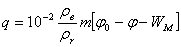 (1)
(1)
where WM
- maximum molecular moisture content of disperse particles less than 0,5 mm in
size, %;  - mass percentage of particles less than 0,5 mm in
size, %.
- mass percentage of particles less than 0,5 mm in
size, %.
For clarification of influence of a superficial
tension of liquid and wet ability of soil on its relative humidity, we will
present space with a time in a look in water of a cylindrical form. Then extent
of filling of a time or relative humidity can be presented as:
 (2)
(2)
где Sк -
критическое сечение, при котором начинает наблюдаться явление капиллярности, м2;
S0 - среднее сечение порового пространства, м2.
The phenomenon of capillarity is shown at
various radiuses of space with a time. However it is necessary to take its maximum
value at which the capillarity phenomenon starts being shown for the size Sk.
For a cylindrical form of space with a time relative humidity can be
expressed as
 (3)
(3)
where rk - the radius at which the m begins the phenomena of
a capillarity or the critical radius of manifestation of a capillarity; r0
- the average radius of a time of a skeleton of soil, m.
Critical radius of rk we will express
through a superficial tension of liquid:
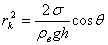 (4)
(4)
where  - water surface tension, N/m; g
- acceleration of a free fall, m/с2; h - height of a
capillary raising of water rk corresponding to radius, m; - regional
corner of wetting of water, hail.
- water surface tension, N/m; g
- acceleration of a free fall, m/с2; h - height of a
capillary raising of water rk corresponding to radius, m; - regional
corner of wetting of water, hail.
Thus, dependence of relative humidity on a water surface tension to
wettability of a skeleton of soil can be presented a formula:
 (5)
(5)
It should be noted that in a formula (5) the
roughness of a piece of a skeleton of soil and an orientation of a form of
steam space isn't considered. Finally, all this influences the size of relative
humidity and therefore on a specific amount of water in a soil time. To exclude
these shortcomings relative humidity of soil it is expedient to determine by a
weight method (mass) and, therefore, the formula (5) needs to be expressed not
through the relation of volumes, and through the relation of masses. It is
reached by that density of water  is entered
into a formula (5) and soil
is entered
into a formula (5) and soil  density.
Besides, transition to a weight method of definition allows excluding the
approach connected with representation of space with a time in the form of a
cylindrical form since the amount of capillary water doesn't depend on a shape
of a skeleton of soil of space with a time. As a result we have:
density.
Besides, transition to a weight method of definition allows excluding the
approach connected with representation of space with a time in the form of a
cylindrical form since the amount of capillary water doesn't depend on a shape
of a skeleton of soil of space with a time. As a result we have:
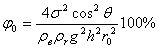 (6)
(6)
From here it is possible to draw a conclusion that with reduction of a
superficial tension and wet ability of a skeleton of soil relative humidity
decreases in proportion to a square of these sizes. When studying a filtration
of oil it is necessary to consider interaction it with the water which is
present at a time of soil which relative humidity is determined by a formula
(6).
Some authors [2,3] claim that the water current with incomplete filling
of a time of soil, will submit to the laws similar to laws of hydrodynamics, and
liquid movement in other conditions, will submit to other laws following from
laws of a superficial tension and evaporation. Besides lack of the bottom limit
of applicability of the law of Darci suggests an idea that in incoherent porous
environments under certain conditions there is a special view of the current of
liquid which has so far no mathematical description depending on a superficial
tension of liquid and wet ability.
Other directions of studying of problems of a filtration of liquid in
porous environments are researches of the equation of movement and continuity
under various boundary conditions [2] and others. Thus the exact solution of
these equations is consolidated to special mathematical methods and their
practical use for specific objectives not always possibly. For the practical appendix they decide
various approximate receptions, as methods of small parameter, final
differences, total representations, etc. In works [3,4] the condition of water
in the soil, in porous water-permeable rocks, depending on their humidity is
described. At the smallest content of liquid it is absorbed in soil grains, and
with increase in humidity it starts enveloping soil grains in the form of films
and further with increase in humidity fills at first small, and then larger
time. When filling all time liquid gets opportunity to move by gravity.
However at a liquid current layer-by-layer with
absorption without a pressure filling of a time doesn't reach. The current
caused by interaction of liquid of the bottom layer with a skeleton of soil
which is defined by a superficial tension of liquid and wet ability of rocks
will prevail thus. In this case, the bottom layer is water with disperse firm
particles. Then the description of such type of movement corresponds to the
equation:
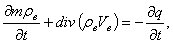 (7)
(7)
Here Vв - speed of movement of water at incomplete filling of
a time of soil, m/s; q - density of a drain of liquid or specific amount of
water which contains in space soil with a time.
At such current of liquid all directions of
distribution of liquid will be equivalent. In this regard the equation (7) can
be presented in the form of an one-dimensional task:
 (8)
(8)
Humidity  in a formula
(6) generally is function of coordinate by X and t time, that is it is possible
to write down
in a formula
(6) generally is function of coordinate by X and t time, that is it is possible
to write down  . Expression
 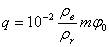 differentiating on time and
substituting in (8) will look as:
differentiating on time and
substituting in (8) will look as:
 (9)
(9)
The sizes Wm, m
don't depend on time and coordinates, and depend on density of rocks composing
soil. Grouping and dividing variables on time and coordinate, and also
considering that  from (9) we will receive for
integration the equation:
from (9) we will receive for
integration the equation:
 (10)
(10)
Relative change of density of liquid at the expense of interaction
processes with oil with disperse particles of soil is much less than relative
change of humidity of soil, i.e. it is possible to write down
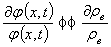 (11)
(11)
On it the right member of equation (11) is equal to zero and the left
part can be presented in a look:
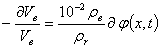 (12)
(12)
Integration of expression (12) it is made on certain limits. At speed
change from initial V0
up to the size U0
corresponding to speed of movement of water on a time of soil, its humidity
changes from natural to relative which corresponds to steam water. Therefore, a
certain integral can be written down as follows:
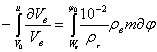 (13)
(13)
After integration for water speed on a time of soil we will have
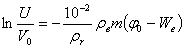 (14)
(14)
Here We - natural
humidity of soil, %.
Exponentiation expression (14) having substituted value  of a formula (6) we will receive
expression for the speed of a filtration of water during a soil time
of a formula (6) we will receive
expression for the speed of a filtration of water during a soil time
 (15)
(15)
Apparently from a formula process of a filtration has difficult
character from the sizes entering into it. However it should be noted essential
dependence on a water surface tension and wet ability of grains of soil.
The received formula allows determining depth of penetration of the
water transporting with oil
 (16)
(16)
The sizes entering into this formula can be
defined experimentally in vitro on soil models. During t it is necessary to
accept time since the oil spill beginning at accident to a complete elimination
of its consequences. To liquidate consequences of ruptures of oil pipelines -
very difficult task in the practical relation. Therefore depending on climatic
conditions, during t it is necessary to accept everything months of year except
winter months. Depending on the size of speed, the location of a rupture of the
oil pipeline, and also depending on depth of an arrangement of ground waters
with rather bigger accuracy it is possible to determine time during which oil
will reach a surface of ground waters by a formula.
It should be noted, at accidents on the oil
pipelines connected with a rupture of it, there is a pollution not only soils
and ground water, but also atmospheric air. Especially strong pollution of
atmospheric air happens when the poured oil appears on a soil surface, at the
expense of its intensive evaporation.
In article process of a filtration is
considered and is revealed that, process of a filtration of oil becomes
complicated presence at steam space of water at various conditions. The oil
filtration in soil should be considered as a layer-by-layer current of two
liquids relatively each other. And as transport of oil the water being in steam
space of soil is. The amount of the liquid being in steam space, decides by
physic mechanical characteristics of soil and the physical and chemical sizes,
characterizing interaction of liquid on soil minerals.
Dependence of relative humidity on wet ability
of soil and superficial tension of liquid which is proportional to squares of
these sizes is established. Dependence of speed of a filtration of liquid in
soil depending on wet ability of grains of soil and a surface of a tension of
liquid is proved. The formula for determination of depth of penetration of oil
in the soil, depending on physic mechanical properties of soil and physical and
chemical characteristics of interaction of liquid with soil grains is offered.
The list of the used literature:
1. Innovation patent #84229 KZ. Способ определения
удельного расхода жидкости для увлажнения
навала горной массы. Zharaspayev
M., Mirzahmetov M.M., Bekturganova G.S.; 17.06.2011. Bulletin-6. Committee on rights of intellectual
ownership of Justice Ministry of the Republic of Kazakhstan.
2.
Христианович С.А., Михлин С.Г., Девисон Б.Б. Некоторые новые вопросы механики
сплошной среды. -М.-Л.: АН СССР, 1938. - 407 с.
3.
Веригин Н.Н., Шерпеуков Б.С. Диффузия и массообмен при фильтрации жидкости в
пористых средах // Развитие теории фильтрации в СССР (1917-1967) - М.: Наука,
1969. С. 237-313.
4.
Лебедев А.Ф. Почвенные и грунтовые воды. -М.-Л.: АН СССР, 1936.-316 с.