MATHEMATICS / 4. Applied
mathematics
PhD Iskakova A., Toksanova
S.
L.N. Gumilev Eurasian National University, Astana, Kazakhstan
Probabilistic
model of the dynamics of social cases
Presented probabilistic model reveals
the need for surveillance issue detailed approach to the study of factors
affecting the dynamics of the recipients of social cases.
1. Intorduction.
Obviously, the dynamics of the receipt of social benefits affect the following
factors: economic (inflation, crisis, changes in the sectoral structure of the
economy), social (health condition, change of residence etc) and psychological
factors (intuziazma loss, loss of interest in work, new hobbies and
motivation).
Probabilistic study of all quantitative indicators for
social benefits is based on the likely impact of the relevant factors. Of
course the theory of probability it is clear that these factors can be
considered as a polynomial distributed. However, the probability distribution
of the sum polynomial distributed random variables and its application in
social studies in the scientific literature in [1, p. 79], [2, p. 012,113], [3,
p. 86].
However,
if you are risen situations in which events were to issleduemmye imposition of
unknown phenomena, in other words, the implicit assumption that there are still
many unsolved problems.
2.
Construction of a probabilistic model of events dependent factors. Any social benefits is a consequence of the influence of group factors.
Let us assume that the social case u
case N factors with some degree of action.
We define each factor is one of the possible numbers l1, l2,
..., ln with the corresponding values of the probabilities p1,
… , pn and

Let’s k factors can contribute to the possible implementation of the u social case. And l1 factor influenced the social event u r1
times, l2 factor
influenced the social event u r2 times, and so on factor ln influenced social event u rn times. It's obvious that
 .
.
Theorem 1. The number of all kinds of influences k factors with repetitions in which l1 factor influenced the social event once u r1, l2 factor influenced the social event u r2 times, and so on factor
ln influenced social event u rn
times, defined as
 .
.
The proof is obvious from the course
of combinatorics (see. [4, p. 19]).
Theorem 2. The probability that in the case of social impact u k factors with repetitions in which l1 factor influenced the social event's time r1, l2 factor influenced the social event u r2 times, and so on factor
ln influenced social event u rn
times, there
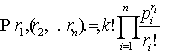 , (1)
, (1)
where the values p1, … , pn determine
the probability factor of influence with the corresponding number l1,
l2, ..., ln on sogial case u.
Proof. Obviously, in this case we have a probability polynomial
distribution, which has the form (1) (see. [5, c.223]). QED.
Ex. 1. In reviewing the analysis of the dynamics of social benefits in the
event of job loss in the North-Kazakhstan region we have the data presented in
Table 1.
Table 1.
Dynamics of recipients of social
payments in case of job loss in the North-Kazakhstan region
|
Years |
2007 |
2008 |
2009 |
2010 |
2011 |
2012 |
2013 |
2014 |
2015 |
|
Number
of recipients |
30 |
110 |
1200 |
1100 |
1230 |
1005 |
1150 |
1320 |
1030 |
Let us assume that the economic
factor can affect the loss of a job with probability 0.7, the 2nd factor of
0.2, 3rd - 0.1. Suspected breaking the factors affecting the dynamics of the
job losses, on the North Kazakhstan region are presented in Table 2.
Table 2.
Suspected breaking the factors
affecting the dynamics of the job losses, the North Kazakhstan region
|
Years |
2007 |
2008 |
2009 |
2010 |
2011 |
2012 |
2013 |
2014 |
2015 |
|
|
Number
of recipients |
30 |
110 |
1200 |
1100 |
1230 |
1005 |
1150 |
1320 |
1030 |
|
|
Variant
1 |
Factor
1 |
21 |
77 |
840 |
770 |
861 |
703 |
805 |
924 |
721 |
|
Factor
2 |
6 |
22 |
240 |
220 |
246 |
201 |
230 |
264 |
206 |
|
|
Factor 3 |
3 |
11 |
120 |
110 |
123 |
101 |
115 |
132 |
103 |
|
|
Variant 2 |
Factor
1 |
22 |
82 |
900 |
825 |
922 |
753 |
862 |
990 |
772 |
|
Factor
2 |
7 |
25 |
276 |
253 |
282 |
231 |
264 |
303 |
236 |
|
|
Factor
3 |
1 |
3 |
34 |
22 |
26 |
21 |
24 |
27 |
22 |
|
Breaking the factors there is a
significant set. So for the first embodiment of partitions factors have for
2007
 .
.
3. The probability
distribution of the sum of the factors affecting the social event. For example, we have social benefits with the value of u, k
represents the sum of the values of the factors that will affect u social benefits. I.e
 . (2)
. (2)
Theorem 3. The probability that the sum of the numbers on the k factors affect repetition on social benefits equal to u, is determined by the formula
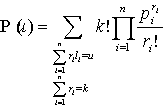 .
.
Proof. Needless to say, if the
formula (2) takes place then system of equitions
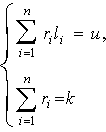
has one or more solutions. The probability of each
solution of last system is determined by Theorem 3. Thus, come to the proof of
the theorem. QED.
Ex. 2. From Example 1 we have only two options partitions factors are shown in
Table 2. Consequently,
the next decision fair.

References:
1. Искакова А. С. Определение наиболее подходящей несмещенной
оценки вероятности оправдываемости прогноза в метеорологии //Сибирский журнал
индустриальной математики. – 2002. – Т. 5. – №. 1. – С. 79-84.
2. Ayman I. Construction of the most
suitable unbiased estimate distortions of radiation processes from remote
sensing data //Journal of Physics: Conference Series. – IOP Publishing, 2014. –
Т. 490. – №. 1. – С. 012113.
3. Iskakova A., Ibragimov B. A method for determining an unbiased estimate //
Nauka i Studia. – Przemyśl: Nauka i studia. - NR 7 (52), 2012. –P. 86-91.
4. Сачков В. Н. Комбинаторные методы дискретной
математики. – Издательство" Наука", Главная редакция
физико-математической литературы, 1977.
5. Panaretos J., Xekalaki E. On generalized binomial and multinomial
distributions and their relation to generalized Poisson distributions. // Ann.
Inst. Math. 1986.V.38.Part A. P. 223 – 231.