Технические науки/2. Механика
D.tech.scien. Artamonova E.N., Grigorieva E.V.
Saratov State Technical
University n.a. Gagarin Y.A., Russia
Modeling of destruction of polymeric materials
In this paper we propose a
mathematical model of destruction (the
relations connecting parameters of efficiency at the time of fracture
characteristics material), based on the relationship of both these approaches
to allow for the dependence of the limiting critical conditions at which the
destruction, the time of stress, temperature environmental exposure, exposure,
etc. This is especially typical for polymers [1]. An examination of these
experimental data one can draw conclusions that should be taken into account
when constructing the mathematical correlations for the conditions of fracture:
Mechanical properties and the process of destruction of polymer
materials substantially depend on time and operating conditions.
Destruction is a two-stage process. At the first stage the
degradation of the properties of the material, the accumulation of damage,
microcracks occur. The stage ends at a time when the merger of microdamage
formed macroscopic crack. This moment is short-lived and by their physical
nature is a loss of stability of equilibrium microdefects.
Because of the irreversibility
of the process of destruction is determined not only the current values of
parameters characterizing it, but the entire prior history change of these
parameters.
Because of the private nature of the experimental data on the
effect of medium on behavior of plastic the composition of the general
mathematical for all materials the
phenomenological description of fracture based on mechanical ideas due to the
difficulties and serious shortcomings. Therefore it is necessary and the molecular interpretation
of macroscopic changes in the material. Thus, the phenomenological theory of
time dependence as would provide a common framework, which must fit the theory
of material behavior, and that put a detailed mechanical theory of change of
macroscopic and microscopic properties of the polymer. This need arises in the
interpretation of the parameters of the phenomenological equation, allowing you
to identify not only the common features, as well as the difference between the
materials.
Because of significant time effects for polymers the process of
their destruction more difficult than traditional materials, the phenomenon of
viscous and brittle fracture occur simultaneously. Fracture criterion in this
case must take into account the achievement σ, ε of the instantaneous and
destructive values σ р, ε р, at
the time tразр., and their dependence on the
development of degradation of material properties ω (t).
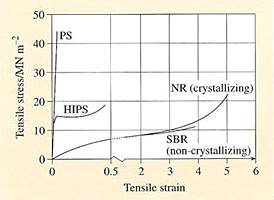
Figure 1.
Analysis of experimental data (Fig.1) suggests characteristics
of the temperature dependence of relaxation processes and fracture for
viscoelastic polymers with the same value of energy activation for each material.Both aspects of the strength of
polymers depend on the local structural changes that primarily can be linked
with the process of accumulation of damage, education grid hairline cracks.
Combining different approaches to describing these processes, i.e. formulation
of a general mathematical theory of deformation and fracture of polymers depends
on the study of the relationship of deformation, destruction and action of
strain, temperature, aggressive factors in the whole time interval of operation
of the element.
According the survey of the
literary sources for the analyzing of long-term durability of materials and
elements made of them two alternative approaches are basically exist:
mechanical (benchmarking) and kinetic.
According the first approach we
model the generalized condition for material destroying:
Ф (θ1, θ2, θ3 ) = Ф р.
Here Ф - the functional is some combination of the components
of the stress or strain. The functional
Ф depends
on the accepted theory strength or given empirically and then the functional
contains parameters determined experimentally.
Ф = ∫dV [1/2 ρu iu i– λ/2 ∂ui/∂xi ∂uj/∂xj - µ/2( ∂ui/∂xj ∂ui/∂xj + ∂ui/∂xj ∂uj/∂xj)].
1.The strain tensor can be
represented as a sum of tensors of elastic deformation of inelastic
deformation:
ε ij = ε ij¹ + ε
ij².
2. For description the strain state and fracture in the framework of a
generalized model of inelasticity is necessary to consider the history of
deformation of the sample depends on the loading path and on time. For
different loading paths for the processes of varying duration results will be
different.We give a physical explanation of the above stated hypothesis.
References:
1. Suvorova J.V., Ohlson
N.G., Alexeeva S.I. An approach to the description of time-dependent materials
//Materials and Design, Vol.24. Issue 4, June 2003.- P.293-297.