Economics. Investment activity and
capital markets.
Post-graduate,
Bogach Dmitry
National
Mining University
Analysis
of changes in the structure of modern stock markets, their dynamics and
interdependence
Over the last decade, the global economy is determined
by a number of new trends. These primarily include the technological revolution
caused by the widespread use of computers and new method of communication which
led to radical changes in production, trade and especially in the financial
sector, especially in the equity markets. To develop investment strategies,
improving the management of the stock market and rationalization of interaction
is necessary to understand the trend’s changes in the structure of capital
markets and their dynamics.
The current stage
of development of economic ties across the world is characterized by
significant changes in the global investment process. Regularity and large
scale movement of investments between domestic and international stock markets
give a rise to a new phenomenon in the field of international investment -
financial globalization, which leads to changes in the structure of markets and
the emergence of distinct relationships between their main indicators. Only
understanding trends in change of market structure can provide a reliable
estimate of their condition. The aim of the study is to describe the changes in
the structure of modern stock markets and dynamics of their development.
The globalization of financial markets , the
development of computer and telecommunications technologies have exacerbated
competition , resulting in stock exchange have to carry out large-scale
investments in new technologies in order to improve competitiveness by offering
new services to attract new companies - issuers of new members and a broad
range of investors.
Recently, as the facts show, a number of exchanges
have changed their organizational - legal form in order to strengthen internal
architecture to compete with other international markets. There is a tendency
of transition from form of associations and organizations which governed by
special regulations, to joint-stock company type, as the result their
membership base framework have become more open and diverse.
Research different markets, organized by Members of
the International Federation of Stock Exchanges, show that their activity is
concentrated mainly on traditional stocks and bonds. Not surprisingly, 98% of
exchanges form the equity markets, 82% - bond markets. Thus, revenues of stock
exchanges consist principally from exploiting common stock products - stocks
and bonds. Markets of derivatives - yet under-represented, especially given
tremendous development in the world trading of futures and options since the
mid 80’s.
Structure of capital which is involved in the equity
markets over the last century, was distributed, mainly, to the U.S. market
(fig.1).
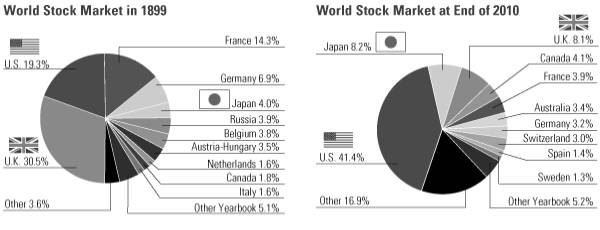
Figure
1. Changes in structure of capital which is involved in the equity markets 1899
to 2010.
The largest stock market - the U.S. market, which
faces some challenges, in particular, such as increased competition from other
market parties, including private trading systems and the Internet. This
external pressure forcing exchanges to adapt its internal structure to changing
influences.
Currently the stock market was struck by a deep crisis. It was
caused by a complex of both objective and subjective factors. The world
continues to operate many exchanges and trade organizations, whose future is
now very uncertain. Unlike the stock market, which in one form or another will
operate fate trade organizations may be more dramatic. At this stage the
currency factor is increasing in the operations of global stock markets. The
instability currencies rates of leading Western countries have a significant
impact on the movement of financial flows between the markets of the U.S.,
Western Europe and Japan. Currently, there is virtually synchronous rise or
drop in the national securities markets of different countries (fig. 2), which
can lead to increase the scale and duration of oscillation cycles of rates
movement.
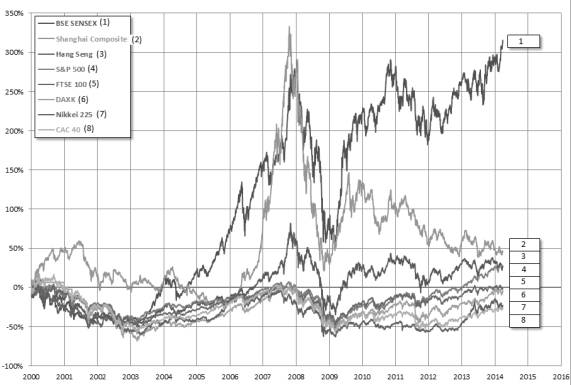
Figure
2. Comparison vibrations major stock markets around the world.
Synchronicity in motions of rates is provided by
information transparency of national stock markets, high speed information
transfer, a significant amount of cross-border securities transactions, the
increased role of institutional investors, the openness of national stock
markets on which active role is played by foreign participants who act as
issuers and investors.
Under conditions of high volatility, the financial
risks of economic agents are repeatedly increasing. To determine the most
stable market, researchers should perform a comparison of levels of volatility
major stock markets (Figure 3). From figure 3 we can see that the most stable
is the U.S. stock market. It is the most capacious market and factors which can
destabilize it, arise in the global economy very rare. Therefore, the
development of models for the management of investment portfolios should be
based on the U.S. stock market.
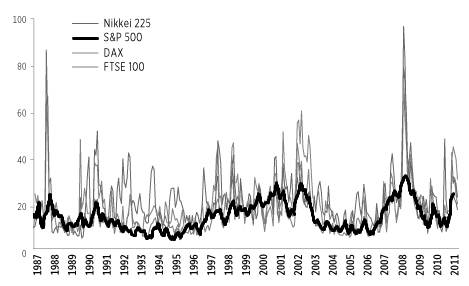
Figure
3. Comparison of the volatility of major stock markets in the years 1987-2011
The U.S. stock market serves mainly domestic investors
and issuers. Share of non-residents in the U.S. market is much lower than in
any other national stock market. The impact on the situation on the U.S. stock
market provides state of the U.S. economy.
The U.S. stock market is dependent on the inflow of
foreign capital. From the inflow of foreign capital into the U.S. market
depends on the position of the dollar in world currency markets. Due to the
huge deficit of trade balance and balance of payments deficit on current
account, for the balance of supply and demand of the dollar on the world
currency market, daily more than 1 billion of
foreign capital should come to the U.S. market.
World stock market develops in cycles. Globalization
of equity markets increases their interdependence. At the national stock
markets there is almost synchronous rise or fall rate of securities. The depth
of the drop in stock price is determined by their overvalued rate. Development of new technologies leads
to blurring of geographical origin of the different market members. These
features should be used when developing investment strategies based on market
neutrality. Because of the stability and liquidity indicators should be used
U.S. markets , then further consideration should be based market Nyse, Nasdaq
and CME.
In
the future, as continuation of the investigation, perhaps consideration of
national stock markets as a global, and finding of new interdependencies
between the stock market, commodity market and derivatives in modern
conditions.
Concluding the review of trends in changing patterns
of stock markets should be noted that the situation prevailing at the time is
unique. The role and scope of the stock markets have become unprecedentedly
high. The structure becomes more complex in terms of participants and used
tools, transactions in the market becomes extremely rapid. As a result, a
comprehensive analysis of structural changes of stock markets in a globalizing
world economy and its main trends and dynamics is defined.
Literature:
1. Alekhine B., Securities Market, UNITY-DANA, 2004.
2. Schetinin V., Economic diplomacy, Moscow, 2001.
3. Bychkov A., The world market for securities:
institutions, tools and infrastructure, Dialog-MGU, 1998.