Физика/5.геофизика
Prof.
B.D. Khristoforov.
Institute
Dynamics of Geospheres RAS. Moscow. E-mail:khist@idg.chph.ras.ru
Dynamic viscosity of solids in ultra - wide range of the
deformations time
Introduction
Many rheological
models of rocks and various materials are considered
viscosity coefficient η constant or a function of temperature.
In our tests on the
loading by blasts and the impacts of porous rock salt, limestone, marble,
textolyte was observed linear increase in viscosity in the range η = 104
- 109 Pas at deformation for the time τ = 10-7
- 10-2 sec [1,2]. These data were supplemented by values of η,
obtained with the comprehensive and
axial compression of limestone on
the press in the study of creep [3], from geophysical estimations of continental drift [4], after the lifting of
the Scandinavian Peninsula from goes glacier of 9000 years ago [5] and the displacements of mascons on the bottom of
the lunar seas [6].
At times the
deformation τ = 10-7
- 1017 sec (up to 4,5 109
years old) for the investigated
materials was obtained linear
empirical relation η ≈
Gτ, where G is close to the shear modulus. This relationship was confirmed by
analysis of the generalized model for
multi-component solid of Fought and consistent with the model for highly viscous
liquids [7].
Below are the results of research the
viscosity to a wider range of hard bodies. Rheological processes at motion of
dislocations in crystals were considered. On 3 orders of magnitude increased times deformation, elastic modulus and external
pressures. The previous data and methods for determining viscosity were correct.
The results may be useful in the construction of geophysical models and mathematical
modeling of dynamic processes in the lithosphere and mantle using rheological
models [8, 9].
Analysis of experimental data
The values of
the viscosity coefficient η were determined in a wide range of
deformation time τ for loads close to destroying under explosive and
impact loading of various materials from literature and author data. Various
methods of determine η were applied depending on
the conditions of deformation. Viscosity at the nano scale ~ 10-9
m and τ ~ 10 - 10 - 10 -
8 sec being
determined by dynamic braking
of
dislocations in crystals [11, 12] by the formulas
η = αB/b2Nm ; τ = B/2Gb2Nm (1)
where B = 0,001 – 0,01 Pasec - viscous braking
coefficient of the dislocation,
b ≈ 0,2 – 0,3 nm and
Nm ≈ 109 m-2
Burgers vector describing the displacement of the moving dislocations and its density per unit area, α
< 1 - constant. Viscosity η = 30 and 50 in crystals
Nacl at times of relaxation for dislocations τ = 1,3 and 1,9 nsec are presented in [11]. The coefficient viscosity
of metals Al and
Be in the elastoplastic region [12] are presented in Table 1. Coefficient of viscosity η defined by the relaxtion time of
dislocations τ = B/2Gb2Nm. I am determined coefficient
η1 on time τ1 rise of the shock front by the formula
η = τ2ρC3/5,8х (2)
where G, ρ,
C, u - shear modulus, density, longitudinal sound velocity and mass
velocity substance.
Table 1. Results
determine the viscosity at blast loading of Al and Be [12].
|
Materials |
ρ, kg/m3 |
P, |
G, MPa |
τ, nsec |
η, Pas |
τ1, nsec |
η1, Pas |
Nm,
10-10 m-2 |
|
АL |
2700 |
1620 |
32000 |
6.6 |
420 |
250 |
16000 |
19 |
|
|
3250 |
34000 |
1.5 |
100 |
31 |
2108 |
25 |
|
|
|
8350 |
42000 |
0,6 |
50 |
6 |
504 |
40 |
|
|
Be |
1800 |
5110 |
160000 |
0,41 |
130 |
30 |
9600 |
3,8 |
|
|
9840 |
174000 |
0,53 |
185 |
23 |
7656 |
4,5 |
|
|
|
15400 |
184000 |
0,39 |
150 |
11 |
4048 |
5,5 |
|
|
|
24300 |
200000 |
0,18 |
70 |
4 |
1600 |
7 |
Table
2 shows the measurements η for rock and porous materials at blast
measurements, where n -
the coefficient porosity, P - pressure,
σs - crushing strength. At τ
~ 10 - 7 - 10 -
4 sec η usually determined by the formula (2)
on the rise time τ measured at different distances x
in the plane wave compression at blasts and shock. Shock waves with a smeared front were obtained in the phase transitions,
elastic - plastic flow and porous materials. When τ > 10 - 4 sec η values obtained at
explosive field measurements from the
formula (3), where σ external stress, dε/dt - rate of deformation.
η = σ/(dε/dt) = σ/(du/dx) (3)
Table
3 shows the estimates coefficient η from deformation characteristics rocks from [3 -
6].
Table 2. The coefficients viscosity
of porous materials at loading
by blasts or shocks.
|
Rocks |
ρ, |
C, km/s |
σs, |
P, |
G, МПа |
τ, |
η, 104 Pas |
|
rock
salt, n = 20 % |
1730 |
3,09 |
22 |
200-600 |
5800 |
1,5-5,4 |
0,18-1,22 |
|
rock salt, n = 13 % |
1880 |
3,61 |
39 |
280-710 |
8100 |
0,67-4,0 |
0,09-1,6 |
|
rock salt, n = 1,5 % |
2130 |
4,41 |
92 |
330-600 |
13300 |
0,6-1,5 |
0,12-0,24 |
|
marble, n = 0,4 % |
2700 |
4,3 |
50 |
940-2300 |
20500 |
0,3-3 |
0,11-14 |
|
limestone, n = 3% |
2600 |
4,4 |
86 |
119-187 |
19600 |
750-4000 |
1100-5000 |
|
textolite , n = 18% |
1340 |
2,61 |
150 |
200 |
2410 |
1,5-11 |
0,09-1,6 |
|
Sand, moisture |
1500- |
0,10 -0,08 |
- |
0,6-0,2 |
5,2 |
8600-13000 |
10 - 20 |
Table 3. Viscosity η of rocks at large times of deformation τ.
|
Rock |
P, MPa |
G, MPa |
τ, sec |
η, Pas |
|
limestone ρ = 2700 кг/м3 [3] |
400 |
20000 |
1,9 103-1,1 107 |
2,4 1013-1,9 1017 |
|
Scandinavian peninsula [5] |
1000 |
20000 |
2,8 1011 |
1019-1022 |
|
Rocks of Earth's crust [4] |
500 |
20000 |
3,2 1010-3,2 1012 |
1021-1025 |
|
Cora of Moon, ρ =3400 кг/м3 [6] |
50-200 |
20000 |
3,2 1010-1,4 1017 |
1020-1029 |
|
Earthquakes М>7 [5] |
- |
45000 |
7,3 106; 0,95 108 |
3,2 1017; 4,2 1018 |
Tables1
- 3 shows the values of viscosity η at the times of deformation
τ ≈ 10-10 - 1017 sec in materials, at where
shear modulus differ by almost 4 orders of magnitude. Fig. 1 shows the dependence of η/G from t in logarithmic coordinates, which agrees well
with their line approximating η/G = τ, for G =
20000 MPa for all
data. Noticeable deviation of η/G at τ ≈ 10-6
- 10-5 sec from curve fitting due to the dependence of η from
pressure and temperature of shock wave, with increasing which η
decreases. The best agreement is observed for limestone and sand at the
lowest pressures and temperatures. For short times the deformation characteristic for the development of dislocation viscosity metals practically coincides with viscosity of rocks. Viscosities of metals usually lower than
at rock at long times of deformation [11, 12].
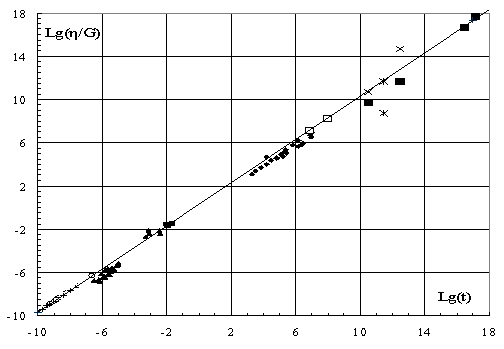
Fig. 1. Dependence
η/G from t.
Straight line - η/G = τ, at G =
20000 MPa.
Direct crosses
- Be, great circles Al, rhombis and small circles - marble and
limestone, triangles NaCl, small squares - wet sand, rhombis limestone - [3], the stars - Scandinavian peninsula [5], oblique crosses - Earth's crust [4]. Large
black squares - lunar rocks [6]. Transparent squares - earthquakes [5].
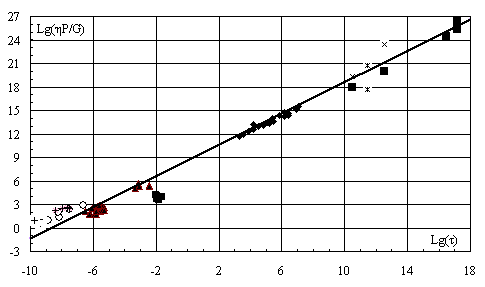
Fig.2.
Dependence Lg(ηP/G),
(Pas) from Lg (τ), (s) for all date.
Legend is as at
Figure 1.
Fig. 2 shows the dependence ηP/G from τ for all data. Blasting
and shock point for metals lie above and the porous materials point lie below
of averaging curve due to the higher temperature in them under a shock compression.
The
discussion
of results
The
experimental data can be approximated by empirical formulas η/G = τ;
η = 4 108(G/P)τ. Similar
dependences are observed for viscous
liquids and homogeneous materials. For inhomogeneous materials from the generalized model of Fought [2,7], in
which time τ establishing strain ε under the tension σ for a
slice from a large number of grains (with average values of η and G)
increases with increasing viscosity can write
τ = η/G; dε/dt = σ/eη = σ/etG; η = σ/(dε/dt) = etG (4
This implies
that the viscosity increases with the time of deformation, elastic modulus and
strain rate decrease. This is consistent with the data shown in figures. In the dynamic experiments the
viscosity decreases with increasing external load.
Simultaneously grown and strain rate. Apparently, the product of η
(dε / dt) ≈ σ is
performed in the entire range
of times the deformation at a constant temperature.
In the studied
rocks and porous materials viscosity characterizes the dissipation of energy during
dynamic deformation due to friction and moving grain. To obtain
the dependence η(τ)
- absorption coefficient is proportional to the frequency, which
is consistent with the principle of geometric
similarity. If the viscosity would not be proportional to the loading
time, then its associated energy absorption coefficient would be proportional
to the square of the frequency of the sound that would violate the law of
geometric similarity in blasts.
If the tensors of stress σik
and strain uik depend on time through the factor e-iωt,
then σik = 2Guik/(1 + i/ωτ), where ω - the frequency of the external force
and
τ - relaxation time [7]. When ωτ
»1 we obtain the usual expression for the elastic bodies σik=2Guik and when ωτ
«1, σik = 2Gτ duik/dt = 2ηduik/dt dependence for
liquids with a viscosity η
= Gτ. In crystals this are dislocations. In continents
are crustal blocks between faults.
Probing body perturbations of
different frequencies can be determined by their structure characteristic times
of establishing equilibrium
deformation τ, where η
= Gτ. Over the entire
range from dislocations to continents general equation for determining the
rheological rocks, porous materials and
metals at nano - technologies associated
with the common features of their structure may take the form σik =
2ηduik/dt.
Thus, when
changes the structure and sizes of bodies, respectively, and changes the time
of establishment of equilibrium deformation and strength characteristics of the
material. This is consistent with the theory
that the relaxation of the shear stress on irregularities leads to the
dependence of mechanical properties on the strain rate [8, 10]. Therefore, to
simulate the behavior of bodies at different strain rates can be applied very
viscous liquids [7] type of rosin, when performed equations (4). Earlier the rosin
were using for modeling of blasts processes in geomechanics [10].
This is due to
the fact that the deformation processes occur at all levels of the
hierarchy of structure from crystals to continents [8 - 10]. Such
a medium can behave as an elastic
body at high frequency of the
external load, the
same medium behaves as a plastic body regardless of its size at low frequency load.
Conclusion.
It were a study of the rheological characteristics of
solids in a wide range of times and speeds of deformation 10-10 -
1017sek and 1010 - 10-17sek-1 at external loads 1-20000 MPa. The results
of data processing of explosive laboratory and at field
experiments, studies of creep, estimates of continental drift, the lifting of the Scandinavian Peninsula
glacier 9000 years ago, the recovery time surface at the epicenter of a strong
earthquake displacements, mascon displacements at the bottom of the lunar maria,
etc. It is shown that in the range of parameters the effective viscosity is proportional of the time of deformation, the
elastic moduli and decreases with increasing
pressure and velocity of deformation.
Effective viscosity is generalized characteristic rheological behavior
solids of size from the nanoparticles
to the continent because the influence of their structure at different
levels on deformity process.
References
1. Khristoforov
B.D. Investigation of
rock deformation and different materials while changing the strength, speed and
time of deformation within a wide range. Physical fields and the dynamics of
interacting geospheres. IDG RAS. Moscow. 2007. P. 123 - 129.
2.
Khristoforov B.D. Experimental modeling of impact of space dust and debrison
flying vehicles and their components. Cosmic
research, 2011, Vol. 49, No.3. P.
263–268.
3.
Ryabinin Yu.N., Beresnev B.I., Martinov E.D. Mechanical properties and
processes in solids
under high pressure//Journal of geophysical research. 1971. Vol.76. No5. P.1370
- 1375.
4. Goldin S. Destruction
of the lithosphere and physical
mesomechanics // Physical mesomechanics. Novosibirsk. 2002. 5 (5). P. 5 - 22.
5. Magnitsky V.A. Internal structure and physics of Earthi. Moscow. Nedra. 1965. 379 p.
6. Gilvary J.J. Internal temperature of the Moon // Nature.1969. Dec. 6224. №
5223. P. 968 – 970.
7. Landau L.D., Lifshitz E.M. Theory of elasticity. Moscow. Nauka.
GRFML. 1985. 204 p.
8. Sadovsky M.A., Bolhovitinov L.G.,
Pisarenko V.F. Deformation of geophysical environment and seismic processes. Moscow. Nauka. 1987. 100 p.
9.
Nicholaevsky V.N. Elastic - viscous models
of tectonic and seismic
waves in the lithosphere //
Physics of the Earth. Moscow. 2008. No
12. P. 92 - 96.
10. Rodionov V.N., Sizov I.A., Tsvetkov
V.M. Basics mechanics of rocks. Moscow. Nauka. 1986. 301
p.
11. Alshin V.I., Indevom V.L. Dynamic braking of
dislocations//Progress physical science.
Moscow. 1975. Vol.115 No 1. P. 48 -
84.
12. Ogorodnikov V.A., Tyunkin E.S., Ivanov
A.G. Strength and viscosity of
metals in a wide range of strain
rate // Journal applied mechanics
and technical physics. Novosibirsk 1995. Vol. 36. No
3. P. 134 - 140.