Политология/5. Политическая социология
Buribayeva Mainura, Shaimerdenova Nursulu
L.N. Gumilyov Eurasian National
University, Kazakhstan, Astana
The
Assembly of People of Kazakhstan and its Role in
Peace-Building
and Interethnic Tolerance
Cultural and
language diversity is a distinctive feature of modern Kazakhstan. We can pinpoint
the fact that every citizen of Kazakhstan can speak two or more languages,
including his native language. Realizing ethnic policy, Kazakhstan has chosen
the path of reasonable language policy. The term ‘ethno policy’ (ethno-national
policy) means 1) inside politicization of modern ethnic groups and involving
them into active international processes; 2) a complex of measures aimed at
ensuring equal rights for ethnic groups of the given state in economic, social,
political, cultural and everyday spheres.
Ethno national policy is part of the national policy of the state which
serves to control political forces and to balance objective specific features
of different ethnic groups [1, p. 453].
The Assembly of
the People of Kazakhstan plays an important role in successful realization of
ethnic policy. It was created on May 1, 1995 by the President of Kazakhstan N. Nazarbayev [2]. The Assembly has become a significant element
of Kazakhstan political system. The Assembly has joined (united) the interests
of all ethnic groups and has ensured equal rights and freedom for our citizens
regardless of their national identity. The president of Kazakhstan emphasizes
the significance of the Assembly in his annual reports and messages. In April
2014 President Nursultan Nazarbayev in his speech at the XXI session of the
Assembly “Strategy Kazakhstan 2050: the culture of peace and concord” pointed
out the main constituent part of the successfully developing state: “From the
first days of acquiring independence we have had thousands of meetings in
different regions, cities, and villages. About twenty years ago when we were
creating the Assembly we passed through all well-known world models. We have found
the only secure mechanism to unite people on common patriotic platform. The
idea is understandable to everyone and it helps to provide people’s everyday
needs, such as jobs, welfare, and education for children, health, housing
facilities, security and rest. In our society all people have equal rights,
there are no ethnical privileges, and the law applies to everyone without
discrimination. All Kazakh people are the children of one Motherland. We all
are different, but we are the children of the Kazakhstan people. We all are
targeted at the well-being of Kazakh people and the prosperity of our Motherland.
That
is our common
success and pride.
That is the policy that I have chosen, has pursued,
and I will continue to pursue as the President of Kazakhstan. Every akim, every
manager, and every citizen should ensure stability and concord in his everyday
work” [3].
The
main feature of a state is a bounded area where government realizes its sovereign
jurisdiction. An important stage in the development of Kazakhstan was the acquisition
of sovereignty and the appearance of such concepts as “national consciousness”
and “national identity” in the citizens’ minds. The distinctive character of our
state is the fact that the representatives of more than 130 ethnic groups live
here. Such multiethnic society has been forming for a long period,
during those hard years when representatives of many ethnicities came to
Kazakhstan and found their motherland here. There are documentary books, films,
historical sources, ALZHIR, KarLag that
describe those years. Those were tragic pages of the history and the evidence of a whole generation of brave men,
mutual respect and personal development. All of those are an integral part of the
history of the nation and the history of the country. During the most difficult
periods of its existence, in the rapidly changing world, under the conditions
of globalization of the world economy the main appeal for survival and
resurrection of the country was to preserve Peace and Reconciliation. The intelligent
and balanced strategy for ethno political development in Kazakhstan contributed
to the creation of conditions for social, political, and economical well-being
of all the ethnic groups in Kazakhstan. So, ethnical diversity of Kazakhstan has
become the fact of friendship and mutual neighborly cooperation.
An important role in the realization of ethno policy
plays the Houses of Friendship that were opened with the purpose of providing state
support to etnocultural organizations, members of the Assembly of the Peoples’
of Kazakhstan. They were created to preserve and develop languages and cultures
of the peoples’ of Kazakhstan, to arrange ethno cultural events, such as forums
and symposiums aimed at teaching vernacular languages and providing social assistance.
Currently there has been worked out the concept for
developing the Houses of Friendship which are aimed at integrating with ethnic
cultural unions, non-governmental and governmental organizations, and with
people in order to consolidate national solidarity in local regions and all
over the country.
At present there are nine Houses of Friendship in
Kazakhstan. They are in Akmolinskaya, Pavlodarskaya, Kostanaiskaya, Northern,
Western, Eastern and Southern regions of Kazakhstan.
In accordance with the order given by the President
seven more regions are building Houses of Friendship. Such regions as
Atyrauskaya, Western, Karagandinskaya, Kyzylordinskaya, Mangystauskaya and in
the city of Astana are going to transform the Houses into centers for social
initiatives and public consent.
In the course of 20 years the Houses of Friendship as
an institute of civil society have worked out such aspects of activity as
functioning of cultural and methodological centers for ethnic cultural unions; propagation
and popularization of ideas of
solidarity, interethnic concord; propaganda of Kazakhstani patriotism; working
with youth organizations and holding Youth Centers Leaders Forums; methodical
and financial help to support priority social projects which are aimed at
maintaining public concord and national solidarity, arranging cultural public
events, employment of population; spread and support of languages, creative
initiatives; meetings with deputies of the Parliament of Kazakhstan and Maslikhats
(local elective body), discussing the Letters of the President to the People of
Kazakhstan; signing different memorandums on cooperation with world companies
and so on. Thus, the idea of President N. Nazarbayev about the establishment of
Houses of Friendship has been realized as a successful project. There has been
created a special world where people of different nationalities can share their
plans, ask questions, learn the culture and languages of their friends and
celebrate holidays. Perhaps, that is the meaning of words “tolerance” and
“interethnic concord”.
Certainly, in modern technocratic conditions of
existence the Houses of Friendship have prospects for future development, for
example, increasing their material and technical facilities, training specialists
for Houses of Friendship, expanding institutional cooperation with national and
international bodies and institutions, informational and analytical
procurement.
Today the main scientific centre of the Assembly is Ethnic and Inter-confessional
Relations Centre. The Centre performs monitoring,
analysis, statistical accounting, realization of planned research, scientific
applied research concerning interethnic and inter confessional relations,
training on state ethnic policy, working out objective predictions and
recommendations about socio-political, language and religious situations. The
centre was established in 2011 at the initiative of the President of
Kazakhstan. The main objective of the centre is to create a fundamental research
base for developing the Kazakhstani model of interethnic and inter confessional
accord. In order to meet the challenge Scientific Expert Council was founded. The
members of the Council are scientists, linguists, historians, sociologists,
political analysts, philosophers and religious scholars. The centre employs
experts in various fields of liberal arts. Their activity is aimed at analyzing
situations in the country and elaborating suggestions and recommendations for
government bodies on keeping peace and accord in the country.
Today
the Assembly is one of the important organizations working at such serious
aspects in society development as interethnic and inter confessional accord in
the country.
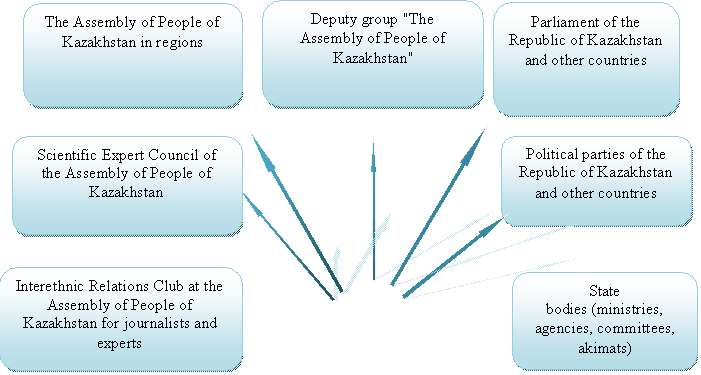
The
structure of the Assembly grows every day as there appear different fields of
work. The role of the Assembly becomes more significant as it cooperates and
interacts with not only Kazakhstani government bodies, but those of other
countries, party organizations, Houses of Friendship, ethno cultural
associations, universities and Scientific Research Centers (Figure 1).
Figure 1. The Assembly of People of Kazakhstan:
Structure and interaction with
other bodies








It is a well-known
fact that one of the main peculiarities of the Assembly is the guaranteed
representation of interests of ethnic groups in the supreme legislative body –the
Parliament. So, the Assembly elects nine deputies for Parliament Mazhilis among
representatives of various ethnic groups who take into consideration the set of
interests of all ethnic groups.
The secretariat
of the Assembly, being its working body, is included in the structure of the Administration
of the President as an independent department. It confirms its effectiveness
and efficiency in state administration and public relations. The Assembly
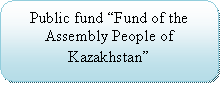
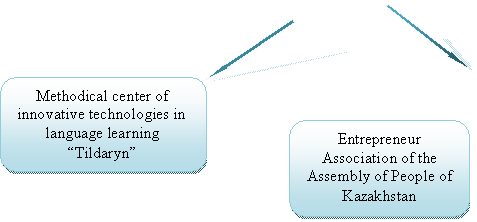
consists of Scientific Expert Council, Interethnic Relations Club for
journalists and experts, Public fund “Fund of the Assembly People of
Kazakhstan”, Methodical center of innovative technologies in language learning
“Tildaryn”, Entrepreneur Association of the Assembly of People of
Kazakhstan.
November 16 is the international day of tolerance, it is
celebrated all over the world, and Kazakhstan also celebrates the Day of Accord
on October 18, however, people say that in our country any day of the year can
be called the day of accord as any person who was born in Kazakhstan, begins to
acquire the experience of communication in the multiethnic society in his\her
childhood and it is a normal for any Kazakhstan citizen.
The fact is that "a
person who lives in accord with others is successful in everything" (N.
Nazarbayev) [4]. This is justified by the main mission of the Assembly which
consists in the following:
·
consolidation of people belonging to different ethnic groups and religions, who are united by ideals of
friendship and humanity;
·
formation of
individuals who are patriots of Kazakhstan, working for successful
development of the country and developing their creative potential
·
bringing up a new generation of Kazakhstani
citizens who are capable to work successfully in various branches under the conditions
of a multiethnic variety of Kazakhstan.
Literature:
1.
Толковый словарь концептуально-терминологического поля этнополитики / В книге
«Императивы государственной этнополитики Республики Казахстан. Аналитические
материалы и методические рекомендации для государственных органов / Под общ.
ред. Е.Л. Тугжанова. – Астана, 2012. – С. 453.
2. Look: [Electronic resourse]. URL: www.assembly.kz
3. Выступление Президента Казахстана Н.А. Назарбаева
на XXI сессии Ассамблеи народа Казахстана «Стратегия
«Казахстан-2050»: культура мира, духовности и согласия», 18 апреля 2014 г.: [Electronic resourse]. URL: http://akorda.kz/ru/page/page_216501_vystuplenie-glavy-gosudarstva-predsedatelya-assamblei-naroda-kazakhstana-n-a-nazarbaeva-na-xxi-sessii
4. Назарбаев Н. Мыслями с народом поделюсь: [Electronic resourse]. URL:
http://personal.akorda.kz/ru/category/knigi/1407