Master Semernin N.A., C.t.s. Semernin
A.N.
M.Kh. Dulati Taraz state university, Kazakhstan
Perspective
methods of non-destructive testing in “Kazphosphate” LLP of Zhambyl region
The study of the
means and methods of nondestructive testing during operation, repair and forecasting
of residual resource of the rolling stock in plants and depots showed that by a
number of parameters of the controlled
units, assemblies and components of rolling stock there is no reliable methods
and means for complete control.
The most common method
is the magnetic particle inspection, the ultrasonic testing has the second place, eddy current method
goes further.
Paradoxical situation has come. Here is an example: one of
the causes of fractures of parts
of trucks in operation – the presence of casting defects,
including internal, which were not identified
at the factory. And to identify these
defects in the manufacture or
operation of parts of trucks is not necessary.
It is necessary to have a sufficient set of tools for the detection of internal defects and improve the detection of surface defects
of parts trucks so that to improve
traffic safety.
Now let us consider modern system of non-destructive
testing of rolling stock:
1. As is
well known the diagnostics is a
system of the type "control
+ prediction of residual life."
The first part of this system is not a big problem if
the applied method of control
has been well studied and validated
for the specific object of control; there is a small problem with the sensors. Because as
their work depends on the completeness and accuracy of the received information.
If not
using the system of parts
recovery or components and
assemblies of rolling stock, the non-destructive
testing works on the principle of
"serviceable - defective."
Restoration of products is used only when they have sufficient
untapped resource and it is brought to the working
condition in the production, as a rule, in scheduled maintenance.
The problem is
the second component of the diagnostic
system – the forecast of the residual resource.
2. At
present, there are many attempts
to create engineering forecasting
methods, the most famous of which
are: analytical, statistical and
probabilistic. It should be noted that the existing methods
of forecasting has not been developed yet and
have little practical value. This is due, above all, to the need to obtain vast information, its generalization and response to change. Therefore, all the works in the creation of residual life assessment
techniques are extremely useful and relevant.
Analysis of the state of the
freight wagons of LLP
"Kazphosphate" Zhambyl region shows that the average age of the main types of freight rolling stock
is more than 20 years at the appointed time service for 32 years (see figure 1). The order of the work to extend the life period
is regulated by "Regulations to
extend the service life of
freight cars plying in
international circulation" and "Uniform
guidelines on technical diagnosis of
the cargo and refrigerated wagons." The latter document
proposes as the main methods of non-destructive testing the magnetic particle
and ultrasonic inspection.
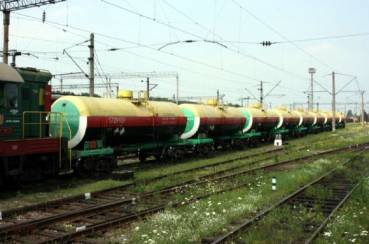
Figure 1.
The “Kazphosphate” LLP tank wagons with yellow phosphor inside
These methods of nondestructive testing
methods are active,
and are based on the active cooperation
of the signal of a flaw
detector to a metal of construction, and the
information about the state of stress
of the tested object is indirect. Also, the use of these methods of nondestructive testing involves time consuming.
Application of the methods
of passive control for technical diagnostics, based on the use
of faulty material as the source of the recording of the physical field, allows us to estimate
the actual stress-strain state
of the structure. Passive method of nondestructive testing is the method
of acoustic emission diagnostics.
Acoustic emission is the
control of the emission
of acoustic waves caused by a
sudden rearrangement of the
structure of the material. Register of waves and their transformation by using piezoelectric sensors allows to
judge about processes occurring
in the material [1,2].
The method is
widespread in diagnosing
of pipelines and vessels, working under
pressure.
The above method is
proposed to be used in the testing of tank of wagons of "Kazphosphate"
LLP in Zhambyl region. The need to load the
object of control by force or pressure
so that to generate in it sources the acoustic emission allows to combine acoustic
emission control with the hydraulic pressure test of the tank. Acoustic emission method allows you to control
the entire object using a fixed transducers system that reduces the time
and cost. The number of sensors
can vary within wide limits (from 2 to 80) (see figure 2) [2], which allows to carry out the high-quality
non-destructive testing of especially
responsible railway tanks.
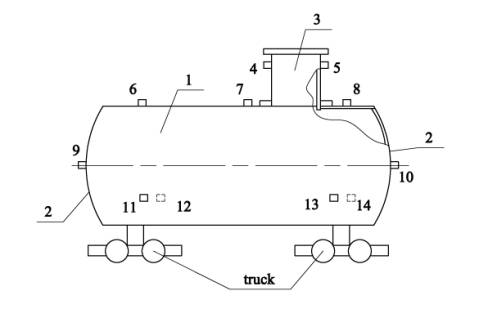
Figure 2. An
example of the scheme of arrangement
of the sensors during the acoustic
emission testing of tank
1 – tank; 2 – bottom;
3 – neck; 4-14
– transducers
The only limitation of
application of acoustic emission method for testing of tank wagons is the difficulty of separation of acoustic emission signals from the noise and signal interpretation, due to
the fact that the acoustic emission
signals are noise-like [1]. This disadvantage
is likely to be eliminated by developments of catalog
of reference defects that need to be compared with the actual picture of the
stress-strain state of tank wagons during the acoustic emission
testing.
The method of acoustic
emission diagnostics of rolling stock
is the most promising in terms of
the possibility of determining the
residual life of tank wagons of "Kazphosphate"
LLP on the basis of a viewing a clear
picture of the actual stress-strain
state of the controlled object.
On the basis of the analysis we may advise to carry out the following integrated activities:
1. Creation
on the basis of one of the contracting
companies of "Kazphosphate" LLP of the experimental and testing center
equipped with all existing types of testing and diagnostic
equipment for fully integrated
non-destructive testing and diagnosing
of new and in-service rail vehicles.
2. Carrying out of the search, research, verification and certification of new most
effective nondestructive inspection of railway tanks all over their volume.
3. Approval of the
list of primary and backup methods
(means) of nondestructive
testing for the detection of all
types of defects.
REFERENCES
1. Standard
20415-82. Non-destructive testing.
Acoustic methods. General provisions [Text]. – 1982. – 4 p.
2. RD
03-131-97. Rules of organization and carrying out of acoustic
emission testing of vessels, vehicles, boilers and process piping [Text]. – M .: NPO MBT – 2000. – 15 p.
3. Semernin, N.A.
Perspectives of technology of non-destructive testing in railway transport [Text] /
N.A. Semernin, A.N. Semernin, N.S. Nauryzbajev // Mechanics &
Technologies, Taraz: Taraz University, – 2014, №3, P. 89-92.