Analysis and
study of compatibility between digital broadcasting and the mobile
communication LTE
Muratbek Dzhamanshalov Kazakh National University
(KazNTU)Almaty, Kazakhstan muratbek_1981@mail.ru
Abstract-Co-existence
between mobile and digital broadcast television, generally focus on one system
that has to be protected, providing the operational constraints for the other
system, which is considered as interferer. In article, an analysis of the
coexistence of primary services is presented, focusing on the study of mutual
interference between DVB T2 broadcasting and 3GPP Long Term Evolution (LTE)
mobile systems.
Index Terms-Mobile communications, digital TV, LTE,
DVB-T2.
I.INTRODUCTION.
In today’s world mobility
is highly valued. That is why the last 15years were characterized by rapid
development of mobile technologies. There is an avalanche increase in the number of mobile users.
There are third network, and now the 4th generation is able to
provide a huge variety of services to users. Approved standards for CDMA, UMTS,
LTE, in the terminology of the International Telecommunication Union (ITU) has
been generally termed IMT.
Especially important is
the evaluation of EMC PC and PS in this band, the more appear in both services
and develop new standards, such as digital TV standards DVB-T and DVB-T2,
standards of IMT WCDMA and LTE. We propose a versatile methodology to take into
account both the interference originated from the mobile radio systems to the
broadcast system and the interference generated from the TV transmitters to the
cellular system from a performance degradation point of view. The
LTE network works in Kazakhstan in the range of frequencies of 1800 MHz.
We present the simulated
scenario; describe the assumptions made on the two interfering systems, and on
the propagation model. The proposed methodology is based on the evaluation of
the cumulative distribution of the Signal-to-Interference plus Noise-Ratio
(SINR) and of the consequent degradation of DVB T and LTE system performance
due to the mutual interference. The analyzed scenario comprises a mobile radio
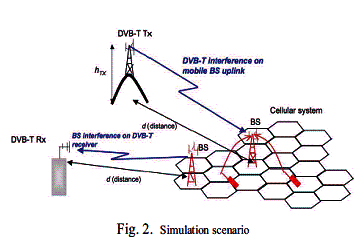
system and a DVB T transmitter. Two different aspects have been considered
(Fig.2):
-
case study 1: interference generated
by a certain number of base stations (BSs) versus DVB T receivers;
-
case study 2: one DVB T transmitter
(of height hTx) which acts as extermal interferer versus several LTE Base
Stations (BSs)
It is worth noting that in case study 2 we decided to take into account the uplink because it
is the most critical link. This may not seem obvious, but it is due to the fact
that cellular base stations are considerably higher than mobile terminals,
hence they can receive a larger amount of interference from the DVB-T
transmitter .The downlink analysis is left for further studies.
Also the interference caused by mobile terminals over the DVB T receivers
will be addressed in future works, owing to the low height and transmitted
power of the mobile terminals.
II.
EMC ASSESSMENT
EMC assessment when sharing RES RS and
IMT systems in the band 790-862 MHz may performed in two ways-a deterministic
assessment and statistical of EMC.
Based
on deterministic estimates EMC develop relevant standards frequency-spatial
spacing (CHTR) RES. For example, the development of such standards CHTR
include[3].It is known that traditionally focused on the definition of the
mutual influence of the two RECs with fixed parameters and can not always take
into account the complex dynamics of change the RES in the real world.
In
accordance with [7] field strength Edef, permissible interfering television
signal for general mobile service calculated the formula:
Edef=-37+F-Gi+LF+10log (Bi)+Po+20
logf-KdB(mV/m), (1)
where: F:receiver noise or mobile base stations in the land mobile
service (SPS) (dB)
Bi: the bandwidth of the terrestrial broadcasting station (MHz);
GI: receiving antenna feeder cable (dBi);
LF: losses in the antenna feeder cable (dB);
f: center frequency of the interfering station (MHz);
Po: man-made noise (dB) (typical value of 0 dB for UHF);
K:correction factor of overlap (in DVB-T) (dB).
Allowable field strength interference from IMT for RES stations
broadcasting service is de-fined by the following formula:
Einter=Emin-PR-Kloc +Asel (2)
where:Emin-minimum median field strength for a given type of modulation
and reception of the broadcasting service dBmkV/m;
PR- defensive attitude broadcasting system from interfering signals,
IMT,dB;
Asel-spatial selectivity of the
receiving antenna RES broadcasting service, dB;
Kloc-combined ratio by location, taking into account the random
distribution of the electro-magnetic field in the territory.
The calculations are performed for the case interference from IMT one
interfering station and two of layouts receiving DVB-T antenna and interfering
station IMT:
-Interference from a transmitting station IMT misses the main lobe of
the receiving antenna DVB-T(ie, selectivity
of Asel=0 dB).
-Interference from a transmitting station IMT comes from the direction opposite to the direction of
the main lobe of the receiving antenna DVB-T (ie, selectivity of Asel=16dB).
A
statistical approach to the evaluation of EMC based on statistical
distributions of the parameters specifying RES (coordinates, frequency, power,
radiation, etc.),calculating the
statistical characteristics of EMI and statistical evaluation of the impact of
EMCO on RES. For statistical evaluation
of EMC for the IMT becomes the most appropriate method of statistical modeling,
called the Monte Carlo method. Monte Carlo method- is a numerical method for
solving mathematical problems by simulating random numbers. It allows you to
simulate any process, which influence on the course of random factors. A
feature of this method is the simplicity of the structure of the computational algorithm.
Applied to problems of EMC Monte Carlo method allows to simulate the real
situation when setting change network settings as appropriate distribution of
random numbers, which to some extent reflects the random behavior of these
parameters. Simulations result is random and is expressed in terms of
probability of probability of
interference.
III.SIMULATION
SCENARIO
Cellular system parameters
We assumed a channel
bandwidth of 5 MHz for LTE, as for this bandwidth the whole BS transmitted
power is in in band transfer function of the victim DVB T receiver. Therefore,
in case study 1, as the power spectrum of a DVB T signal is approximately flat
in its 8 MHz channel, the interference generated on the 5 MHz chanell can be
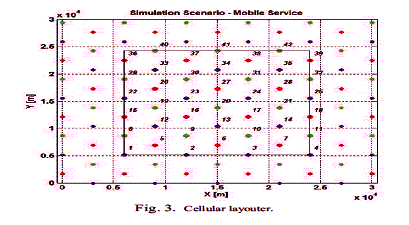
assimilated to AWGN. The adopted cellular layout is shown in Fig.3.It comprises
99 base station, but the statistics are collected only in the innermost 42 of
them (enclosed in the smaller square in the figure). To avoid border effects.
We simulated the Link
Adaptation behavior of LTE mobile system as a function of the SINR, which for
the purpose of this work is assumed equivalent to Signal to-Noise-Ratio (SNR),
owing to the assumption that the interferer behaves like an AWGN source.
DVB-T system parameters
Different DVB T
transmitter configurations have been considered in the simulations by varying
the Effective Radiated Power (ERP) and the antenna height. The cell radius
varies with the configuration and it is determined according to the Reference
Planning Configurations (RPCs) defined
in ITU-R (2006), assuming:
-Location
Probability (LP):95%
-Emed:58.2
dB V/m(ITU-R,2006, Annex 3.4)
Note
that in order to obtain a 95% LP at the cell edge, 9.05 dB must be added to the
receiver minimum required SNR.
In
each simulation run the TV receiver positions have been randomly generated
within the DVB-T coverage area.
IV.SIMULATION RESULTS
Mobile interferer victim DVB-T
Different configurations of DVB-T transmitter height and ERP have been
considered and the effect of the co-channel interference has been evaluated
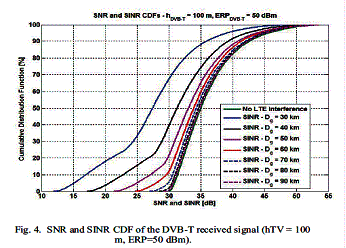
varying the distance between the broadcasting and mobile service areas. Fig.4
shows the Cumulative Distribution Functions (CDF) of the SNR and the SINR of
the received DVB-T signal obtained with hTx=100 m and ERP=50 dBm and for
various distances between the edge of the DVB-T coverage area edge and the
centre of area served by the LTE network. We clearly notice the effect of the
distance, with a serious interference when the distance is 30 Km. Increasing
the distance causes a reduction of interference, and as expected the CDFs
quickly approach the nointerference
case for higher distances.
From the CDFs.we are able to compute the performance degradation in the
DVB-T broadcasting service. For instance, since the required minimum SNR for
the TV receiver is 21 dB, as stated in Table III. The degradation of SNR due to
the neighbouring mobile interfering system causes the reduction of the service
coverage area.
TABLE III.Main Simulation parameters
|
Television tower |
|
|
ERP |
50 dBm or 70 dBm |
|
Antenna height |
100 m or 200 m |
|
Antenna pattern |
Omnidirectional in
azimuth |
|
Operating frequency |
800 MHz |
|
Receiver |
|
|
Antenna gain |
14.15 dBi |
|
Antenna height |
10m |
|
Antenna pattern |
Mask taken from
International Telecommunication Union-Radio communication sector [ITU-R]
(1992) |
|
Receiver minimum |
SNR 21 dB |
|
Noise equivalent
bandwidth |
8MHz |
|
Number of TV receivers
generated for each Monte Carlo simulation |
200 |

DVB-T interferer vs
victim mobile network
The
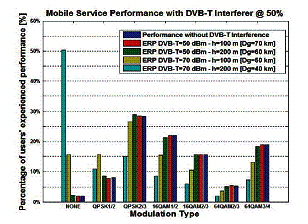
effect of the interferer is evaluated in terms of the percentage of mobile
users that are able to access a certain modulation type, which is, of course, a
function of the received SINR. The interference originated from the DVB-T
transmitter has been estimated using ITU-R P.1546, considering the
interference originated both at 50% and
1% of time. The DVB-T interference contribution has been added to the internal
interference contribution of the LTE system considering a cluster size equal to
3.The results are shown in Fig.5 and Fig.6. Obviously worst cases are obtained
for higher-T transmitter ERP and antenna heights, as this causes the increase
of the interferer signal strength and the reduction of the guard distance, and
for a percentage of time equal to 1%, as this corresponds to lower attenuation
values in the ITU-R P.1546 propagation model. As a matter of facts, the
performance degradation is evident for higher interference from the DVB T
transmitter (i.e.ERP=70 dBm), while with ERP=50 dBm the impact of the DVB T
system is lower. In particular, with hTx=100 m the performance degradation is
negligible. This is due to the low interference generated on the BSs antennas
with ERP=50 dBm, as in this case this value is negligible with respect to the
internal interference of the mobile system (this is especially evident with the
attenuation values at 50% of time).
The proposed methodology takes into
account both the interference originated from the mobile radio network on the broadcasting system and
the interference generated from the TV transmitted on the cellular system. The
aim is to assess the reciprocal interference in order to compare the different
behaviors of the two radio links, thus identifying the most critical situations. The document proposes a versatile
methodology, which can be easily adapted to different configurations, for
protecting either DVB-T or mobile service.
Another
item of future investigation deals with adjacent channel interference between
mobile radio and digital television operating in adjacent frequency bands.
REFERENCES
[1] The Radio
Regulations.Geneva, ITU,2008
[2] Detailed results of
field study of compatibility between DVB-T and UMTS.European Broadcasting
Union/ Free TV Australia Ltd
[3] Faizullaev
A.N.Development of norms frequency-spatial separation of radio equipment
operating in the frequency range of 450MHz.Magazin “Infocommunications;
Networking-Technology-Solutions”
[4]
Assessing the conditions of EMC accounting system features a radio interface
UMTS. Skrynnikov VG/T-Comm, №2,2008
[5]
Measurements on the performance of DVB-T Receivers in the presentce of
interference from the mobile service (especially from
LTE)/Marseille,June2010/ECC Report 148.
[6]
Chaiko Y.V Dzhamanshalov M.U Evaluation of digital
broadcasting and the mobile communication