Tereshatov V.V., Makarova M.A.,
Senichev V.Yu.,Vnutskikh Zh.A., Savchuk A.V., Slobodinyuk A.I., Kiselkov D.M.
Federal
State Budget Foundation of Science Institute of Technical Chemistry of Ural
branch of Russian Academy of Sciences. Perm, Russia
Obtaining and
properties of tetrablock-polyurethane ureas with mixed polyether segments and
various hard ones
An overwhelming majority
of urethane-containing polymers (polyurethanes, polyurethane ureas) consist of soft
(SS) and hard (HS) segments (blocks) forming polymer chains [1,2]. The structure
of the soft segments is determined by used oligomers. Reaction of diisocyanate
and low-molecular-mass diol, or diamine results in formation of hard segments. Some
compositions contain cross-linking agents and plasticizers [3]. A difference in
polarity of soft and hard segments leads to their microphase separation and
formation of soft and of hard nano-dispersed phases. Hard domains are
stabilized by hydrogen bonds [2].
Properties of
urethane-containing materials are regulated varying the chemical structure,
molecular weight, polarity of soft segments, as well as concentration and
structure of hard segments. Thus, materials with diverse properties were
developed. Usually, segmented polyurethanes (SPUs) and polyurethane ureas
(SPUUs) consist of alternating uniform soft SS and hard HS segments (SSHS)n
[1]. Structure and properties of such materials are well-studied.
Urethane-containing multiblock-copolymers are much less investigated.
New investigation
objects are of significant interest for detecting particularities of behavior
for urethane-containing elastomers with a complex structure of the polymer
chains. This paper presents results of the synthesis and investigation of
thermal, thermo-mechanic, physic-mechanic and other properties of
tetrablock-copolymers containing various polyether soft segments and various
hard blocks (segments).
Segmented polyurethane
ureas (SPUU) with mixed polypropileneoxide (PPO) soft segments and polytetramethyleneoxide
(PTMO) ones of various molecular mass (Mn)
were investigated. The following compounds were used as initial components for
the synthesis of SPUU: 2,4-toluene diisocyanate (TDI) , isophorone diisocyanate
(IDI), oligopropylene oxide diol (PPO) Voranol 1010L with Mn=1000 g·mol-1, oligotetramethylene oxide
diol with Mn=1000 g·mol-1,
and 4,4¢-methylene-bis-(2-chloroaniline)
(MOCA). The synthesis was performed as a two-step process, with preliminary
preparation of prepolymers: TDI- and PPO-based FP-1 and IDI- and PTMO-based
FP-2. Prepolymers FP-1 and FP-2 were mixed in the given ratio. Then, the melted
MOCA was introduced into the reactor. Hardening of samples was provided within
3 days at 90oC.
Glass transition
temperature ( ) of the soft segments matrix (soft phase) of investigated
elastomers was determined with use of the DSC 822e calorimeter;
softening temperature
) of the soft segments matrix (soft phase) of investigated
elastomers was determined with use of the DSC 822e calorimeter;
softening temperature  of the hard phase was
determined with use of the TMA/SDTA 841e device. Mechanical tests were
conducted at the stretching rates from 0.28 s-1.
Tensile strength
of the hard phase was
determined with use of the TMA/SDTA 841e device. Mechanical tests were
conducted at the stretching rates from 0.28 s-1.
Tensile strength  (maximal stress value
calculated for initial cross-sectional area of samples), relative critical
strain value
(maximal stress value
calculated for initial cross-sectional area of samples), relative critical
strain value  (%), engineer modulus E100
(stress value calculated for initial cross-sectional area of samples at 100%
relative strain), and true tensile strength
(%), engineer modulus E100
(stress value calculated for initial cross-sectional area of samples at 100%
relative strain), and true tensile strength , where
  were determined.
Rheological properties of reaction mixes (reaction masses) were investigated
with use of Reotest-2 equipped with the «cone-plate» device at 90±0.5°С, and at the share rate of 180 s-1.
were determined.
Rheological properties of reaction mixes (reaction masses) were investigated
with use of Reotest-2 equipped with the «cone-plate» device at 90±0.5°С, and at the share rate of 180 s-1.
Elastomers based on prepolymer FP-1 and
FP-2 blends, contain different quantity of polypropylene oxide SSPPO
and polytetramethylene oxide SSPTMO soft segments and hard segments
of various types:
HS1 (TDI- and МОСА-based)

HS2 (IDI- and МОСА-based)

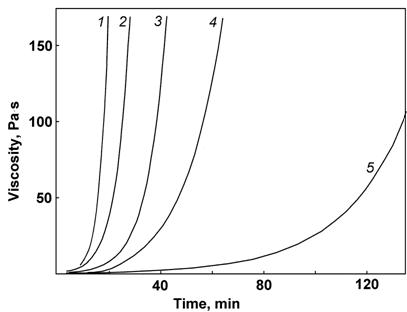
Results of rheokinetic study of
compositions on the base of prepolymers FP-1 and FP-2 showed an intensive increase in viscosity at 90°С to be observed within
the period less than 15 min for system FP-1 +МОСА, but after 100 min for
FP-2+МОСА system. Rheokinetic curves of
the compositions based on prеpolymer blends are
greatly shifted towards the curve corresponding to the composition based on
FP-1 (Fig. 1). Thus, interaction rates of the prepolymers with aromatic diamine
are different. The obtained data allow us to suppose that FP-1 in prepolymers blend
predominantly reacts with МОСА at the initial stage of
polyurethane ureas synthesis. This reaction leads to the formation of hard
segments HS1. Further FP-2 reacts with
diamine to form hard segments HS2 and PTMO soft segments. Taking
this into account the structure of multi-block copolymer chains can be
represented by the following simplified formula: (SSPPOHS1)m–(SSPTMOHS2)n.
The fragments of SPUU polymer chains consist of different types of hard and soft segments provided that oligodiisocyanate reactivity varies significantly. Molar ratio of PTMO and PPO soft segments is equal to the one of FP-2 and FP-1.
|
The molar fraction of the hard
segments HS2 in the composition of
urethane urea segments HS1+HS2 is close to the molar
fraction of prepolymer FP-2 in the blend with FP-1. Thus, the composition of
soft and hard segments in SPUU corresponds to the composition of FP-1 and
FP-2 prepolymer blend, used at the synthesis of the material. The evidence of sole glass transition temperature for soft phase in
SPUU indicates the thermodynamic compatibility between PTMO and PPO segments. |
|
|
Fig.1Rheokinetic curves at 90oC for compositions with various molar
fraction of FP-2 in the mix with FP-1: 1-0, 2-0.3, 3-0.5, 4-0.7, 5-1.0 |
Thermal and physic-mechanic
properties of polyurethane ureas depend on the molar composition of the FP-1-FP-2 prepolymer mix in the non-linear manner, and,
correspondingly, on the ratio between polymer chains (SSPPOHS1)m
and (SSPTMOHS2)n
, where n ≈ x2 (Table).
An optimal combination
of microphase separation and interchain interaction in the soft phase leads to
the significant improvement of strength and strain properties of the
multiblock-copolymer at the FP-2 molar fraction
x2 ≈ 0.5 in the mix with FP-1. This effect combining
with good rheology properties of the reaction mass expands possibilities of new
materials application for various technologies.
Table. Properties
of SPUUs at the various FP-2 molar
fraction x2 in the mix with FP-1
|
x2 |
Tgs, °C |
Th, °C |
sk, MPa |
ek, % |
Е100, МPа |
fr, MPa |
|
0 |
-5 |
190 |
38.4 |
410 |
16.1 |
196 |
|
0.3 |
-18 |
176 |
42.5 |
512 |
8.4 |
260 |
|
0.5 |
-46 |
173 |
57.6 |
620 |
6.8 |
415 |
|
0.7 |
-61 |
171 |
52.1 |
607 |
5.8 |
368 |
|
1.0 |
-70 |
167 |
48.2 |
552 |
5.6 |
314 |
Acknowledgments This work was financially supported by the Russian Fund for Basic
Research and Government of Permskiy kray (Project 16-43-590647r_a).
References
1.
Petrovic
Z.S., and Ferguson J. Polyurethane elastomers. Prog Polym Sci
1991;16(5):695–836.
2.
Paiksung
C.S., Smith T.W., Sung N.H. Properties of Polyether poly(urethaneureas) based
on 2,4-toluelene diisocyanate. 2. Infrared and mechanical studies. Macromolecules 1980; 13(1):117–21.
3.
Volkova E.R., Tereshatov V.V., Vnutskikh Zh.A. Formation of polyurethane structural materials based
on blends of oligoethers with different reactivities. Russian J Appl Chem 2010; 83(8):1372–79.