Технические
науки / 12. Автоматизированные системы управления на производстве
Kulyk A.J., Kulyk J.A, Kulyk A.A.
Vinnytsia national technical university, Ukraine
Construction of systems of transfer of the information with use of the
device of wavelet-functions
In
modern telecommunication systems and the computer networks constructed with use
of technology Radio-Ethernet principles of broadband modulation are widely used
[1 – 3]. The principle of their work will consist in division of a radio signal
in wide a strip of frequencies due to use of special algorithms. Two of them
are standardized: a method of direct sequence (DSSS) in which basis replacement
of each transmitted unit with a code combination and a method of frequency
jumps (FHSS) is put. At the first method as a code combination use Walsh
functions. As these functions are orthonormaling
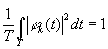 , (1)
, (1)
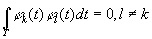 ,
(2)
,
(2)
that the information
does not mix up, and everyone reception point reacts to the code combination
allocated only to it. At the other method the receiver and the transmitter
synchronously through everyone some milliseconds are recustomized on different
bearing frequencies within the limits of 79 channels of a range of transfer
according to the algorithm determined by pseudo-casual sequence. Respect the
protection of the information both algorithms are reliable enough, as only the
receiver which uses harder the sequence can react to a signal of the
transmitter. Thus opportunities of disputed situations that raise reliability
of transfer are stipulated.
One
more method of construction of broadband means of transfer of the information
is entering redundancy by simultaneous parallel transfer of the information
several (about 10) frequency channels (DHSS) [3].
Respect
the parameters, use of a method of direct sequence (DSSS) is perspective. It is
connected both to higher speed of transfer, and with the raised noise immunity
though this method and differs the certain complexity of construction of the
equipment. It is connected by that each code combination being Walsh function,
actually is the sequent which methods of allocation though are known [4], but
demand essential hardware expenses. It is connected by that everyone code at
the same time, perspective of a method is outlined that the big attention is
now paid to replacement of coding Walsh functions with others. The certain
operating time is in use quazichaotic signals [5, 6]. But the generated
sequences are unipolar, that contradicts main principles of transfer of the
information as they contain an essential constant component and demand
artificial bipolarization. Proceeding from this, more perspective is use
Wavelet functions, free from the specified lacks [7]. One of kinds of Wavelets
are Haar functions for which formation the formula is used
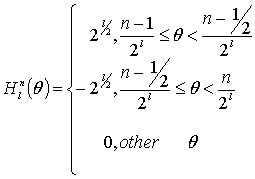 , (3)
, (3)
where  ;
;
N – quantity of formed functions;
 ,
,
of the
channel. Graphically these functions look like, submitted in fig. 1. Noticeably,
that in comparison with Walsh functions, Haar functions are uniform, that simplifies
designing filters, and bipolar as it is demanded with principles of
construction of means of transfer of the information. At the same time, each their
Haar functions represents one frequency, but within the limits of function its
components are shifted on an hour axis. That is at use of Haar functions for groups
of reception devices it is possible to use identical filters whereas at use of
Walsh functions under each of them it is necessary to project the separate
filter. Due to it is possible to reduce essentially 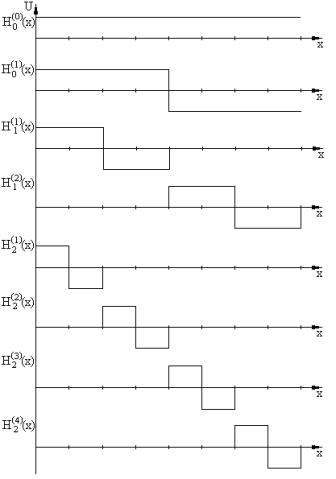 hardware expenses
without loss of advantages of a method of broadband modulation as Haar
functions too orthonorming and the principle of division of signals is kept completely.
hardware expenses
without loss of advantages of a method of broadband modulation as Haar
functions too orthonorming and the principle of division of signals is kept completely.
|
Fig. 1 – First three Haar functions |
|
Fig. 2 – Principle of coding by Haar functions in conditions of
broadband modulation |
In this
case the problem of identification of signals is subdivided into identification
of frequency of the accepted signal and his phase concerning 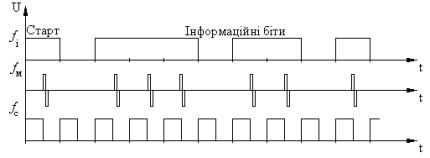 base value of a
time interval. As for an asynchronous mode of transfer each report of information
begins with a starting pulse the reference mark means algorithm of transfer as
it is shown in fig. 2.
base value of a
time interval. As for an asynchronous mode of transfer each report of information
begins with a starting pulse the reference mark means algorithm of transfer as
it is shown in fig. 2.
At a
synchronous mode of transfer each report of information begins with transfer
syncrosymbol which also can act as a reference mark of a phase of a signal.
The
generalized block diagram for realization of the described method of transfer
of the information is resulted in fig. 3. For realization the classical
microprocessor structure with use of a mode of interruptions though it is
possible to use and a mode of program interrogation is chosen.
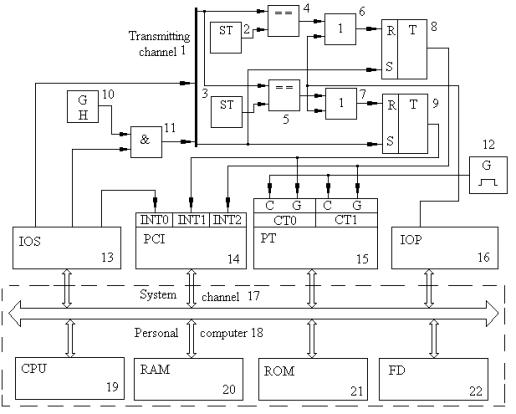
Fig. 3 – The generalized structure of the device
reception-transfer
of the information.
Transfer
of the information is carried out with the help of the consecutive interface to
which signal the certain component of Haar function is mixed.
On the
reception party the scheme of measurement of time intervals with use
programming the timer is constructed, and the parallel interface is intended
for formation of signals of management.
At
receipt of an informative signal on the reception device on a starting pulse
measurement of a time interval which is defined by a phase of a signal, and
also lengths of positive and negative pulses begins. Only in case of full
concurrence of the received set of pulses with control on all parameters, the
data will be decoded and will be transformed to a report of information.
The
control of length and structure of a signal allows to allocate completely
handicaps and to neutralize them, Except for it is possible to identify the
messages intended for the concrete receiver and to ignore all others.
The
developed structure does not interfere with use, if necessary, algorithms
handicapprotection coding, cryptographic closing of the information and others.
In view
of orthogonality of functions the offered algorithm can be used not only for
radio channels, but also at use of wire and fibre-optical communication lines.
REFERENCES:
1. Невдяев Л. CDMA: сигналы и их свойства // Сети. –
2000. – № 11. – http://www.osp.ru/nets/2000/11/022_print.htm
2.
Боровков К.В., Малыгин И.В. Перспективные способы модуляции в широкополосных
системах передачи данных.- Технологии и средства связи. – 1998. – № 5. – http://int14.by.ru/doc/telecom/mod.htm
3.
Сети на основе радио-Ethernet. – http://www.novacom.ru/technology/radionet.htm
4. Хармут Х.Ф. Передача информации
ортогональными функциями. – М.: Связь, 1975.- 272 с.
5.
Кальянов Э.Г. Пакетная передача информации при её маскировке многомодовым
хаосом // Труды 5-й Междунар. конф. «Цифровая обработка сигналов и её
применение» (DSPA-2003). – Том 2. – С.-Пб. –
2003. – http://www.autex.spb.ru
6. Дмитриев А.,
Старков С. Новые подходы к решению проблем в системах связи и компьютерных
сетях: динамический хаос // Компьтерра. – 2001. – № 46. – http://www.kinnet.ru/cterra/423/14434.htm
7.
Грибунин в.Г. Применение вейвлетов в связи // http://www.math.spbu.ru/user/dmp/reports/12.html