Сельское хозяйство/4.
Технология хранения и переработки сельскохозяйственной продукции
Cherno N.K., Osolina S.A., Nikitina A.V.
Odessa National Academy
of Food Technologies, Odessa, Ukraine
BIOPOLYMER COMPLEXES FROM
PLEUROTUS OSTREATUS AS ANTIOXIDANTS
Mushrooms are a source of many biologically active compounds. Ethanol-soluble
substances show antibacterial and antioxidant properties; the water-soluble
fraction of mushrooms has immunomodulatory, antitumor, antibacterial and
anti-oxidant properties [1]. Alkaline-insoluble remainder of mushrooms is an
effective enterosorbent of xenobiotics, it shows cholesterol-lowering activity
[2]. We can also predict the antioxidant properties of these samples, because
they are biopolymer complexes. These complexes consist of glucan, chitin and
melanin [3]. The latter substance
is one of the most effective native antioxidant [4]. If we confirm the
antioxidant properties of biopolymeric complexes, the area of their application
will expand.
Cultivated mushrooms are a prospective source of biopolymer complexes,
because their growing under controlled conditions provides the safety of the raw-material.
Pleurotus ostreatus has the highest content of insoluble fraction among these
mushrooms [5].
The aim of this work was to obtain biopolymer complexes from Pleurotus ostreatus and to evaluate
their antioxidant properties.
Biopolymer complexes were prepared by sequential processing of mushrooms
with hot water, acid and alkaline solutions. The concentration of the alkaline
agent was 3 % and 7 %, the time of treatment was 90 and 270 min.
The chemical composition of the isolated biopolymer complexes is given
in Table 1. It is found that carbohydrates are the main component of the
samples. They compose of easily
and hardly hydrolysable polysaccharides. Increasing
the concentration of sodium hydroxide and the contact time with the raw
materials reduces carbohydrate content in the samples. The level of easily hydrolysable polysaccharides
in the complexes is less than the one of hardly hydrolysable polysaccharides.
However, the sample obtained by treating the
raw material with 7 % alkaline solution during
270 minutes has a higher content of this polysaccharide fraction. It can
be explained that the part of carbohydrate complex is modified by alkaline agent.
Then it transits to the category of easily
hydrolysable polysaccharides. The hardly hydrolysable polysaccharide
content in the samples with the increase concentration of alkaline and
treatment time reduces in 1.7 times respectively.
Table 1
The chemical composition of biopolymer complexes, % (of dry matter)
|
Rate |
3 % NaOH |
7 %
NaOH |
||
|
90 |
270 |
90 |
270 |
|
|
The total amount of polysaccharides |
88,8 |
86,7 |
83,9 |
79,1 |
|
including easily hydrolysable polysaccharides |
33,0 |
28,2 |
28,6 |
46,2 |
|
including chitin |
7,5 |
8,1 |
10,0 |
12,7 |
|
Melanin |
2,5 |
3,4 |
7,9 |
10,3 |
Only glucose is identified by the chromatography method in the
hydrolysates of easily hydrolysable polysaccharide. The hydrolysates of hardly hydrolysable polysaccharides
in addition to the glucose contain monosaccharide glucosamine also. It is the
product of the hydrolytic destruction of chitin. Thus, the biopolymer complexes
contain polysaccharides – glucan and chitin. The level of latter compound
increases in 1.7 times when the concentration of sodium hydroxide solution and
the duration of the alkaline treatment rises.
The polymer of phenolic nature – melanin is a accompanying component to
the carbohydrate. Its level increases in 4.1 times with the rise both alkaline
reagent concentration and treatment time. Protein in the samples is in the minor
amounts.
The samples may be classified as the dietary fibres based on the
analysis of their chemical composition. This was confirmed by their resistance
to the action of digestive enzymes in vitro.
The antioxidant activity of the samples is evaluated according to their
ability to inhibit the formation of oxidation products during the influence
oxygen on the oil at high temperature [6].
As it is shown in Fig. 1, the antioxidant activity of the biopolymer
complexes depends on such factors as the concentration of the alkali, treatment
time of the raw materials, the sample content in reacting mixture.
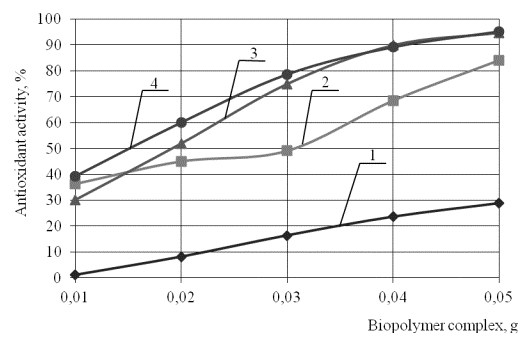
Fig. 1 The antioxidant activity of the biopolymer complexes:
1 – biopolymer complex isolated in the processing of raw materials
with 3 % NaOH solution during 90 min;
2 – biopolymer complex isolated in
the processing of raw materials with
3 % NaOH
solution during 270 min;
3 – biopolymer complex isolated in the processing of raw
materials with 7 % NaOH solution during 90 min;
4 – biopolymer complex isolated in
the processing of raw materials with 7 % NaOH sodium hydroxide
solution during 270 min.
The samples inhibit peroxide oxidation of oil much better while alkaline
solution concentration rises. For example, under the same conditions (the
treatment time and concentration of the complexes) the antioxidant activity of
the preparations 3 and 4 is 1.1 – 25.8 times higher than preparation 1 and
2.
The antioxidant activity of the biopolymer complexes
increases in 2.3 – 24.6 times, if the raw-material is treated by 3 %
solution of sodium hydroxide. The intensity in change of this index decreases when
mushrooms are processed with more concentrated reagent solution.
These characteristics depend on changing the ratio of components in the
complexes. There is a direct correlation between the antioxidant activity and
melanin content in the samples. Probability, amino polysaccharide content might
influence on the value of this index.
It was shown that the antioxidant activity of the biopolymer complexes
increases if the sample content in reacting mixture rises. However, when the
amount of complexes 3 and 4 increases from 40 to 50 mg in reacting mixture the
value of this index does not change significantly. The antioxidant activity of
these preparations and 10 mg ascorbic acid that is widely used in the food
industry as an antioxidant is the same.
Despite the efficacy of antioxidants obtained by the industrial
synthesis their addition to the food product can cause a number of undesirable
effects for consumers. Mushroom biopolymer complex is a safe substitution to
such compounds. It can be a means for inhibiting the lipid peroxidation. It
will prevent decreasing biological value of food products due to keeping
essential fatty acids.
Thus, the biopolymer complexes obtained from Pleurotus ostreatus are the effective antioxidants. The foodstuff
containing these preparations will have more prolonged storage life.
References:
1. Chang, S.-T. Mushrooms. Cultivation,
Nutritional Value, Medicinal Effect, and Environmental Impact / S.-T Chang, P.
Miles. – 2nd Ed. – London, New York, Washington: CRC Press, Boca Raton, 2004. –
451 p.
2. Cherno, N.K. Comparative analysis of biopolymer complexes from mushrooms (Agaricus bisporus) / Cherno N.K., Osolina S.A., Gural L.S., Nikitina A.V. // Сборник
научных
трудов
SWorld. Материалы междун.
науч.-практ. конф. «Современные
направления теоретических и прикладных исследований ’ 2013». – Вып 1. Т. 37. – Одесса: Куприенко, 2013. – Цит.: 113-0925. – С. 54-59.
3. Феофилова, Е.П. Клеточная
стенка грибов / Е.П. Феофилова. – М.: Наука, 1983. – 248 с.
4. Бабицкая, В.Г.
Меланиновые пигменты грибов Paecilomyces variotii и Aspergillus carbonarius / В.Г. Бабицкая, В.В. Щерба,
Т.В. Филимонова, Е.А. Григорчук
// Прикл. биохимия и микробиология. – 2000. – Т.36, № 2. – С. 153 – 159.
5. Черно, Н. К. Хімічний склад
морфологічних частин гливи звичайної (Pleurotus ostreatus) / Н.К. Черно, С.О. Озоліна, О.В. Нікітіна // Розвиток наукових досліджень ’ 2012: Матеріали
восьмої міжн. наук.-практ. конф. 19 – 21 листопада 2012. – Полтава, 2012. – Т. 11. – С. 123 – 125.
6. Салькова, Е.Г. Изучение
антиоксидантной активности экстрактов кутикулы яблок / Е.Г.
Салькова, М.Г. Амзашвили //
Прикл. биохимия и микробиология. – 1987. – Т. 23, № 5. – С. 686-691.